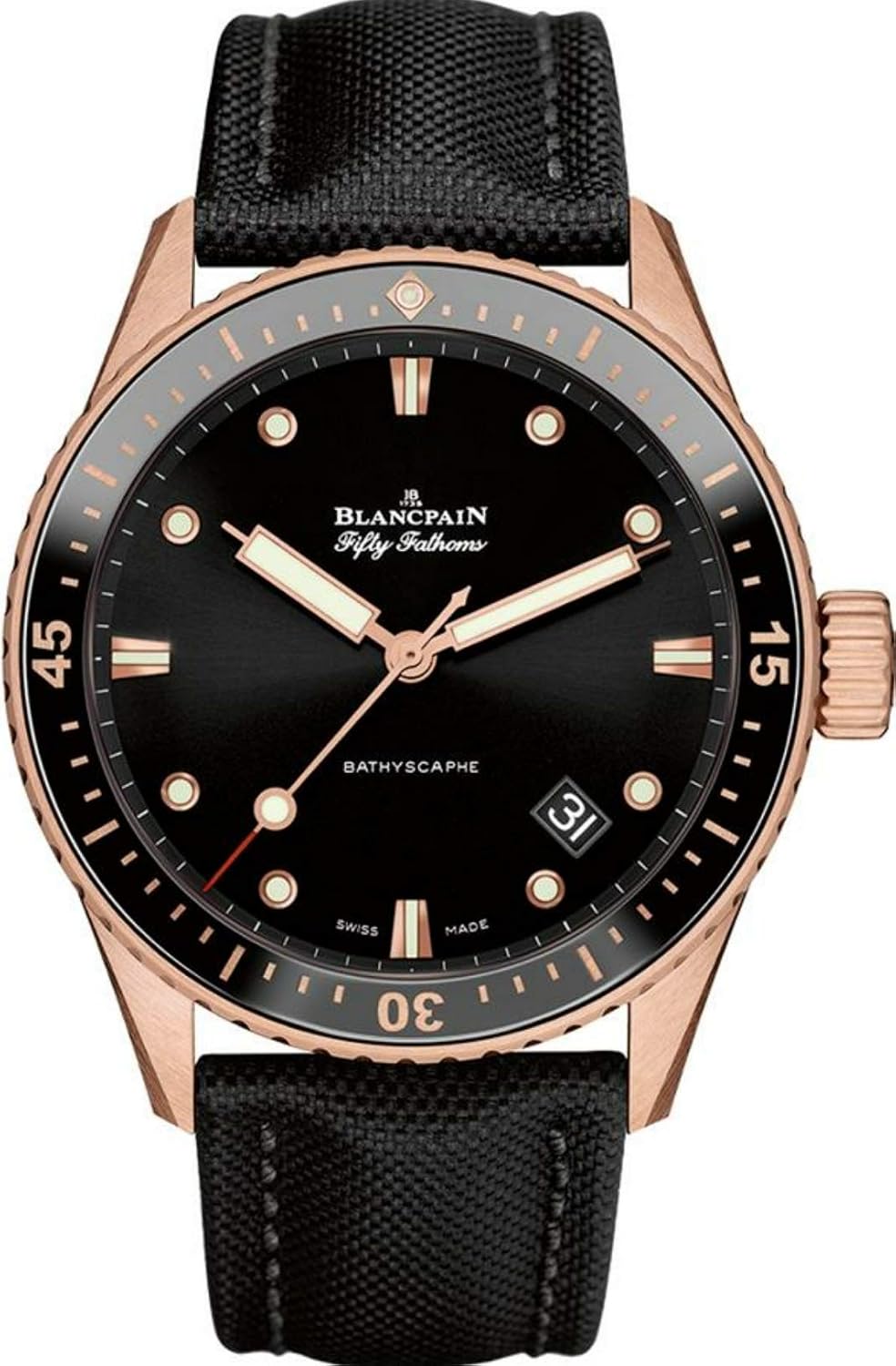
There is a specific pleasure in wearing a watch designed by people who were frightened of the sea. The Blancpain Fifty Fathoms Mil-Spec ref. 5008-1130-B52A is not a lifestyle object with a dive bezel bolted on. It is a modern reading of a tool built for military divers in the late 1950s, and it carries the one feature that separates it from every other dive watch on the market: a moisture indicator sitting at six o'clock.
That indicator is the reason this reference exists. Blancpain built the original Mil-Spec to military specification for divers who needed to know, instantly and without disassembly, whether water had breached the case. The modern version reproduces the idea faithfully, wraps it in a 40.3mm stainless steel case, and limits production to 500 pieces. It is the smallest, quietest, most historically loaded Fifty Fathoms you can put on a wrist — and after a week of wearing it, I think it may also be the most wearable.
What follows is not a museum tour. It is what the watch is like to own: how it sits, how it reads, how it survives a normal week of desks, doorframes, car doors, and the occasional swimming pool.
The Dial: Legibility With a Party Trick
Black dial, big luminous markers, broad hands, and a bezel that reads at a glance in bad light. That is the Mil-Spec's daytime personality, and it is exactly what you want from a dive watch. Contrast is high, the markers are large enough to read at arm's length without squinting, and there is no date window cutting a hole in the symmetry. Blancpain resisted the urge to add a cyclops, a date, or a power-reserve indicator. The dial is a single, confident statement.
Then there is the moisture indicator. Sitting at six o'clock, it is a small two-tone disc that changes appearance if moisture ever finds its way inside the case. In practice, on a modern watch with modern gaskets, it will never move. That is the point. It is functional paranoia preserved as design, and it gives the Mil-Spec a face that no Submariner, Seamaster, or Aquatimer can copy without looking like a costume.
Legibility at night is where the watch earns its keep. The Super-LumiNova is applied generously to the markers and hands, and the bezel's luminous pip means you can time a dive — or a parking meter — in the dark. It charges quickly under a phone torch and holds well enough through a night. It is not the brightest lume I have worn this year, but it is comfortably in the top tier, and it fades gracefully rather than dying all at once.
The Case and How It Actually Wears
Here is the headline for anyone who has been scared off the Fifty Fathoms by the 45mm Automatique: the Mil-Spec is a 40.3mm watch, and it wears like one. The bezel occupies a generous share of the dial-side real estate, which makes the watch read slightly smaller than its number, and the case sides are shaped so that the watch sits down into the wrist rather than perching on top of it.
On my 16.5cm wrist, the Mil-Spec was comfortable from the first hour. There is no overhang, no sense of the lugs floating off the sides of the arm, and no wrestling match with a shirt cuff. The case is not thin — this is a 300-metre dive watch with a screw-down crown — but it is not a hockey puck either, and the weight distribution is good. Stainless steel at this size lands in the sweet spot: substantial enough to feel like a real object, light enough that you forget it by mid-afternoon.
The crown is large, easy to grip, and screws down with a satisfying final quarter-turn. The bezel is unidirectional, as it should be, with crisp detents and no back-play worth complaining about. It is the sort of bezel you can turn with wet fingers, which sounds like a trivial detail until you have owned a watch where you cannot.
The Strap Question
The Mil-Spec arrives on a black sailcloth-style textile strap with a pin buckle. It is the correct choice for the watch — a steel bracelet would push it toward generic dive-watch territory, and leather would be wrong on a 300-metre tool. The textile strap is stiff out of the box and takes a week or two to break in, after which it conforms nicely and, crucially, does not hold water the way a leather strap would.
It is also the weakest part of the package. Sailcloth-style straps fray at the edges over time, they pick up salt and sunscreen, and they are not cheap to replace. Many owners will end up on a rubber strap or a NATO within the first year, and the watch takes both without complaint. If you are buying this as a daily wearer rather than a safe queen, budget for a second strap.
The Movement: Calibre 1151
Inside is Blancpain's in-house Calibre 1151, an automatic with a 100-hour power reserve running at 28,800 vibrations per hour. That reserve is the practical headline. A hundred hours means you can take the watch off on Friday evening and put it back on Wednesday morning without resetting it. For a three-hand dive watch with no date, that is a genuinely meaningful convenience rather than a spec-sheet brag.
The architecture is classic Blancpain: a slim automatic with a decorated movement, Côtes de Genève on the bridges, chamfered edges, and a level of finishing that matters more to the person who services it than to the person who wears it. Blancpain does not submit this watch for COSC certification, so there is no chronometer certificate in the box — but in-house regulation standards at this level are typically strict, and my sample behaved accordingly.
Accuracy in the Real World
Over a week of normal wear — desk work, a couple of swims, one long drive, and two nights left off the wrist — my sample settled around two seconds fast per day. That is excellent for a watch without a chronometer certificate, and it is consistent with what the 1151 tends to do when it is properly regulated. Expect somewhere in the region of minus three to plus five seconds a day as a realistic range across individual examples.
The long power reserve also means accuracy is stable across the week. A watch with a 38-hour reserve can drift noticeably as it runs down overnight; the 1151's hundred hours keeps the mainspring in a healthier state of tension for far longer, so the rate stays consistent whether you have been wearing it for one day or four.
A Week on the Wrist
Monday: shirt cuff, keyboard, coffee. The Mil-Spec slides under a cuff without drama because 40.3mm is a civilised size and the strap sits flat. The moisture indicator catches a colleague's eye at lunch, which is the first of several conversations you will have about it.
Wednesday: swimming. Three hundred metres of water resistance means the pool is not a test, it is a formality. The bezel turns under wet fingers, the lume is charged by the pool lights, and the textile strap dries faster than you would expect.
Friday: dinner. This is where the Mil-Spec surprises. On a black strap, with a black dial and a bezel that does not shout, it reads as a serious, restrained steel watch rather than a piece of dive-kit. It is not a dress watch — nobody will mistake it for a Villeret — but it does not embarrass a jacket, which is more than can be said for most 300-metre divers.
Sunday: off the wrist, in the box. Monday morning it is still running, still on time, and still on the correct date — well, there is no date, which is another small mercy. Set it and forget it for four days is a real ownership benefit.
Specifications at a Glance
- Reference: 5008-1130-B52A
- Case: stainless steel, 40.3mm
- Water resistance: 300 metres
- Crystal: sapphire
- Movement: Blancpain Calibre 1151, automatic, 100-hour power reserve, 28,800 vph, 28 jewels
- Strap: black sailcloth-style textile with pin buckle
- Production: 500 pieces
What It Is Not
It is not a bracelet watch. If you want the full Fifty Fathoms experience on steel, buy the Automatique. It is not a small watch in the vintage sense; 40.3mm is modern-medium, not 36mm. And it is not a value proposition in the way a Tudor is. You are paying for the name, the history, the in-house movement, and the fact that only 500 exist.
Variants and Siblings
Blancpain has iterated on the Mil-Spec over the years, and the reference family around the 5008 is worth understanding before you buy. The 5008B-1130-B52A is a later Mil-Spec iteration with its own production run; the 5015-1130-B52A is the full-size Fifty Fathoms Automatique at 45mm, which is the same idea in a much larger case; and the 5015-1130-71S puts that Automatique on a steel bracelet. If you want the modern Fifty Fathoms in its current 42.3mm form, the 5010-1130-B52A is the reference to look at.
Within the wider Blancpain catalogue, the obvious alternatives are the Bathyscaphe line, which is slimmer and more everyday, and the Villeret collection, which is where you go if you want a dress watch instead of a tool.
Rivals and Homages
The Mil-Spec's closest rival is the Omega Seamaster 300 Heritage, which offers a similar vintage-diver mood with a Co-Axial movement and a lower entry price. The Tudor Black Bay 58 is the value champion of the category and wears beautifully, though it lacks the Mil-Spec's historical specificity. The Rolex Submariner is the default answer and remains the most liquid watch in the world, but it is also the least interesting answer. If you want a modern diver with real vintage DNA and a complication nobody else has, the Mil-Spec is in a category of one.
On the affordable end, the Fifty Fathoms silhouette has been copied extensively. Seestern and Tandorio both make FF-style divers in the $130–$180 range that capture the bezel-and-lume look, and they are perfectly decent pool watches. None of them will have a moisture indicator, an in-house movement, or a 500-piece production run, and none of them will feel remotely like this on the wrist. That is not a criticism; it is simply a different product.
Value, Service, and the Long Game
At launch the 5008-1130-B52A was priced around $14,500, and because it is a limited edition of 500 pieces, it has not been available at retail for years. Secondary market pricing has generally hovered in the low-to-mid teens, with clean full-set examples at the upper end. The trend has been stable rather than explosive: limited-edition Fifty Fathoms models hold value well but rarely become speculative assets, and this one is not an exception.
Servicing is a Blancpain-only affair in practice. The 1151 is a well-understood movement, but independent watchmakers rarely stock the parts, and Blancpain's service network is the realistic route. Expect to send the watch away rather than hand it to a local shop, and expect to pay accordingly. Budget for it the way you would budget for a car service: infrequently, but not cheaply.
Verdict
The Blancpain Fifty Fathoms Mil-Spec is the rare reissue that justifies its own existence. It takes a genuinely obscure piece of dive-watch history — the moisture indicator — and turns it into the most distinctive dial feature in modern diving. At 40.3mm it is the most wearable Fifty Fathoms in the family, it runs for four days off the wrist, and it looks as good with a jacket as it does with a wetsuit.
It is not cheap, it is not available new, and it will never be as liquid as a Submariner. But if you want a serious dive watch that nobody else at the table is wearing, and you want it to be genuinely comfortable for a full week, this is the one. Buy it, wear it, swim in it, and stop worrying about the moisture indicator. It will never move.