The Heritage of 'Particularly Robust'
To understand the Tissot PR516, one must first understand what the 'PR' stands for. In 1965, Tissot introduced the 'Particularly Robust' line, designed to withstand the vibrations and shocks of professional motorsport. While the original models featured the iconic perforated 'rally' bracelet—meant to mimic the steering wheels of the era—the new reference T149.462.11.011.00 takes a slightly more refined approach. It bridges the gap between the rugged tool watch of the sixties and the luxury-adjacent sport watches of the 2020s.
This specific reference is the mechanical heart of the new PR516 collection. While Tissot also released quartz variants, the manual-wind version is the one that captures the imagination of the enthusiast. It speaks to a time when drivers had to interact with their machines, checking oil, adjusting carburetors, and, of course, winding their watches before a race. In a world of smartwatches and set-and-forget automatics, the PR516 asks for a moment of your time every morning, and in return, it offers a mechanical purity that is increasingly rare at this price point.
The Manual Wind Experience: Caliber A05.291
At the core of the PR516 is the Valjoux A05.291. For those familiar with the legendary Valjoux 7750/7753 family, this movement will feel like an old friend, but with modern upgrades. Tissot (via ETA) has removed the winding rotor, which serves two purposes. First, it allows the wearer to see more of the movement through the sapphire case back. While the finishing is industrial—don't expect hand-applied anglage here—the architecture of a chronograph is always a joy to behold. Second, it simplifies the movement, focusing on the core task of timekeeping and timing.
The inclusion of a Nivachron hairspring is a massive boon for the daily wearer. Our modern environments are filled with magnetic fields—from laptop speakers to magnetic iPad covers—that can easily magnetize a traditional steel hairspring, causing the watch to run wildly fast. Nivachron is titanium-based and largely unaffected by these fields, ensuring that the PR516 remains accurate regardless of your office setup. The 68-hour power reserve is also a thoughtful touch; you can wind it on a Monday morning and, if you happen to leave it on the nightstand for a day, it will still be ticking when you return.
Case Architecture and Dial Legibility
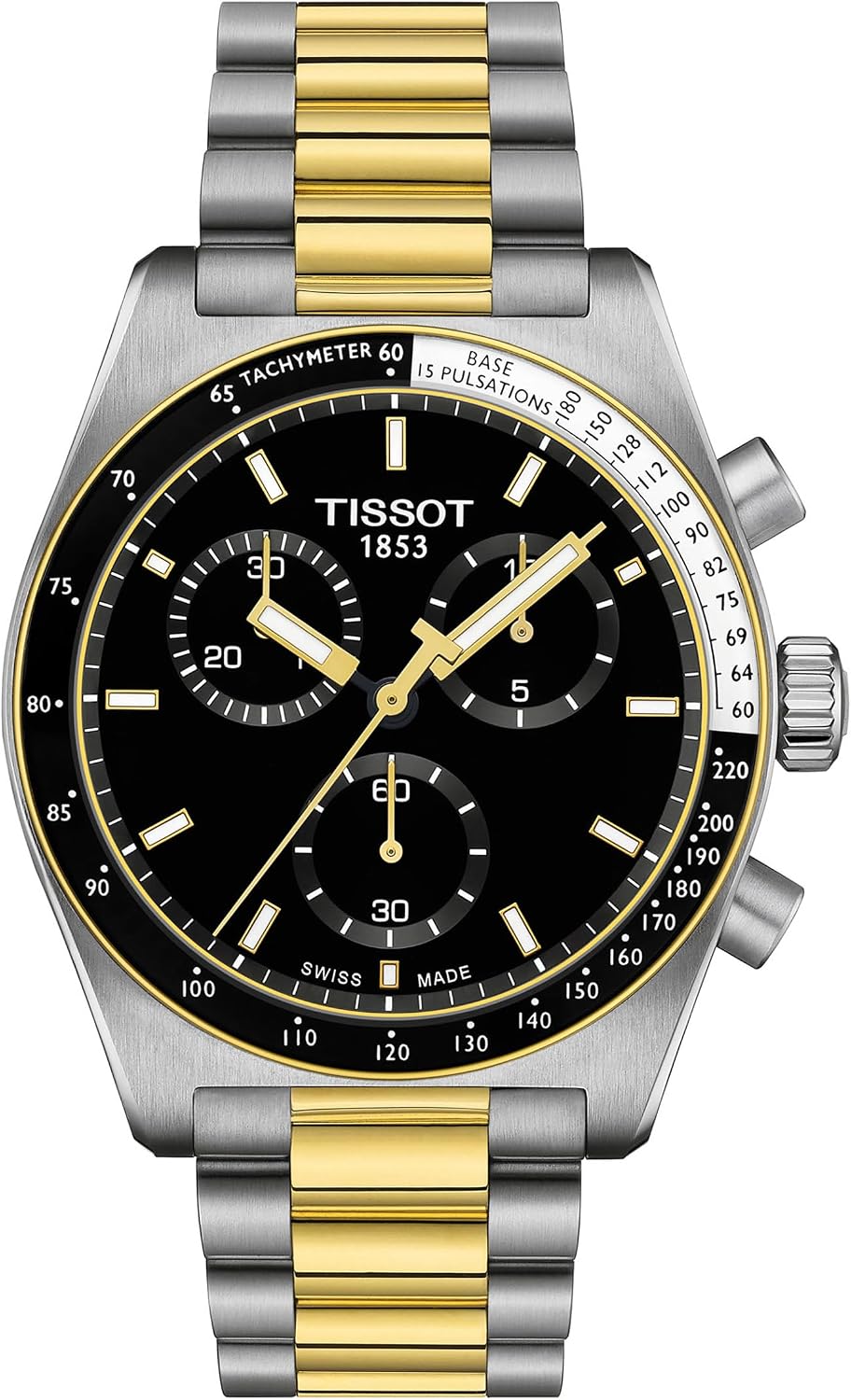
The case of the PR516 measures 41mm in diameter, which is the 'Goldilocks' zone for many modern collectors. However, the thickness of 13.7mm is something to consider. Much of that height comes from the box-style sapphire crystal, which adds a vintage warmth and creates interesting distortions at the edges of the dial. Because the case back is relatively flat, the watch doesn't 'tower' over the wrist, but it will struggle to slide under the tightest of shirt cuffs. This is a watch that wants to be seen.
The dial of the T149.462.11.011.00 is a study in high-contrast legibility. The white sub-dials (a 'reverse panda' or 'panda' variation depending on the specific colorway) are recessed, giving the face a sense of depth. The use of Super-LumiNova on the indices and hands is generous, but the real star is the lume on the bezel. The tachymeter and pulsometer scales are luminous, a feature that is as practical as it is visually striking in low-light conditions. During a week of late-night drives and dimly lit dinners, the PR516 remained perfectly readable at a glance.
On the Wrist: A Week of Daily Wear
Wearing the PR516 for seven days revealed its true character. On Monday, in a professional setting, the polished accents on the H-link bracelet provided enough flash to feel 'luxe.' By Wednesday, during a more active afternoon, the 100m water resistance offered peace of mind. It is rare to find a manual-wind chronograph with a full 10 bar of water resistance; usually, these are delicate 'dry' watches. Tissot has ensured that the PR516 can handle a splash or even a swim, provided the pushers aren't engaged underwater.
The bracelet is comfortable, though I found the lack of a tool-less micro-adjustment to be a slight drawback. As wrists expand and contract with temperature changes throughout the day, having to use a tool to move a spring bar in the clasp feels a bit dated. However, the quick-release pins are excellent, allowing you to swap the steel for a perforated leather rally strap in seconds, which arguably suits the racing DNA of the watch even better than the bracelet does.
The Verdict
The Tissot PR516 (ref. T149.462.11.011.00) is not just a value proposition; it is a statement of intent. It shows that Tissot is willing to cater to the 'purist' collector who wants a mechanical connection to their timepiece. It is robust, technically advanced thanks to the Nivachron spring, and aesthetically grounded in a golden era of design. For under $2,000, there are few watches that offer this much 'soul' combined with the backing of a major Swiss manufacture. If you can live with the 13.7mm thickness and the daily ritual of the crown, the PR516 is a rewarding companion that feels like it belongs on the wrist of someone who actually knows how to drive.