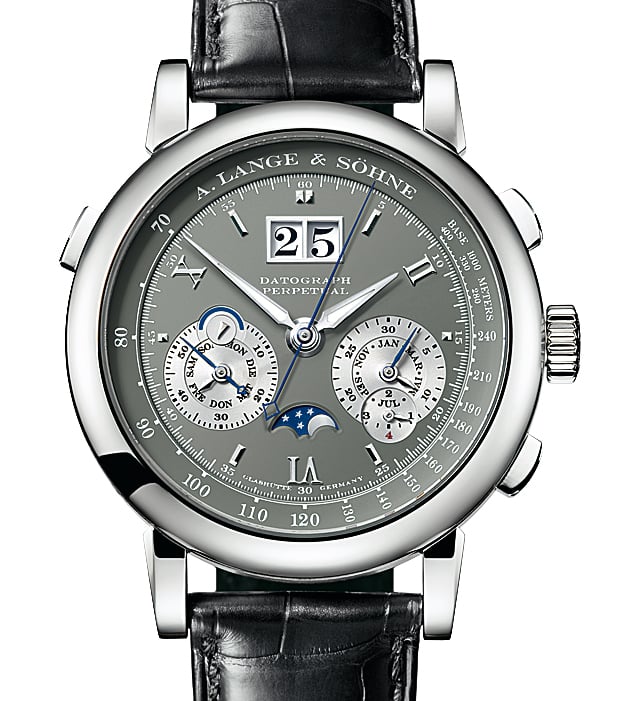
The Saxon Titan: A Masterclass in Horological Architecture
When you talk about the A. Lange & Söhne Datograph Perpetual, you aren't just talking about a watch. You are talking about a seismic shift in the landscape of luxury watchmaking. When the original Datograph was released in 1999, it didn't just compete with the Swiss; it terrified them. It was a movement designed from the ground up, at a time when even the most prestigious Swiss houses were still relying on modified Lemania or Valjoux bases. The Perpetual variant, which arrived later, took that legendary chronograph foundation and integrated a perpetual calendar, creating a technical powerhouse that remains the gold standard for the 'Mega-Chrono' category.
A Movement Like a Miniature City
To understand the Datograph Perpetual, you have to turn it over. The sapphire crystal caseback reveals the Caliber L952.1, and it is, without hyperbole, one of the most beautiful sights in all of watchmaking. Collectors often refer to the Datograph movement as a 'cityscape.' Because of its depth and the way the components are layered, it looks like a sprawling metropolis made of German silver, steel, and synthetic rubies.
Unlike Swiss movements which typically use brass, Lange utilizes untreated German silver (an alloy of copper, nickel, and zinc). This material is harder to work with—it is incredibly sensitive to skin oils and marks easily—but it rewards the owner with a warm, golden hue as it ages. The finishing is beyond reproach: every single angle is hand-beveled, the wheels are circular-grained, and the balance cock is hand-engraved with a floral motif. Because each engraver has a unique style, no two Datographs are identical. This level of artisanship is what separates Lange from the industrial luxury of its competitors.
The Dial: Symmetry in Complexity
The dial of the Datograph Perpetual is a masterclass in information management. Despite housing a chronograph, a big date, a day of the week, a month, a leap year indicator, a day/night indicator, and a moon phase, the dial never feels cluttered. This is achieved through the 'Equilateral Triangle' layout. The outsize date at 12 o'clock forms the apex, while the two sub-dials at 4 and 8 o'clock form the base. This creates a visual balance that is incredibly pleasing to the eye.
The moon phase is another highlight. Calculated to remain accurate for 122.6 years, the solid gold disc features a deep blue hue that adds a touch of poetic romance to an otherwise very technical watch. The use of the outsize date—inspired by the Five-Minute Clock in the Semper Opera House in Dresden—is the brand's signature, providing a level of legibility that is rare in perpetual calendars.
On the Wrist: The Weight of Excellence
Wearing a Datograph Perpetual is a physical experience. In white gold or platinum, the watch has a heft that reminds you of its value every time you move your arm. It is not a 'thin' watch. At 13.5mm, it stands proud of the wrist. However, for the modern collector who grew up on 40mm+ sports watches, the Datograph feels modern and substantial. It has a presence that a 36mm vintage Patek simply cannot match.
The strap is a hand-stitched alligator skin that is as robust as the case. The deployant buckle is a work of art in itself, shaped like the Lange logo and providing a secure counterweight to the heavy watch head. On the wrist, the watch feels balanced, though you will certainly know it's there. It is the perfect companion for a tailored suit, but it also dresses down surprisingly well with a cashmere sweater and a pair of dark denim jeans.
The Cultural Impact and Collector Context
Why does the Datograph Perpetual hold such a high status? Part of it is the 'Dufour Effect.' When Philippe Dufour, a man who spends his life perfecting the simplest of movements, chooses a Datograph as his personal chronograph, the world takes notice. It signaled to the community that Lange wasn't just a German alternative; it was a technical superior.
In the current market, where 'hype' often trumps 'horology,' the Datograph Perpetual remains a bastion of true value. It is a watch for the connoisseur. It doesn't scream for attention with a bright blue dial or a celebrity endorsement. Instead, it whispers of deep pockets and even deeper knowledge. It is the watch you wear to a meeting where you don't need to prove anything to anyone.
Investment Potential and the Secondary Market
From an investment standpoint, the Datograph Perpetual is a stable asset. While it doesn't experience the volatile 300% markups of certain steel sports watches, it has a high floor. The retail price is significant, often crossing the $140,000 mark, but on the secondary market, you can find well-maintained examples in the $100,000 range. For a watch of this complexity and finishing level, that is arguably a bargain. As more collectors pivot away from integrated-bracelet sports watches and back toward 'real' watchmaking, the Datograph is poised for a steady climb in value.
Final Thoughts
The A. Lange & Söhne Datograph Perpetual is a triumph of German engineering. It is a watch that demands a lot from its owner—it requires manual winding, it needs a large wrist to carry its weight, and it demands a significant financial commitment. But in return, it offers a horological experience that is second to none. It is a piece of art that functions as a machine, a legacy piece that will still be ticking (and looking beautiful) long after its owner is gone. If you are looking for the absolute pinnacle of what a chronograph can be, your search ends in Glashütte.