The Philosophy of Precision: Introduction to the Richard Lange
In the world of high horology, complexity is often used as a proxy for value. We are conditioned to look for tourbillons, perpetual calendars, and split-second chronographs as the markers of a manufacture's prowess. However, the true test of a watchmaker often lies in the execution of the 'simple' three-hand watch. The A. Lange & Söhne Richard Lange is a profound testament to this philosophy. It does not seek to dazzle with multiple apertures or overlapping dials; instead, it demands respect through the sheer quality of its construction and its adherence to the historical standards of the scientific observation watch.
The Richard Lange collection was launched in 2006, marking a significant moment for the Glashütte-based manufacture. While the Lange 1 and the Saxonia had already established the brand's aesthetic identity, the Richard Lange looked further back into the archives—specifically to the high-precision pocket chronometers of the 19th and early 20th centuries. These were instruments used by scientists, explorers, and navigators for whom a second was a critical unit of measure. To honor this, Lange moved the seconds hand from the traditional sub-dial at 6 o'clock to the center, a technical challenge that required a complete rethink of the movement architecture.
Case Architecture and Materiality
The reference 232.025 features a case crafted from 950 platinum, the most noble of metals. Platinum is notoriously difficult to work with; its density and toughness wear down tools rapidly, and achieving the mirror-polish seen on the Richard Lange's bezel requires an extraordinary level of skill. The case measures 40.5mm in diameter, a size that feels contemporary yet remains firmly within the bounds of classical elegance. The thickness is a modest 10.5mm, providing a sleek profile that belies the complexity of the movement within.
Lange's case construction is distinct from the fluid, rounded forms often found in Swiss watchmaking. There is an architectural quality to the Richard Lange; the lugs are stepped and soldered to the case middle, a hallmark of traditional Saxon construction. The mid-case features a brushed finish, providing a sophisticated contrast to the high-polished bezel and lug tops. This interplay of finishes accentuates the watch's geometry and prevents the platinum from appearing overly monolithic.
The Dial: A Study in Legibility
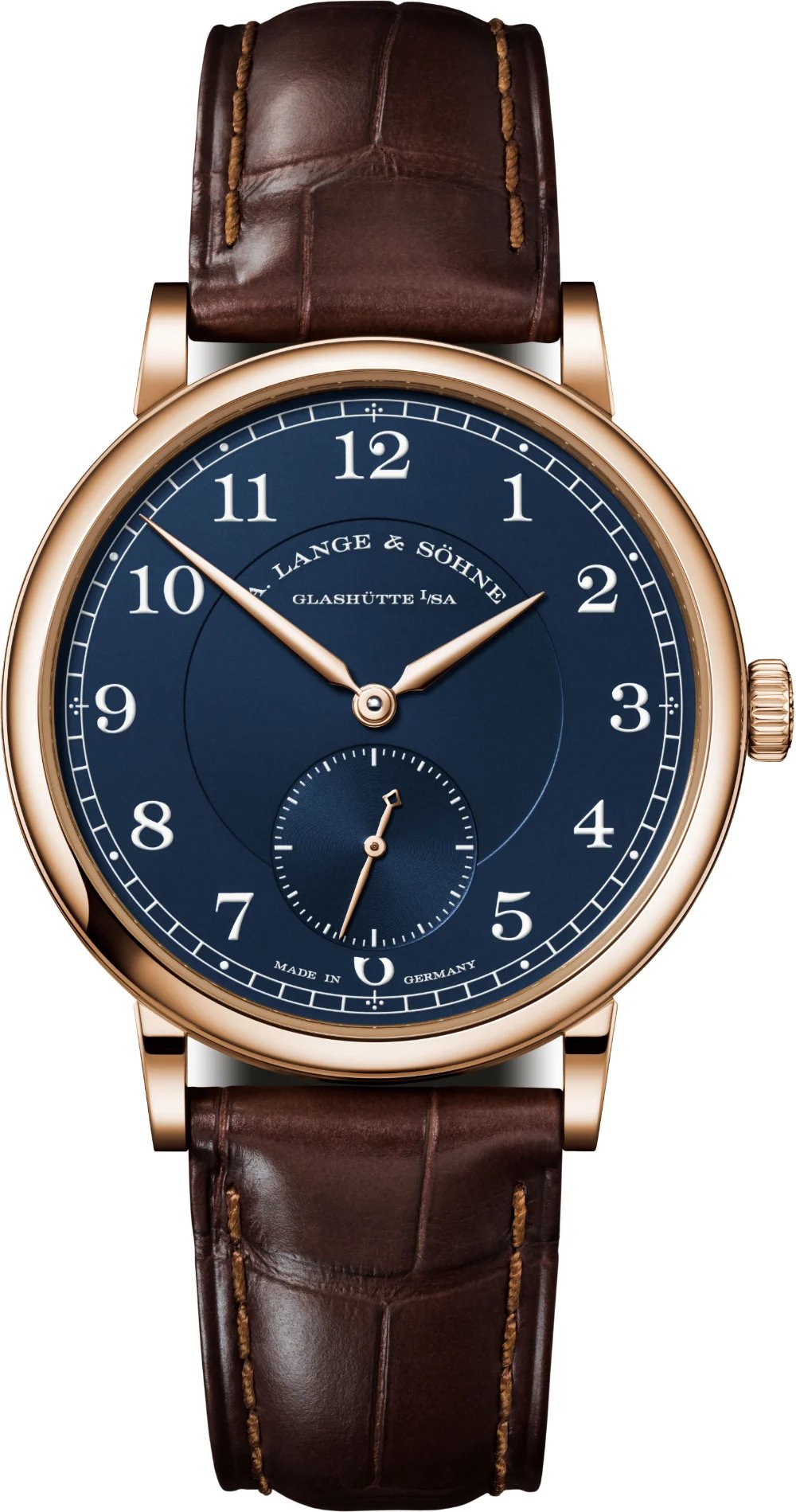
The dial of the Richard Lange is a masterclass in functional design. Crafted from solid silver, it has a subtle, grained texture that absorbs light rather than reflecting it, ensuring that the indicators remain legible in various lighting conditions. The Roman numerals are tall and slender, printed in a deep, crisp black that provides maximum contrast against the argenté background. The outer minute track features Arabic numerals at the five-minute intervals, rendered in a smaller font that maintains the hierarchy of information.
The hands are a highlight of the piece. The hour and minute hands are 'alpha' shaped and crafted from blued steel, a process that involves heating the metal to precisely 300 degrees Celsius to achieve a deep, uniform cornflower blue. This isn't just an aesthetic choice; blued steel is more resistant to corrosion. The sweep seconds hand is exceptionally long and thin, extending to the very edge of the minute track. Its counterweight is meticulously shaped, and its movement is a smooth, high-frequency sweep that serves as a constant reminder of the mechanical precision at play.
Calibre L041.1: The Heart of the Matter
While the dial is a model of restraint, the movement is a riot of traditional finishing. The Calibre L041.1 is visible through the sapphire crystal caseback, and it is here that the Richard Lange truly justifies its position at the peak of the horological pyramid. The movement is built around the traditional Glashütte three-quarter plate, made of untreated German silver (an alloy of copper, nickel, and zinc). Unlike the brass plates used by most Swiss manufacturers, German silver develops a warm, golden patina over time, making each watch unique to its owner.
The plate is decorated with Glashütte ribbing—a broader, more muscular version of Côtes de Genève. The edges of the plate are hand-beveled and polished to a mirror finish (anglage). One of the most striking features is the use of gold chatons. In the days of pocket watches, rubies were not uniform in size, so they were set into gold sleeves (chatons) which were then screwed into the plate. While modern synthetic rubies make this unnecessary, Lange continues the practice as a tribute to historical craft. These chatons are held in place by heat-blued screws, creating a vibrant tri-color effect of gold, blue, and silver.
The balance cock is perhaps the most famous element of any Lange movement. Each one is hand-engraved with a floral motif. Because each engraver has a slightly different style, no two balance cocks are identical; a collector can often identify the specific artisan who worked on their watch. Beneath the balance cock sits the in-house manufactured balance spring. A. Lange & Söhne is one of the very few manufactures in the world with the capability to produce their own hairsprings, allowing them to calibrate the escapement to an incredible degree of accuracy.
Technical Innovation: The Sweep Seconds Gear Train
To achieve a central sweep seconds hand while maintaining the slimness of the movement, Lange’s engineers had to innovate. In a traditional movement, the fourth wheel (which drives the seconds) is located off-center. To move it to the center, an additional gear train is required. In the L041.1, this is executed with a large, central wheel that is driven by the third wheel. This arrangement requires extremely tight tolerances to prevent 'stutter' in the seconds hand—a common issue in lesser center-seconds movements. The result is a hand that moves with rock-solid stability across the dial.
The watch also features a hacking seconds mechanism. When the crown is pulled out to the time-setting position, a small lever (shaped like a 'V') contacts the rim of the balance wheel, stopping it instantly. This allows the wearer to synchronize the watch to a reference signal with second-perfect accuracy, a fitting tribute to the watch's 'observation' heritage.
Historical Context: The Legacy of Richard Lange
The watch is named after Richard Lange (1845–1932), the eldest son of the manufacture's founder. Richard was a scientist and an inventor as much as he was a watchmaker. His most significant contribution to horology was the discovery that adding a small amount of beryllium to the alloy used for balance springs significantly improved their elasticity and temperature resistance—a patent that paved the way for modern chronometry. By naming this specific model after him, the manufacture is signaling that this watch is the spiritual successor to his quest for the perfect timekeeper.
Comparison and Market Positioning
In the landscape of high-end dress watches, the Richard Lange occupies a unique niche. Its primary competitor is the Patek Philippe Calatrava. While the Calatrava is the quintessential dress watch, it often leans toward a softer, more delicate aesthetic. The Richard Lange is more robust, both in its physical construction and its design language. It feels less like a piece of jewelry and more like a high-precision instrument. For the young collector who appreciates the 'New German School' of watchmaking—characterized by technical transparency and architectural depth—the Lange is often the more compelling choice.
From an investment perspective, the Richard Lange is a stable performer. It does not suffer from the 'hype' cycles that plague stainless steel sports watches, which means it is less likely to see a dramatic crash in value. It is a 'blue chip' horological asset. The platinum version, in particular, is produced in relatively small numbers, ensuring that it remains a rare sight at collector gatherings.
Conclusion: The Verdict
The A. Lange & Söhne Richard Lange is a watch that reveals its secrets slowly. To the uninitiated, it may look like a simple, elegant timepiece. But to the horologist, it is a symphony of Saxon tradition and modern engineering. Every element, from the length of the seconds hand to the curve of the anglage on the three-quarter plate, has been considered with a level of intensity that is frankly rare in the modern luxury industry.
It is a watch for the purist. It is for the individual who understands that the most difficult thing to achieve in watchmaking is not a complex complication, but a simple watch executed to the highest possible standard. In the Richard Lange, A. Lange & Söhne has not just created a timepiece; they have created a monument to the second.