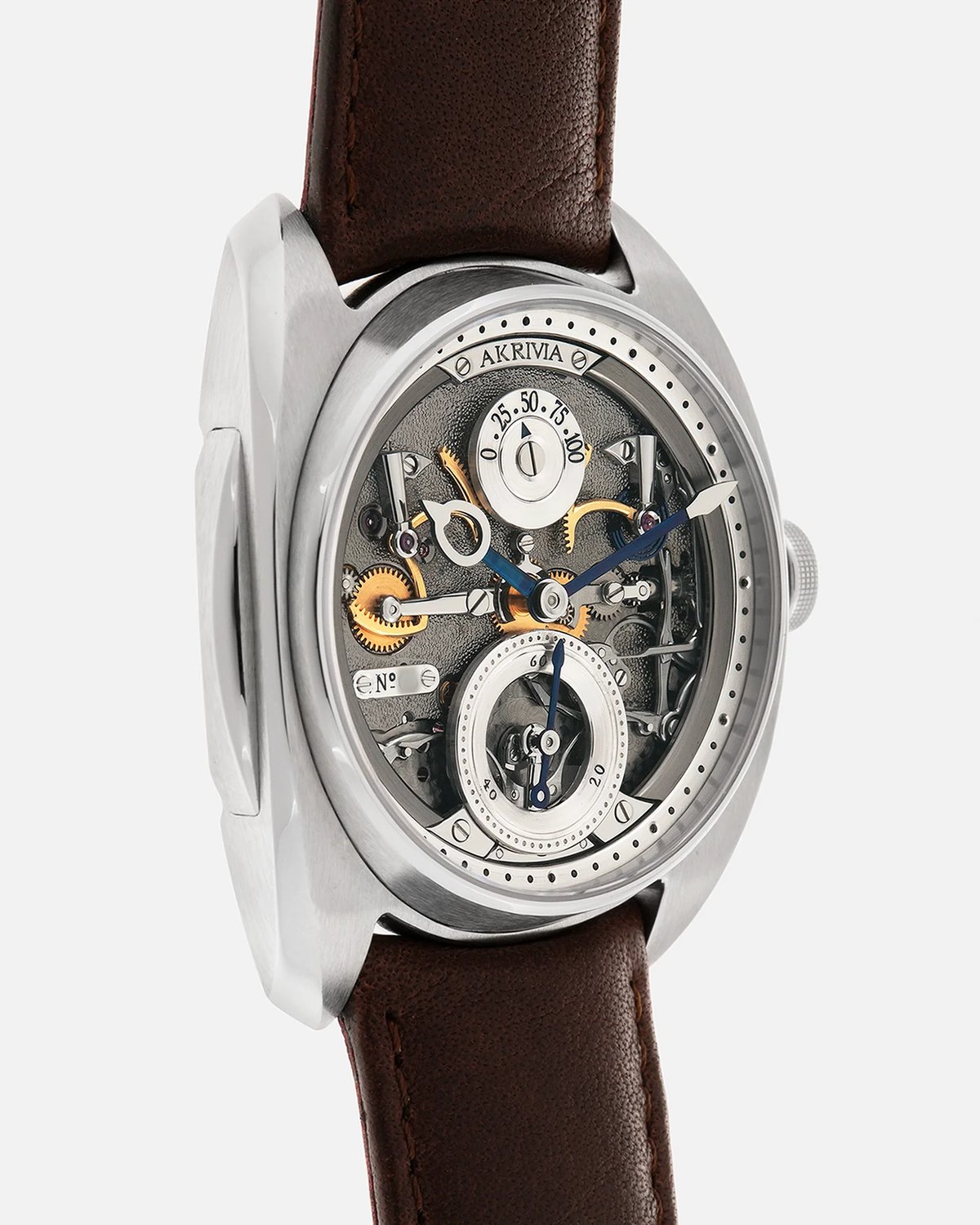
The short version: the AK-06 is Akrivia's chronograph — hand-built, hand-wound, hand-finished, and produced in numbers so small that the waiting list is effectively a private club. You do not buy this watch because you need a chronograph. You buy it because you understand that the top of this market stopped being Patek a while ago.
The Market Case, Because That Is Why You Are Here
Over the past decade the independent segment has quietly become the most interesting corner of horology. Not the largest — nothing at the top of the independents is large. The most interesting. When an atelier makes a few dozen watches a year and every one of them passes across a single bench, you get two things the volume manufacturers structurally cannot produce: scarcity that is not manufactured, and finishing that has not been rationalised into a cost centre.
Akrivia sits at the very top of that pile. The AK-06 is the reference that made a certain kind of collector stop treating the brand as an interesting curiosity and start treating it as a position. And here is the first thing any serious buyer needs to internalise: you almost certainly cannot buy one at retail. Not sold out in the way a steel sports watch is sold out, with boutiques taking names for a queue that will never move. Sold out in the way that a handful of pieces a year are sold out — through relationships, through the atelier, through people who already know each other.
That is the reality at the summit of this market, and it changes how you should think about the AK-06 entirely. This is not a purchase decision in the ordinary sense. It is an allocation decision.
Akrivia: One Atelier, One Reputation
Akrivia was founded in Geneva in 2012 by Rexhep Rexhepi, a watchmaker born in Kosovo who moved to Switzerland as a child and entered the industry as a teenager. Rexhepi spent his formative years inside Patek Philippe's workshops — the sort of training that teaches you what a Geneva finish is supposed to look like before it teaches you anything else — and then moved through the complications side of the business before opening his own atelier at an age when most watchmakers are still somebody else's second pair of hands.
The name comes from the Greek notion of akribeia: exactness, precision, the quality of being precisely right. It is a grand word for a small workshop, and it has turned out to be an accurate one.
For its first several years Akrivia was a specialist's secret. That changed with the Rexhep Rexhepi Chronomètre Contemporain, the time-only piece that put the atelier in front of a global audience and turned the name into a waitlist. The Chronomètre Contemporain II followed. Both are now among the most sought-after watches made anywhere, and both established the template: classical proportions, obsessive hand-finishing, and production numbers that make a major brand's limited edition look like a mass-market run.
Which brings us to the AK series — the numbered references that run from AK-01 up to the AK-06. The AK-06 is the chronograph at the top of that line, and it is the piece that demonstrates the atelier can do more than beautiful time-only watches.
What the AK-06 Actually Is
The AK-06 is a chronograph, and it is a hand-wound one, which is the only honest way to build a chronograph at this level. Automatic chronographs are engineering exercises. Hand-wound chronographs are craft exercises. Akrivia is in the craft business.
The architecture follows the classic two-register layout: a running seconds indication and a chronograph register, which is the arrangement you want if legibility matters more to you than feature count. A single pusher handles start, stop and reset. That is both a historical reference point and a genuine pleasure in daily use — one button, one gesture, no ambiguity about which of the two you just pressed.
The dial reads like a mid-century scientific instrument rather than a modern luxury product, and that is entirely the point. Akrivia's design language sits deliberately between the pre-war and post-war eras: sector-style layouts, finely printed scales, applied indices, and a restraint that a lot of brands mistake for a shortage of ideas. Nothing on the dial is there to fill space.
Akrivia releases technical detail sparingly and configures pieces closely with the people who commission them, which means two AK-06s can differ in ways no catalogue would ever capture. If you are the kind of buyer who needs a complete dimensional sheet before committing, this is not your brand. If you are the kind of buyer who wants to talk to the person who made the thing, it is exactly your brand.
The Movement and the Finishing
The movement is made in-house, hand-wound, and finished to a standard that is genuinely difficult to describe without sounding like marketing copy. So let us be concrete about what hand-finishing actually means, because at this level it is the entire ballgame.
Machine finishing is uniform. It is produced by a rotating tool against a jig, and it looks identical on every plate that comes off the line. Hand finishing is not uniform, because a person is doing it. Anglage — the bevelling of every bridge edge — is drawn by hand across a rotating wooden lap, and the result is a bevel that changes width slightly as it travels, catches light differently at different points, and has a polish a machine cannot replicate because a machine cannot feel when the edge is right. Black polishing, the mirror finish applied to steel components, is done on a tin lap with a paste and takes an enormous amount of time to get flat and flawless. Frosting, the grained surface treatment you see on the plates of the best independent movements, is applied by hand with a wire brush and a rotating motion.
All of that is present here. The point of the AK-06's movement is not that it has a long feature list or a clever patent. The point is that it has been finished by people, for a buyer who can tell the difference, in a quantity that makes the economics of that finishing possible. That is the whole proposition.
On the technical side, Akrivia does not publish a full specification sheet for the AK-06, and we are not going to invent one. What matters is that the movement is the atelier's own, it is wound by hand, and it is serviced by the people who built it.
On the Wrist
We are not going to give you case dimensions, because Akrivia does not publish them for this reference and inventing a number would be worse than leaving the space blank. What can be said honestly is this: the AK-06 wears like a classical chronograph, not a modern one. It sits in the register of mid-century watches — the proportions that made chronographs wearable with a suit in the first place — rather than the oversized, thick-cased modern chronograph that tries to look technical by being large.
Balance is the thing you notice first. A hand-wound chronograph of this type is not a heavy watch. It does not sit on the wrist like a statement; it sits like a tool that happens to be beautiful. The pusher action is the other thing you notice. On a well-built monopusher, the start is crisp without being harsh, the stop is clean, and the reset snaps back with a firmness that tells you the mechanism was set up by hand rather than assembled to a tolerance. That tactile feedback is a large part of what you are paying for, and it is the part that photographs worst and satisfies most.
The strap matters more than usual here. A hand-finished case with a lot of subtle surface variation needs a strap that does not fight it — something in a matte or lightly grained leather, stitched simply. Put a glossy, heavily padded strap on a watch like this and you have undone the design in ten seconds.
Accuracy and Daily Life
A hand-finished independent movement is regulated carefully, but it is not submitted for chronometer certification, and it is not built to be a daily-beater substitute for a quartz watch. Expect a well-regulated example to keep time to within a handful of seconds a day — good enough that you never think about it, not so precise that you would use it to set your other watches.
The bigger ownership point is that this is a watch you wear rather than a watch you track. It is hand-wound, so there is a daily ritual; that ritual is either the reason you want it or the reason you should not buy it. There is no lume and no pretense of being a sports watch. This is not a watch for the pool, and it is not trying to be.
Where It Fits
Formal and dress occasions are the natural home for the AK-06. It slides under a cuff, it reads as considered rather than loud, and it does the thing that the best dress watches do: it rewards the person sitting across the table who knows what they are looking at, without announcing itself to anyone who does not.
It also works as a daily wearer for someone whose daily life does not involve a gym, a pool or a construction site. A hand-wound chronograph with a hand-finished case is a watch you can wear constantly if you accept that it will pick up marks, and marks on a watch like this are not damage — they are the record of it being used, which is what it was made for.
It is not a sports watch. It is not a travel watch. It is not a watch you buy because you need a tool. It is a watch you buy because you have decided that the top of your collection should be something made by a person rather than a process.
Family, Variants and the Wider Catalogue
The AK-06 sits at the top of the numbered AK series, which runs from AK-01 upward. Each reference in the series represents a different problem the atelier set itself, and the family as a whole is the clearest record of how Akrivia's thinking has developed.
Within the AK-06 itself, Akrivia does not run a conventional catalogue of variants the way a major brand does. Pieces are produced in very small batches and configured closely with their owners, so dial treatments, case metals and finishing choices can vary from example to example. There is no published matrix of reference numbers to collect, and anyone who tells you otherwise is guessing.
Elsewhere in the Akrivia universe, the Rexhep Rexhepi Chronomètre Contemporain and its successor, the Chronomètre Contemporain II, are the two references that built the brand's reputation with the wider collector base. If the AK-06 is the connoisseur's chronograph, those two are the calling cards.
What Else at This Level
If you are shopping in this stratum, the AK-06 is not the only option, and it is worth being clear-eyed about the alternatives.
F.P. Journe's monopusher split-seconds chronograph is the obvious comparison: another hand-finished chronograph from an independent atelier, another allocation problem, another watch that trades well above its retail price. Journe has a longer track record and a deeper secondary market; Akrivia has the smaller numbers and the more artisanal finishing story.
Patek Philippe's current manual-wind chronograph is the establishment answer. It is easier to buy, easier to sell, and easier to service anywhere in the world. It is also made in numbers that make it a fundamentally different object. If liquidity matters more to you than scarcity, that is the trade.
Vacheron Constantin's vintage-inspired chronograph is the other serious option from a major house — a real chronograph with real finishing, priced in a zone that overlaps with the independents, and available without a decade of relationship-building.
And if what you actually want is the finishing rather than the chronograph, Kari Voutilainen's work is the other benchmark at this level. Different philosophy, same obsession.
Homage Territory
There is no meaningful homage of an Akrivia, because the thing that makes an Akrivia an Akrivia — the hand-finishing, the tiny production, the person at the bench — cannot be copied at a low price point. What you can buy instead is the silhouette and the idea.
A vintage-inspired two-register chronograph from a budget brand gets you the layout and the mid-century feel for a couple of hundred dollars. It will not get you the pusher action, the bevels or the resale value. But if what you want is to test whether a two-register, hand-wound chronograph actually suits your wrist before you commit to the real thing, it is a cheap experiment and a sensible one.
The Investment Case: Hold, Flip, or Frame It
Let us be honest about the data situation. Akrivia does not publish retail pricing for the AK-06 in a way that is useful for a buyer, and the secondary market for the reference is thin enough that any quoted range would be misleading. What can be said is directional, and the direction is clear.
Akrivia's market has been one of the strongest in independent watchmaking. The Chronomètre Contemporain references have traded well above their original retail, and the demand for anything that comes out of the Geneva atelier substantially exceeds supply. The AK-06 sits in that same current. When examples surface — rarely, and usually privately — they do not sit around.
The flip question is more interesting than the buy question. The classic independent trade is to buy at retail, wait, and sell into a market that has run for a decade. That trade has worked, and it has worked because the supply has not increased. Akrivia has not scaled. The atelier has not opened a factory, has not added a line, has not diluted the thing that made it valuable. That is the single most important fact in the investment case: the constraint is real, and it is not going away.
Which argues for holding. A watch this scarce, from a maker this respected, with a secondary market this tight, is not a flip. It is a position you take and then forget about for a decade. If you need the money back in eighteen months, buy something else — the transaction costs and the thin market will eat you.
There is no meaningful public auction history for the AK-06 specifically, which is itself informative: the pieces are not coming to market in a way that generates records. They are moving privately, between collectors, which is what happens to watches that people do not want to sell.
Service, Parts and the Atelier Relationship
Ownership at this level is a relationship, not a transaction. Servicing goes back to the atelier that built the watch, which is the only place with the parts and the knowledge to do it properly. Independent watchmakers outside the brand will not have access to components, and a generalist service centre should not be allowed anywhere near a movement like this.
The practical consequence is that you should think of the AK-06 as a watch with a home in Geneva. If you live somewhere with a strong independent watchmaking community, that helps, but it does not replace the atelier. Budget for shipping, insurance and time whenever the watch needs attention, and accept that the turnaround will be measured in months rather than weeks.
What you get in return is a service experience that most owners of major-brand watches have never had: the person who services your watch is likely to be the person who made it, or someone who trained directly under them.
Pros and Cons
The case for the AK-06 is straightforward. It is finished to a standard that volume manufacturers cannot reach at any price, because the economics of hand-finishing only work at tiny volumes. It is produced in numbers so small that ownership is genuinely rare rather than marketed as rare. It is a hand-wound monopusher chronograph, which is the most satisfying category of watch to own and the hardest to fake. And it comes from an atelier whose market has been one of the strongest in the independent segment.
The case against is equally straightforward. You cannot buy one at retail unless you already have a relationship. Servicing means a trip to Geneva. There is no published specification sheet, so you are buying the maker rather than the numbers. And the secondary market, while strong, is thin — if you need to sell quickly, you will not get a fair price.
The Verdict
The AK-06 is not a sensible watch purchase. It is a conviction purchase. You are betting that the top of this market will continue to reward scarcity, hand-finishing and a single maker's reputation — and on the evidence of the last decade, that bet has been the best one available in horology.
If you can get one, get one and hold it. If you cannot, understand that the inability is the point. The AK-06 is not scarce because a marketing department decided it would be. It is scarce because there are only so many hours in a year and only one atelier in Geneva making them.
That is the whole thesis. Everything else is finishing.