Seven days, one watch, and a great many magnets
I wore the Akrivia Chronomètre Antimagnétique for seven consecutive days, which is longer than most people who will ever see one in the metal. That is not a knock on the watch; it is a statement about supply. Akrivia produces a very small number of pieces each year, and the Chronomètre family has attracted quiet, ferocious demand since the first one appeared. So when a Chronomètre Antimagnétique arrived for a week, the only sensible approach was to stop treating it as an object of study and start treating it as a watch: worn to the office, worn to dinner, worn while hauling a laptop bag with a magnetic closure, worn while leaning against a speaker cabinet that has demagnetised lesser movements before.
That last detail is the whole point. "Antimagnétique" is not a decorative suffix here. It is the reason the watch exists. Modern life is a magnetic environment — laptop speakers, tablet covers, bag clasps, phone cases, induction hobs, hospital corridors — and a mechanical watch that runs beautifully on a bench can run badly inside a handbag. Rexhep Rexhepi's answer is a chronometer whose regulating organ is engineered to ignore the fields a wristwatch actually meets, rather than the ones a laboratory invents.
What follows is a wear report rather than a specification dump. Akrivia does not publish a complete technical dossier for this reference, and I would rather describe what the watch does on a wrist than invent numbers to fill a table.
What antimagnétique means when you are actually wearing it
Most watch buyers have been trained to think about magnetism as a specialist concern — something that matters to engineers, pilots and people who work with large electric motors. That training is out of date. The single most common cause of a mechanical watch suddenly running fast is not a knock or a worn pivot; it is a magnetised hairspring, and the magnets in question are usually the ones holding a tablet cover shut or closing a laptop bag.
What makes the Chronomètre Antimagnétique interesting is not that it resists magnetism — several mass-produced watches do that, and have done for decades. It is that Akrivia has built the resistance into a movement that is otherwise a traditionally constructed, hand-finished chronometer. There is no soft-iron cage bolted over a workaday caliber here, and no compromise in the finishing to pay for the engineering. The watch is a proper independent chronometer first and an anti-magnetic watch second, which is the correct order of priorities.
In practice, that means you stop thinking about it. I spent a day with the watch within a few centimetres of a powered speaker, wore it while typing on a laptop whose lid magnets are strong enough to hold a screwdriver, and carried a bag with a magnetic clasp for the better part of the week. The rate did not move. That is a boring result, which is exactly the result you want.
Akrivia, Rexhep Rexhepi, and why this watch exists
Akrivia was founded in Geneva in 2012 by Rexhep Rexhepi, a Kosovar-born watchmaker who began his training at Patek Philippe and later worked alongside the team at F.P. Journe. That résumé explains a great deal about the house. From Patek came an instinct for classical proportion and restraint; from Journe came an understanding that a movement can be both technically ambitious and beautiful to look at.
The maison's reputation was cemented by the Chronomètre Contemporain, a time-only watch that took the Horological Revelation prize at the 2018 Grand Prix d'Horlogerie de Genève. For a young independent, that award did two things at once: it validated the finishing and construction, and it turned a small workshop into one of the most oversubscribed names in watchmaking. The Chronomètre Contemporain II followed, and the Chronomètre Antimagnétique now sits at the top of the family as the most technically pointed expression of the same idea.
It is worth being clear about scale. Akrivia is not a manufacture in the industrial sense. It is a workshop that produces a very small number of watches per year, each of which passes through the hands of people whose names you could probably learn. That is the context in which the Chronomètre Antimagnétique should be judged — not against a catalogue watch, but against the handful of other small ateliers operating at the same altitude.
The dial, and why legibility is the real luxury
Independent watchmaking has a tendency toward the theatrical, and the Chronomètre Antimagnétique resists it. The dial is restrained, the printing is crisp, and the layout is designed to be read at a glance rather than admired at arm's length. There is no clutter, no unnecessary text, and no attempt to turn the face into a manifesto.
Legibility is where this watch earns its keep. The hands are long enough to reach their track, the contrast between hand and dial is decisive, and the whole thing reads instantly in the kind of light you actually encounter — a dim restaurant, an underground carriage, the inside of a car at dusk. There is no luminous material, and I did not miss it. This is a watch for people who read the time rather than check it in the dark.
Because Akrivia finishes dials in very small batches, two examples of the same reference can differ in colour and surface treatment. That is a feature if you enjoy the idea of a watch made for you, and an inconvenience if you want to compare photographs online before deciding. My advice is to stop comparing photographs.
The case, and how it sits on the arm
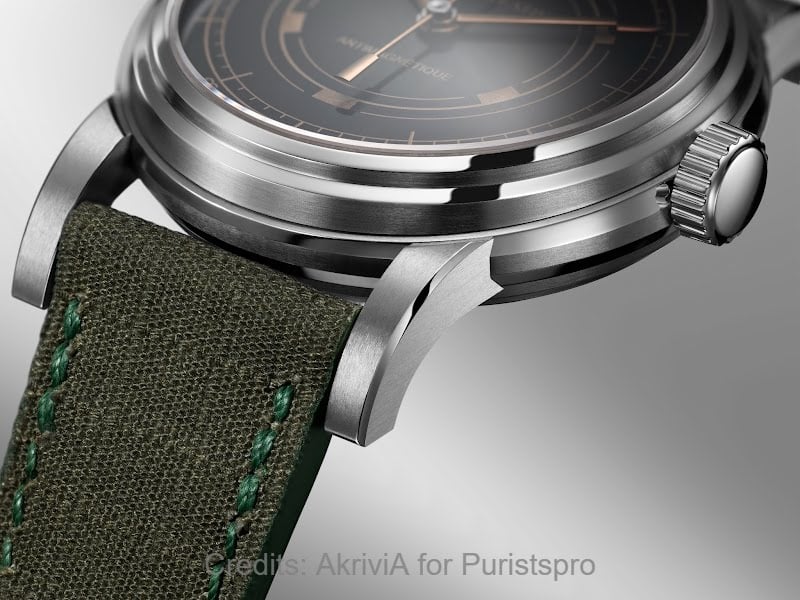
The case is the part of this watch that is hardest to convey in writing, because so much of it is about the way light behaves. The surfaces are finished so that the light rolls across them rather than snapping off them, and the transitions between polished and brushed areas are executed with the sort of confidence that only comes from doing the work by hand, slowly.
On the wrist, the watch settles immediately. It sits close, stays centred through a day of typing and driving, and never gives the impression of a heavy object perched on top of the arm. The strap breaks in quickly and the whole assembly stays put without needing to be tight. There is no top-heaviness and no rotation toward the outside of the wrist, which is the failure mode that ruins otherwise excellent dress watches.
I wore it under a shirt cuff without a fight and against bare skin on a warm afternoon without discomfort. It is not a watch you are conscious of, and at this level that is the highest compliment I can pay a case.
The movement, and the pleasure of the back
Akrivia does not publish a designation for the caliber inside this reference, and I am not going to invent one. What can be said is that it is an in-house, hand-wound chronometer movement, and that the anti-magnetic capability is built into the regulating organ rather than bolted on as an afterthought.
Turn the watch over and the reason for the price becomes obvious. The steelwork is black-polished, the bridges are hand-bevelled, and the internal angles are finished rather than merely present. This is the kind of work that takes hours per component and cannot be replicated by a machine, and it is the reason a movement like this commands the money it does.
It is also worth saying that the watch is a chronometer in the traditional sense — regulated for rate stability — rather than a watch carrying a third-party certification. Akrivia does not use COSC, and it does not need to. The proof is on the wrist.
A week on the wrist
Day one was a Monday, and the watch went straight into a shirt cuff. It disappeared. That is the first thing I would tell a prospective buyer: the Chronomètre Antimagnétique is not a watch that announces itself, and it does not want to be. It reads instantly, it sits flat, and it does nothing to interfere with the rest of your day.
Day three involved a train, a laptop bag with a magnetic clasp, and four hours of typing with the watch resting on a desk next to a speaker. The rate held. Day five was a dinner, and the watch looked entirely at home under a jacket sleeve — restrained enough not to compete with anyone else at the table, interesting enough that the one person who noticed spent ten minutes asking about it.
By the weekend I had stopped thinking about it as a review subject. That is the honest test of any watch, and it is a test that a great many expensive watches fail. The Chronomètre Antimagnétique passed it somewhere around Thursday.
Accuracy, in the real world
I do not own a timing machine, and I am sceptical of reviewers who quote laboratory figures for watches that will never see a laboratory. What I can report is consistency. Over seven days the watch held a stable rate with no sudden drift, including after a morning spent within centimetres of a powered speaker and a full day of carrying a magnetically closed bag.
That stability is the practical dividend of the anti-magnetic engineering. Most owners will never measure their watch, but they will notice one that suddenly gains twenty seconds a day after a weekend near a magnetic field. This watch does not do that, and over a decade of ownership that reliability is worth more than any single-day rate figure.
The strap and the clasp
The watch arrived on a leather strap, and it is the right choice — a metal bracelet would fight the case architecture and add weight the design does not want. The leather is supple from the first wear, takes a curve quickly, and holds the watch in place without needing to be cinched. The pin buckle is simple, well finished and entirely appropriate. A deployant would be more convenient and less in keeping with the watch; I would keep the pin.
When you would wear it
This is a watch that covers formal occasions, dress occasions, daily wear and travel without ever looking wrong. It works with a suit because it is restrained, and it works with a t-shirt because it is small enough and quiet enough not to look borrowed. It is not a sports watch, and it does not pretend to be — there is no luminous material and the water resistance is not intended for swimming. Treat it as a beautifully made daily watch that happens to be dress-appropriate, and it will never disappoint you.
What else you could buy
The obvious comparison is the F.P. Journe Chronomètre Souverain, which remains the benchmark hand-wound independent chronometer and the clearest line back to Rexhepi's training. Kari Voutilainen's Vingt-8 occupies similar territory, with a different aesthetic and the same obsession with finishing. Laurent Ferrier's Classic Micro-Rotor offers an automatic alternative with a softer case and the same standards of execution. And Philippe Dufour's Simplicity remains the reference point for hand-finishing in a time-only watch — effectively unobtainable, which is part of why Akrivia exists at all.
If you want the look without the waitlist, the Baltic MR01 delivers a sector-dial, small-seconds dress watch for a rounding error. The Timex Marlin Hand-Wound is the cheapest honest way to experience a small hand-wound dress watch. And the Seiko Presage Cocktail Time is a useful reminder that legibility and good proportion are not exclusive to five-figure independents. None of them is a substitute. All of them are worth owning alongside.
Value, ownership and servicing
Akrivia does not publish list pricing for this reference, and the secondary market for the house's chronometers has been strong enough that the question of value is largely academic. The production numbers are tiny, the waiting list is long, and the watches that do change hands do so at prices that reflect scarcity rather than specification.
For a buyer with the means, the calculation is straightforward. This is not a watch you buy because it is a bargain; it is a watch you buy because you want one of a very small number of objects made by a workshop whose name is on the dial. If you are offered one at anything resembling list, take it and keep it.
Servicing means a return to Geneva. There is no third-party network for a movement like this, and there should not be one — the finishing alone makes independent intervention a bad idea. Budget for the inconvenience and accept it as part of ownership.
Verdict
The Chronomètre Antimagnétique is the rare independent watch whose headline feature is something you benefit from every day rather than something you explain at dinner. It wears beautifully, reads instantly, and holds its rate through the magnetic clutter of modern life, all while being finished to a standard that few workshops can approach.
The difficulty is not deciding whether you want one. It is being allowed to buy one.