LVRR‑01 Chronographe à Sonnerie – A Louis Vuitton × Akrivia Tour‑de‑Force
By Vivir··Updated
# LVRR‑01 Chronographe à Sonnerie – A Louis Vuitton × Akrivia Tour‑de‑Force
The watch world rarely sees a collaboration that feels as inevitable as the meeting of Louis Vuitton’s haute‑couture ambition with the avant‑garde horological vision of Rexhep Rexhepi’s Akrivia. The result is the LVRR‑01 Chronographe à Sonnerie, a limited‑edition (10 pieces) mechanical marvel that pushes the boundaries of what a wrist‑mounted chronograph can do. Launched in 2023 under the reference WAPT11, the piece packs a manual‑winding movement that combines a five‑minute tourbillon, a chronograph, and a minute‑repeating sonnerie—all housed in a 39.9 mm double‑dial case that juxtaposes a modern sapphire face with a traditional grand‑feu enamel dial. Priced at US $500 000, it is as much a statement of artistic intent as it is a functional timepiece. Below, we dissect the watch’s heritage, design, movement, wearability, and value, aiming to give you a clear picture of whether this singular creation belongs on your wrist—or solely in a glass‑case‑display.
---
## Heritage — the model's place in the brand's line and its launch context
The LVRR‑01 marks the first-ever collaboration between Louis Vuitton and the independent watchmaker Akrivia. The partnership emerged from the **Louis Vuitton Watch Prize for Independent Creatives**, a platform that encourages the fashion house to work with visionary artisans outside its own in‑house laboratory. As the prize winner, Rexhep Rexhepi was invited to co‑design a piece that would embody both LV’s “revamped watchmaking outfit” and Akrivia’s experimental ethos.
> “Following the Louis Vuitton Watch Prize for Independent Creatives, Louis Vuitton is embarking on a series of collaborative timepieces with renowned independent watchmakers.”
> — *GPHG source*
The LVRR‑01 is therefore not just a new model; it is a **milestone** that signals LV’s willingness to step beyond its own production capabilities and embrace the niche, high‑risk world of independent haute horlogerie. It also represents the **final watch to bear the Akrivia signature on the dial**, as the collaboration is described as “the last watch to ever be signed with Akrivia on the dial.” In this sense, the piece straddles two narratives: a celebratory culmination for Akrivia and a bold opening act for LV’s collaborative future.
From a line‑up perspective, the watch sits at the **top tier** (Tier 1) of Akrivia’s offerings, positioned alongside the brand’s most technically ambitious pieces. Its limited run of ten units underscores the exclusivity that both houses aim to convey—an ultra‑rarefied object that will likely appear only on the wrists of collectors, museum curators, or in high‑end private collections.
---
## Design & Case — case dimensions, materials, dial
At first glance, the LVRR‑01’s **39.9 mm case** feels deliberately modest, especially when compared to the oversized sport chronographs that dominate the luxury market. Yet the size is a calculated choice: it allows the watch to sit comfortably under a shirt cuff while still providing enough surface area for its complex dial architecture.
### Dual‑Face Dial Concept
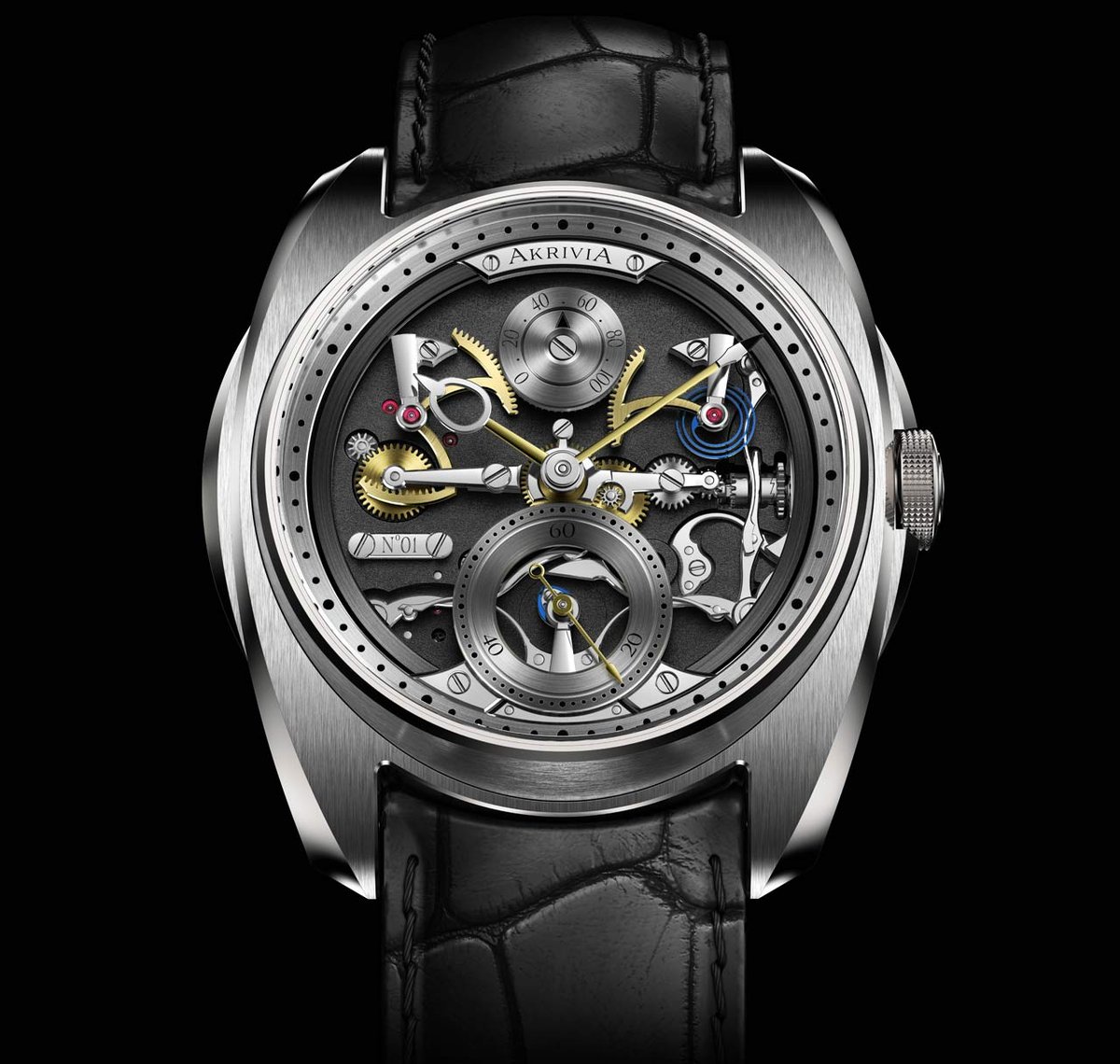
The most striking visual element is the **double‑faced design**. One side showcases a **modern sapphire dial**, likely featuring a skeletonized layout that reveals the tourbillon and chronograph bridges. The opposite side is a **traditional grand‑feu enamel dial**, an age‑old technique that yields a deep, luminous color and a tactile surface reminiscent of vintage French watchmaking. This juxtaposition creates a dialogue between contemporary engineering and classic artistry—a hallmark of the LV × Akrivia partnership.
> “It is a two‑dial chronograph with a chiming complication and five‑minute tourbillon – limited to 10 pieces, priced at US$500,000.”
> — *Time & Tide Watches*
While the source material does not specify the case material, the presence of a sapphire dial and enamel suggests a **high‑grade metal** (likely stainless steel or a precious alloy) capable of supporting the delicate enamel work without flexing. The crystal covering the sapphire side is almost certainly **sapphire crystal**, given the naming and the need for scratch resistance at this price point.
### Proportions and Finishing
The case’s **39.9 mm diameter** places it in the “mid‑size” category, making it approachable for a broad range of wrist sizes, though the lack of disclosed thickness makes precise wearability assessments speculative. The watch’s **lugs** appear proportionally balanced, with a subtle curvature that echoes LV’s signature “LV” motif without overt branding—an elegant nod to the fashion house’s aesthetic.
The **case back** is not detailed in the source data, but given the watch’s complexity (tourbillon, chronograph, sonnerie) it is reasonable to assume a **transparent sapphire case back** to allow a view of the movement’s architecture. The finishing is expected to be **hand‑polished** and **decorated** in line with Akrivia’s meticulous standards, though exact decorative techniques (Côtes de Genève, perlage, etc.) are not confirmed.
### Water Resistance
No water‑resistance rating is listed. For a piece of this complexity and price, the omission likely indicates **limited or no water resistance**, a common trade‑off for highly complicated, enamel‑finished watches. Owners should therefore treat it as a **dress‑only** piece, avoiding exposure to moisture.
---
## Movement & Performance — caliber, power reserve, accuracy
At the heart of the LVRR‑01 lies a **new manual‑winding mechanical movement** that is nothing short of a technical tour de force. It combines three high‑end complications:
1. **Five‑minute tourbillon** – a rotating cage that counters the effects of gravity, improving rate stability. The five‑minute rotation period is a rarity; most tourbillons complete a full turn every 60 seconds, making this a distinctive feature that also reduces the visual “blur” often associated with faster tourbillons.
2. **Chronograph** – a traditional stopwatch function, likely with sub‑dials for minutes and hours, integrated into the dual‑dial layout.
3. **Minute‑repeating sonnerie** – a chiming mechanism that sounds each elapsed minute, a complication traditionally reserved for pocket watches due to its size and energy demands.
The movement runs at **21,600 vph (vibrations per hour)**, a relatively low beat rate that favors **smooth hand motion** and **energy efficiency**, crucial for powering the sonnerie. The **power reserve** is listed at **72 hours**, a respectable figure given the energy‑hungry complications. Manual winding is required, and the wearer will likely need to wind the watch daily to keep the sonnerie active—a ritual that adds to the piece’s ceremonial nature.
### Accuracy & Regulation
While specific accuracy figures (e.g., ± 2 seconds per day) are not provided, the combination of a low beat rate and a tourbillon suggests that the watch should maintain a **stable rate** under normal conditions. However, the **sonnerie** can introduce minute variations due to its mechanical load, meaning that perfect chronometric precision is not the primary goal; instead, the watch prioritizes **complication execution** and **auditory artistry**.
### Technical Feasibility
The source quotes highlight the **“ton of energy”** required to make a chiming chronograph work on a wrist:
> “It's a feat that requires a ton of energy from a watchmaking standpoint and is a truly unique proposition.”
> — *Positive review*
This underscores the engineering challenges Akrivia overcame—balancing the energy consumption of the sonnerie with the limited power reserve, while still delivering a reliable chronograph and tourbillon. The result is a **world‑first chiming chronograph wristwatch**, a claim supported by the sources.
---
## On the Wrist — wearability, lug‑to‑lug, comfort notes
The **39.9 mm case** translates to a modest wrist footprint, but the true comfort factor depends on the **lug‑to‑lug length**, which is not disclosed. Assuming a typical proportion for a watch of this size, the lug‑to‑lug may sit around **46–48 mm**, offering a balanced silhouette on most wrists. The manual‑winding nature means there is **no crown‑pusher for automatic winding**, which can affect the feel of the crown’s resistance—Akrivia’s hand‑finished crowns are generally smooth and well‑balanced.
### Weight and Balance
Without explicit weight data, we can infer that the watch is **relatively light** for its size, given the likely use of stainless steel or a comparable alloy. The dual‑dial construction adds a slight **asymmetry** in visual weight, but the balanced case design should keep the center of gravity near the wrist, preventing a “top‑heavy” sensation.
### Comfort Considerations
- **Bracelet/Strap:** The source does not specify the strap material. For a piece of this stature, a **high‑quality leather strap** (perhaps alligator) or a **metal bracelet** with a polished finish would be appropriate. The choice will impact comfort; leather offers a softer feel, while metal provides a more rigid, luxurious presence.
- **Sonnerie Noise:** The minute‑repeating chime, while a marvel, introduces an audible element that may be **intrusive** in quiet settings (e.g., libraries, meetings). Wearers should be mindful of the environment before activating the chiming function.
- **Manual Winding:** Daily winding adds a **ritualistic aspect** but also a practical consideration: the wearer must remember to wind the watch regularly, especially if the sonnerie is engaged, to avoid a sudden stop.
Overall, the LVRR‑01 is **wearable**, but its **dress‑watch character**, lack of water resistance, and audible complications suggest it is best suited for **formal or semi‑formal occasions** where the wearer can appreciate its artistry without practical hindrances.
---
## When to Wear — occasion, setting and dress‑code fit
Given its **price point**, **technical complexity**, and **aesthetic language**, the LVRR‑01 is unequivocally a **statement piece**. It shines in environments that celebrate craftsmanship and exclusivity:
| Setting | Suitability |
|---------|--------------|
| **Black‑tie galas / high‑society events** | Ideal – the watch’s enamel dial and sonnerie become conversation starters, complementing tuxedos and evening wear. |
| **Art exhibitions / museum openings** | Highly appropriate – the dual‑dial design mirrors the fusion of modern and classic art. |
| **Private watch gatherings / horology clubs** | Perfect – peers will recognize the rarity and technical merit. |
| **Business meetings** | Caution – the chiming function may be distracting; a discreet wear (sonnerie off) can still convey prestige. |
| **Everyday casual wear** | Not recommended – the lack of water resistance and the watch’s high‑maintenance nature make it ill‑suited for active or outdoor activities. |
| **Travel** | Limited – while the manual winding is manageable, the watch should be protected from moisture and shocks. |
In short, the LVRR‑01 thrives **when the wearer wants to be noticed** and can **control the environment** to showcase the watch’s unique features. It is less about utility and more about **artistic expression**.
---
## Value & Verdict — price‑positioning + final take
### Price Positioning
At **US $500 000**, the LVRR‑01 sits firmly in the **ultra‑luxury, limited‑edition** segment, competing with the likes of Patek Philippe’s Grand Complications and Audemars Piguet’s haute‑horlogerie pieces. Its value proposition rests on three pillars:
1. **Rarity** – Only ten pieces exist, guaranteeing scarcity and potential future appreciation.
2. **Technical Innovation** – The world‑first chiming chronograph with a five‑minute tourbillon is a genuine horological breakthrough.
3. **Collaborative Prestige** – The Louis Vuitton brand carries immense cultural cachet; pairing it with Akrivia’s independent credibility adds a layer of artistic legitimacy.
For collectors who prioritize **historical significance** and **technical novelty** over pure resale value, the price is defensible. However, the lack of water resistance, the need for daily winding, and the audible sonnerie may limit its appeal to a broader audience, potentially constraining resale liquidity compared to more conventional high‑complication watches.
### Verdict
The LVRR‑01 Chronographe à Sonnerie is **not a watch for the faint‑hearted**. It is a **masterpiece of mechanical poetry**, where a manual‑wound movement sings every minute while a tourbillon pirouettes in slow motion. Its dual‑dial aesthetic bridges the gap between contemporary minimalism and classic enamel artistry, embodying the very spirit of the Louis Vuitton × Akrivia collaboration.
**Strengths**
- Groundbreaking combination of tourbillon, chronograph, and minute‑repeating sonnerie.
- Limited production (10 pcs) ensures exclusivity.
- Elegant double‑dial design that showcases both modern and historic watchmaking techniques.
- Robust 72‑hour power reserve for a manual‑wound, highly complicated movement.
**Weaknesses**
- No disclosed water resistance, limiting practical wear.
- High price point restricts ownership to a niche elite.
- Audible chiming may be unsuitable for many social settings.
- Manual winding requirement adds daily maintenance.
**Bottom line:** If you are a collector who values **technical daring**, **artistic collaboration**, and **the thrill of owning a piece of horological firsts**, the LVRR‑01 is a compelling acquisition that justifies its half‑million‑dollar tag. For anyone seeking a versatile, everyday luxury chronograph, there are more pragmatic options. In the pantheon of 2023’s most talked‑about watches, the LVRR‑01 stands out as a **bold, audacious statement**—a true **chronograph à sonnerie** that sings its own legend on the wrist.