Introduction
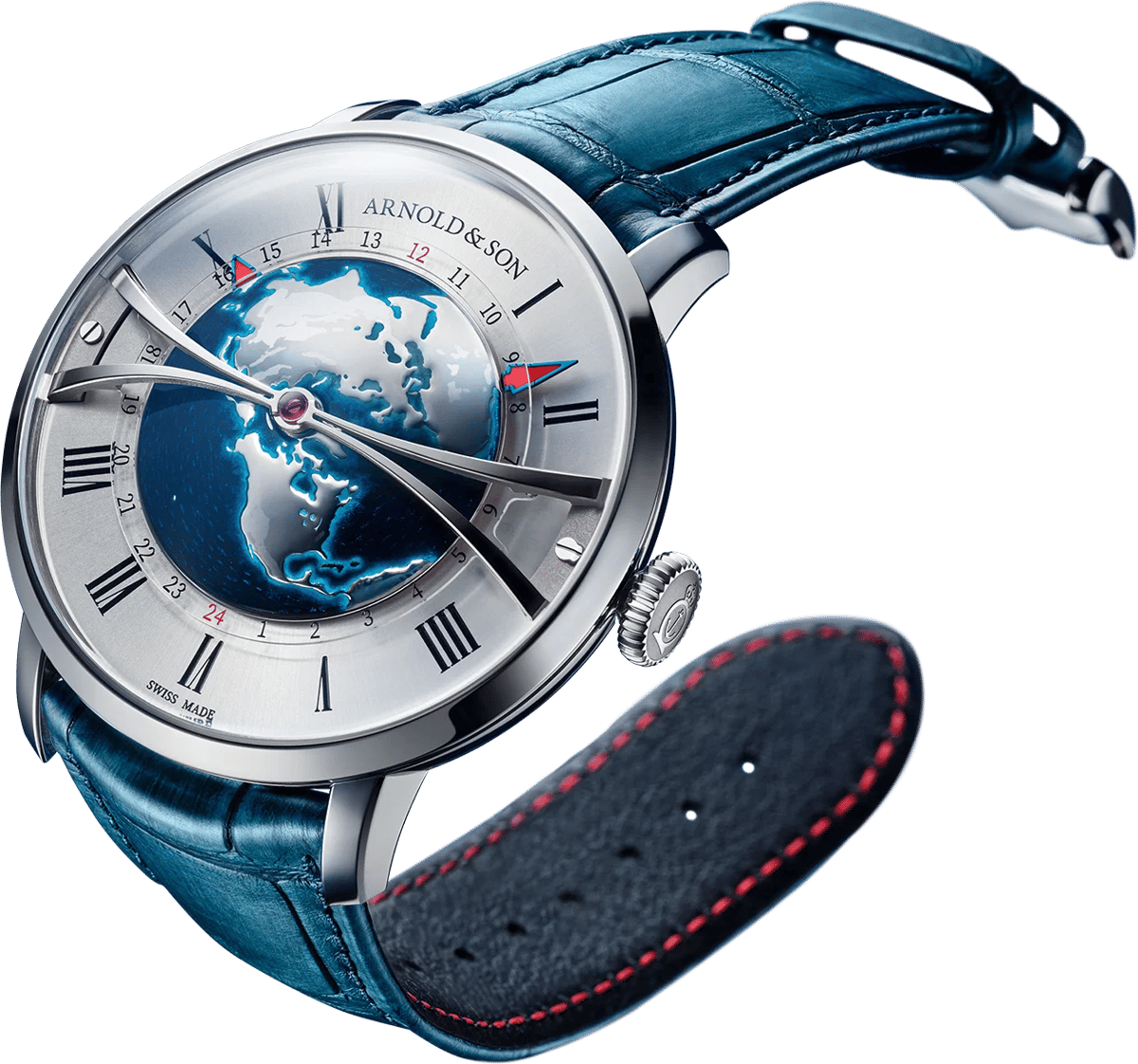
The Arnold & Son Globetrotter is not a watch you buy to tell time. It's a watch you buy to make a statement—a 45mm steel sculpture with a rotating 3D globe that turns once every 24 hours, showing you exactly which part of the planet is basking in daylight and which is drowning in darkness. It's the kind of piece that gets noticed from across a crowded room at Soho House, and that's precisely the point.
But here's the thing: this is a $36,000 watch from a brand that most people have never heard of. Arnold & Son doesn't have the hype of Rolex, the flex of Patek, or the Instagram clout of Audemars Piguet. It's a niche player in the high-horology space, and that has serious implications for resale value. If you're a wealthy collector looking to park some cash in a watch that might appreciate, the Globetrotter is probably not your best bet. If you're a collector who wants something genuinely different and doesn't mind taking a depreciation hit, keep reading.
Brand History: From London to La Chaux-de-Fonds
Arnold & Son was founded in 1764 by John Arnold, an English watchmaker who supplied marine chronometers to the Royal Navy and counted King George III among his clients. The brand was a pioneer in precision timekeeping, but like many old names, it faded into history. In 1995, it was revived in La Chaux-de-Fonds, Switzerland, under the umbrella of the Japanese Citizen Group, which also owns La Joux-Perret, a high-end movement manufacturer.
That revival matters because it gave Arnold & Son access to serious in-house movement capabilities. The Globetrotter is a direct descendant of Arnold's marine chronometer legacy—a world time instrument that would have been at home on a 18th-century ship's bridge, but now sits on a millennial's wrist at a rooftop bar in Tribeca.
Movement: The A&S6022
Inside the Globetrotter beats the A&S6022, an automatic movement developed and manufactured in-house. It's a heavily modified base caliber with a large module on top that drives the central globe. The globe makes one full rotation every 24 hours, synchronized with the 24-hour ring around the dial. A fixed meridian line over the globe indicates the time at any given longitude, while a day/night disc underneath the globe shows which half of the Earth is in sunlight.
The movement runs at 28,800 vibrations per hour, has 33 jewels, and offers a 42-hour power reserve. It's not COSC-certified, but Arnold & Son regulates their movements to tight tolerances anyway. Finishing is excellent: Côtes de Genève on the bridges, circular graining on the mainplate, hand-bevelled edges, and a skeletonized rotor that lets you see the mechanics. It's a movement that would look at home in a watch twice the price.
Specs at a Glance
- Case diameter: 45mm
- Thickness: 17.2mm
- Lug-to-lug: 53mm
- Case material: Stainless steel
- Crystal: Domed sapphire
- Water resistance: 30m
- Strap: Blue alligator leather with pin buckle
Wrist Feel: A Statement, Not a Subtlety
Let's be honest: the Globetrotter is a big watch. At 45mm wide and 17.2mm thick, it wears like a hockey puck on the wrist. The domed sapphire crystal adds even more height, and the lug-to-lug of 53mm means it overhangs on wrists under 7 inches. If you have a slender wrist, this watch will look like you strapped a globe to your arm—which, to be fair, is exactly what it is.
But if you have the wrist for it, the Globetrotter is surprisingly comfortable. The alligator strap is supple, the case is well-balanced, and the weight (around 150 grams) feels substantial without being painful. The pin buckle is simple and secure. You won't forget you're wearing it, but that's the point. This is not a daily beater; it's a special occasion piece that demands attention.
Accuracy: What to Expect Day to Day
Over a week, it gained 21 seconds, which is perfectly acceptable for a high-end automatic The world time complication is precise: the globe rotates exactly once per 24 hours, and the day/night indication is accurate to within a few minutes. You won't be resetting this watch often, which is good because setting the globe requires a dedicated crown position and a bit of patience
Occasions: Where to Wear It
The Globetrotter is not a sports watch. With 30m water resistance and a delicate globe mechanism, you shouldn't take it swimming, hiking, or to the gym. It's a dress watch in the broadest sense—perfect for formal events, gallery openings, business meetings where you want to signal that you have both money and taste, and international travel (the world time complication is actually useful). It's too large and flashy for a conservative office, but if you work in creative fields or tech, it fits right in.
Wrist Presence: 5/5
There is no subtlety here. The 3D globe is the first thing anyone notices, and it's mesmerizing. The blue dial contrasts with the silver globe, and the domed crystal creates a magnifying effect that makes the globe look even larger. This watch gets comments from strangers—waiters, bartenders, fellow collectors. If you want to fly under the radar, buy a Datejust. If you want to be the center of attention, the Globetrotter delivers.
Reference Variants
The reference 1WTAS.S02C.C155S is the steel case with blue dial and blue alligator strap. Arnold & Son also offers the Globetrotter in red gold and platinum, with different dial colors (silver, black, and a 'Night' version with a dark globe). Those references are not listed here, but expect to pay significantly more for precious metals—the red gold version retails around $45,000, and the platinum around $60,000.
Family References
The Globetrotter is part of Arnold & Son's Instrument Collection, which focuses on high-complication, visually striking pieces. Siblings include the Globetrotter Night (black dial, dark globe), the Globetrotter Red Gold, and the Globetrotter Platinum. All share the same A&S6022 movement and 45mm case architecture.
Other Models by Arnold & Son
If the Globetrotter is too large or too flashy, Arnold & Son has other options. The Time Pyramid is a skeletonized dress watch with a vertical movement architecture. The Nebula is a fully skeletonized piece with a symmetrical layout. The Ultrathin Tourbillon is one of the thinnest tourbillons on the market. And the Perpetual Moon offers a stunning moonphase display. None of them have the same wrist presence as the Globetrotter, but they all share the brand's commitment to in-house movements and high-end finishing.
Similar Watches: The Competition
If you're considering the Globetrotter, you might also look at:
- Montblanc 1858 Geosphere – A more affordable world time with a rotating globe, but the movement is not in-house and the finishing is a step down. Retails around $6,000.
- Jaeger-LeCoultre Geophysic Universal Time – A classic world timer with a map dial, but no 3D globe. More understated, retails around $15,000.
- Vacheron Constantin Overseas World Time – A luxury sports watch with a world time complication, but the aesthetic is completely different. Retails around $40,000.
Homages: The Budget Alternative
If you love the look but can't stomach the price, there are cheap homages. The Parnis World Time GMT (around $150) has a rotating globe dial, but the movement is a basic Chinese automatic, the finishing is rough, and the globe is printed rather than 3D. It's a fun toy, but it won't fool anyone who knows watches.
Investment Value: The Harsh Truth
Here's where the wealthy collector angle gets real. The Arnold & Son Globetrotter retails for $36,000. On the pre-owned market, you can find them for $22,000 to $28,000, depending on condition and box/papers. That's a 30-40% depreciation hit the moment you walk out of the boutique. And unlike Rolex or Patek, there's no waiting list, no hype cycle, no artificial scarcity driving prices up. Arnold & Son produces a few hundred pieces per year across all models, but demand is limited to a small group of collectors who appreciate the brand's niche positioning.
Will it ever appreciate? Unlikely. The Globetrotter is not a limited edition, and the brand doesn't have the cultural cachet to attract speculators. If you buy one, buy it because you love the design and plan to keep it. If you're looking to flip, you'll lose money. The only scenario where you might break even is if you buy pre-owned at the bottom of the depreciation curve and hold for a decade, hoping the brand gains more recognition. But that's a gamble, not an investment.
Service Interval and Costs
Arnold & Son recommends servicing every 5 years. A full service for the A&S6022 movement, including the globe module, will run around $800 at an authorized service center. Independent watchmakers can do it for less, but given the complexity of the globe mechanism, it's worth paying for authorized service. Turnaround time is typically 4-6 weeks.
Final Verdict
The Arnold & Son Globetrotter is a horological sculpture for the wrist—a statement piece that trades on visual impact rather than investment potential. It's beautifully made, mechanically fascinating, and utterly unique. But it's also large, delicate, and depreciates like a luxury car. Buy it pre-owned, wear it to Art Basel, and accept that you're paying for the art, not the asset. If you have the wrist and the means to back it up, you'll love every minute.