The Manufacture Milestone: Introduction to the Engineer M
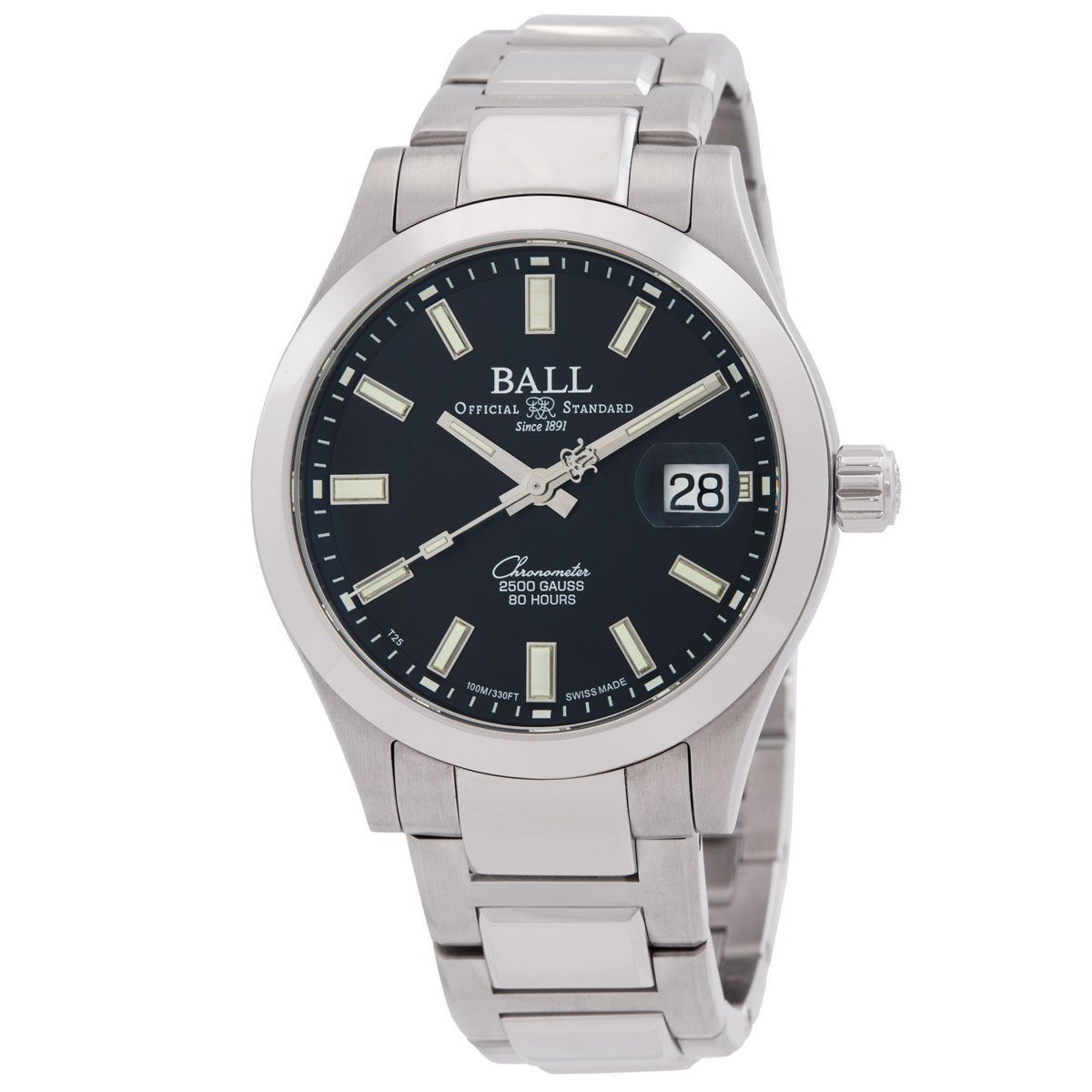
For decades, the conversation surrounding Ball Watch Company centered on their innovative use of tritium gas tubes and their rich American railroad heritage. However, within the last five years, the narrative has shifted. With the introduction of the 'M' designation—standing for 'Manufacture'—Ball has entered a new echelon of watchmaking. The Engineer M Marvelight, reference NM2128C-S1C-BE, is the standard-bearer for this new era. It represents a synthesis of the brand’s rugged DNA with a level of movement sophistication that challenges the established Swiss hierarchy.
The choice of 904L stainless steel for the case and bracelet is the first indicator that this is not a standard timepiece. While 316L is the industry standard for high-end watches, 904L—famously used by Rolex—contains higher amounts of chromium, molybdenum, nickel, and copper. This results in superior resistance to corrosion and acids, but more importantly for the enthusiast, it allows for a higher polish and a distinct luster that is immediately apparent upon unboxing.
Architecture of the RRM7309-C: A Technical Deep Dive
At the heart of the NM2128C-S1C-BE lies the Caliber RRM7309-C. This is not a modified ETA 2824 or a Sellita clone. It is a ground-up manufacture movement designed to meet the demands of the modern collector. The most significant specification is the 80-hour power reserve. In an era where 'weekend-proof' movements are becoming the expected standard, Ball has delivered a caliber that can be set down on Friday evening and picked up on Monday morning without the need for winding or resetting.
The movement operates at a frequency of 28,800 vibrations per hour (4Hz), which ensures a smooth sweep of the seconds hand—a characteristic often sacrificed in other high-power-reserve movements that drop to 3Hz to conserve energy. Ball has achieved this efficiency through optimized barrel geometry and escapement refinement. The finishing, visible through the sapphire caseback, is exemplary for this price point. We see deep perlage on the baseplate and circular graining on the bridges, all executed with a precision that speaks to the brand's investment in modern CNC technology and hand-finishing techniques.
Furthermore, the RRM7309-C is COSC-certified. This means each movement has undergone 15 days of testing at the Contrôle Officiel Suisse des Chronomètres, across five positions and three temperatures, ensuring a daily rate of -4 to +6 seconds. In my time with the watch, it performed even better, settling into a consistent +2 seconds per day.
The Metallurgy of 904L Steel
The use of 904L steel in the Engineer M is more than a marketing gimmick. From a technical standpoint, 904L is more difficult to machine, requiring specialized presses and lubricants. The reward is a case that is virtually immune to the 'pitting' that can occur in 316L steel when exposed to saltwater over long periods. For the collector, the benefit is primarily aesthetic. The steel has a 'whiter' hue compared to the slightly greyish tint of 316L, which makes the polished surfaces of the Engineer M pop with a brilliance that is typically associated with much more expensive luxury pieces.
The case geometry itself is classic. At 40mm, it hits the 'Goldilocks' zone for most wrist sizes. The lugs are tapered and brushed on the top surface, with a high-polish chamfer that runs along the edge, providing a visual transition to the polished bezel. This interplay of finishing techniques highlights the precision of the case construction.
Chronometry and the Railway Legacy
Webb C. Ball’s legacy was built on the 'Official Railroad Standard,' which required watches to be accurate within 30 seconds per week. The Engineer M honors this by incorporating modern anti-magnetic and anti-shock features. The watch is rated to 5,000Gs of shock resistance and 4,800A/m of magnetic resistance. While these are standard for Ball, they are exceptional for a watch that looks this refined. The movement is protected by a proprietary shock-absorbing system that secures the balance wheel, the most vulnerable part of any mechanical watch.
The Tritium Radiance: Illumination Without Compromise
No review of a Ball watch is complete without discussing the micro gas tubes (H3). Unlike Super-LumiNova, which requires an external light source to charge and fades over a few hours, tritium gas tubes glow consistently for up to 25 years. On the Engineer M Marvelight, these tubes are applied to the hour markers and the hands. The 'Marvelight' designation refers to the oversized, baton-style tubes used on the dial, which provide a significantly larger surface area for illumination.
In low-light conditions, the blue dial is transformed. The tubes provide a crisp, constant glow that is invaluable for nighttime legibility. It is a functional feature that has become a stylistic hallmark of the brand. The integration of these tubes into the applied indices is done with such cleanliness that, during the day, they simply look like high-quality hour markers.
The Dial: Sunray Blue and Practicality
The dial of the ref. NM2128C-S1C-BE is a deep, sunray blue that shifts in tone depending on the ambient light. In direct sunlight, it radiates a vibrant cobalt; in office lighting, it recedes into a sober navy. The date window at 3 o'clock is magnified by a cyclops lens on the sapphire crystal. While the cyclops is a polarizing feature among enthusiasts, it serves the brand’s commitment to legibility and follows the design language of the classic 'everyday' sports watch.
The hands are polished dauphine-style, which provides excellent contrast against the blue background. The seconds hand features the 'RR' (Railroad) counterweight, a subtle nod to the brand's history that adds a touch of ornamental detail to an otherwise functional handset.
Wrist Experience and Ergonomics
Wearing the Engineer M is a tactile delight. The bracelet links are tight, with no 'rattle' even when shaken vigorously. The butterfly clasp, while lacking the micro-adjustment of a diver's extension, ensures the underside of the wrist remains slim and comfortable—essential for those who wear their watches under a shirt cuff. The 46.6mm lug-to-lug distance is remarkably compact for a 40mm watch, making it wearable even for those with smaller 6.25-inch wrists.
Market Position and Investment Value
At an MSRP of approximately $2,999, the Ball Engineer M sits in a highly competitive bracket. It competes directly with the likes of the Tudor Black Bay 41, the Longines Spirit, and the Oris Aquis. Where the Ball wins is in the 'spec-sheet' battle. Very few, if any, competitors at this price point offer 904L steel, an 80-hour manufacture movement, COSC certification, and tritium gas tubes in a single package.
From an investment perspective, Ball watches typically experience a standard depreciation on the secondary market. However, the 'M' manufacture models are proving to be more resilient than their ETA-based predecessors. This is a watch purchased for its engineering excellence and its ability to serve as a lifelong companion, rather than a speculative asset to be flipped for profit.
Final Verdict
The Ball Engineer M ref. NM2128C-S1C-BE is a triumph of modern industrial watchmaking. It successfully honors the brand’s history of precision and safety while pushing forward into the manufacture territory. For the sophisticated collector who appreciates the technical nuances of movement architecture and metallurgical superiority, the Engineer M offers a compelling alternative to the mainstream luxury brands. It is a watch that doesn't just tell time; it tells a story of American grit and Swiss precision, illuminated by the constant glow of tritium.