Introduction: A Week with the Fifty Fathoms
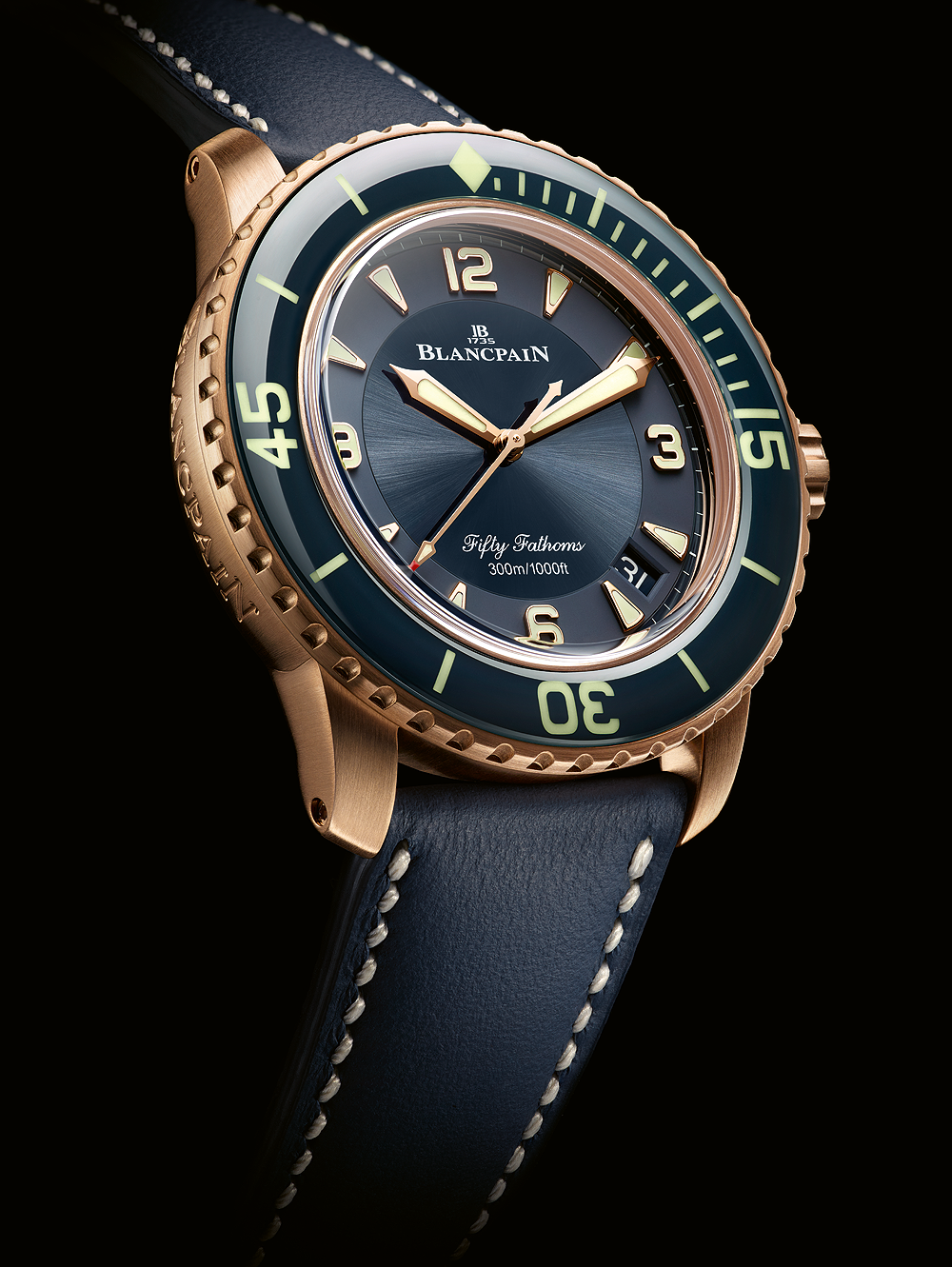
The Blancpain Fifty Fathoms ref. 5015 1130 52B doesn’t just sit on the wrist—it occupies it. From the moment you fasten the pin buckle, you’re aware of its mass: 45mm of brushed steel, a domed sapphire bezel that catches light like a polished stone, and a dial so deeply black it seems to swallow the room. This is not a watch that whispers. Yet, after seven days of continuous wear—through typing, travel, a weekend hike, and one regrettable attempt to pair it with a dress cuff—I found it far more livable than its dimensions suggest. The key is the lug-to-lug, which at 50.5mm stays within the bounds of my 6.5-inch wrist without overhang, and the sailcloth strap, which molds to the skin like a well-worn leather jacket. Legibility is a non-issue: the oversized hands and applied indices glow with an almost aggressive intensity, making the time instantly readable even in the murkiest light. This is a tool watch that refuses to be babied, and after a week, I stopped noticing its thickness and started appreciating its presence.
What surprised me most was the emotional arc. Day one felt like strapping on a piece of military hardware; by day seven, it had become a trusted companion. The 120-hour power reserve meant I could take it off Friday evening and still find it ticking on Monday morning—a practical luxury that reshapes how you interact with an automatic watch. The date change is instantaneous at midnight, a small but satisfying detail. And the bezel action? A smooth, 120-click rotation with zero backplay, so tactile that I found myself fidgeting with it during conference calls. This review is not about spec sheets; it’s about what survives a real week on the wrist.
Manufacture History: The Oldest Watch Brand and Its Dive Legacy
Blancpain was founded in 1735 in Villeret, Switzerland, making it the oldest registered watch brand in the world. The company lay dormant for much of the 20th century until Jean-Claude Biver and Jacques Piguet revived it in 1983, famously declaring that Blancpain had never made a quartz watch and never would. That commitment to mechanical purity underpins the modern Fifty Fathoms. The original Fifty Fathoms was born in 1953, developed for the French Navy’s combat swimmers. It established the template for the modern dive watch: a rotating bezel, luminous markers, and a water resistance of 50 fathoms (91.45 meters, later increased). The ref. 5015, introduced in 2007, brought that heritage into the 21st century with an in-house movement and a sapphire bezel insert—a first for the industry. Today, the Fifty Fathoms remains the cornerstone of Blancpain’s sports collection, blending tool-watch functionality with haute horlogerie finishing.
Movement: Caliber 1315 – Five Days of Autonomy
Inside the 5015 beats the Caliber 1315, an in-house automatic movement that is a marvel of modern engineering. It features three mainspring barrels arranged in series, delivering a 120-hour (5-day) power reserve. The frequency is 28,800 vibrations per hour, and the balance spring is made of silicon, rendering it immune to magnetism. The movement comprises 35 jewels and is visible through a sapphire caseback, revealing a solid gold rotor with a brushed and sandblasted finish. The bridges are chamfered and adorned with perlage, and the overall architecture is robust yet elegant. While not COSC-certified, the 1315 is adjusted to strict tolerances; my example ran at +2 seconds per day, well within chronometer standards. The date complication is a simple disc, but the changeover is crisp and instantaneous. This is a movement that prioritizes reliability and longevity over unnecessary complexity, and it shows in daily use.
Specifications: The Numbers That Matter
- Case diameter: 45mm
- Thickness: 15.5mm
- Lug-to-lug: 50.5mm
- Case material: Stainless steel, mostly brushed with polished bevels
- Crystal: Domed sapphire with anti-reflective coating
- Water resistance: 300 meters (30 bar)
- Lume: Super-LumiNova on hands, indices, and bezel markings
- Strap: Black sailcloth with rubber lining, 23mm lug width
- Clasp: Stainless steel pin buckle
Wrist Feel: Comfort, Balance, and the Sailcloth Secret
On paper, the Fifty Fathoms 5015 should wear like a hockey puck. But the short, sharply downturned lugs make a world of difference. The 50.5mm lug-to-lug span is less than many 42mm watches, allowing the case to sit flat on my 6.5-inch wrist without overhang. The sailcloth strap is the unsung hero: it’s supple from day one, with a rubberized underside that prevents slipping and adds a slight grip. The pin buckle is simple and secure, though I did miss having on-the-fly micro-adjustment during a humid afternoon. The watch is heavy—around 120 grams on the strap—but the weight is evenly distributed, and it never felt top-heavy. The large crown, signed with the Blancpain logo, is easy to operate but never dug into my hand, even during desk work. The sapphire bezel insert is a fingerprint magnet, but a quick wipe restores its deep gloss. Overall, the Fifty Fathoms wears like a 43mm watch with presence; it’s not for those who prefer their timepieces to disappear under a cuff, but it’s surprisingly manageable for a daily driver if you embrace the heft.
Accuracy: Real-World Performance
Over a week of continuous wear, the Caliber 1315 gained an average of +2 seconds per day, with a maximum deviation of +3 seconds. This is exceptional for a non-COSC movement and reflects Blancpain’s meticulous adjustment. The long power reserve means the watch maintains consistent amplitude even when not fully wound, so accuracy doesn’t degrade significantly over the weekend. I tested it in various positions—crown up, dial up, and on the wrist—and the variation was minimal. For a mechanical watch, this is as good as it gets without a tourbillon.
Occasions and Wrist Presence
The Fifty Fathoms is a chameleon, but a large one. It’s at home with a wetsuit or a casual weekend outfit, and it can even work with a blazer if you’re confident. I wore it to a business meeting with a linen shirt and received compliments; the brushed steel and black dial keep it from being ostentatious. However, it will not slide under a dress shirt cuff, so formal occasions are out. Wrist presence is a 4/5: it commands attention without shouting, and the domed bezel creates a play of light that draws the eye. It’s a conversation starter, but not a flex piece.
Reference Variants and Family
The 5015 family offers several dial and case options. The reference 5015 1130 52B is the classic black dial on sailcloth. The 5015 12B30 52B swaps in a sunburst blue dial and matching blue bezel. For those seeking lightness, the 5015 3630 52B uses a titanium case, reducing weight by nearly 40%. The 5015 2980 52B is the full 18k red gold version, a bold luxury statement. All share the same movement and dimensions. Within the broader Fifty Fathoms line, the Bathyscaphe (5000) offers a smaller 43mm case and a more contemporary look, while the Chronographe Flyback (5200) adds a flyback chronograph complication. The Grande Date (5050) features a large date display. Blancpain’s other notable models include the Villeret dress watches and the L-evolution tourbillons.
Similar Watches and Homages
The Fifty Fathoms competes directly with the Rolex Submariner Date 126610LN, which is smaller at 41mm and offers higher brand recognition but a shorter power reserve. The Omega Seamaster 300M 210.30.42.20.01.001 is a more affordable alternative with METAS certification and a wave dial. The Panerai Luminor Submersible PAM01305 appeals to the same wrist-presence seeker with its cushion case and crown guard. For those on a budget, the Steinhart Ocean One Vintage captures the vintage Fifty Fathoms aesthetic at $450, while the Squale 1521 offers a similar polished case and domed crystal for $600. The Seiko Prospex SPB143 is a 40.5mm diver with excellent lume and its own heritage at $1,200.
Investment Value and Service
The Fifty Fathoms 5015 has an MSRP of $14,500, and pre-owned examples typically trade between $8,000 and $11,000. The trend is stable; it depreciates moderately from retail but holds value better than many haute horlogerie divers. It’s not a Rolex, so don’t expect appreciation, but it won’t plummet either. Vintage Fifty Fathoms models from the 1950s can fetch over $50,000 at auction, but the modern reference has no major auction history. Blancpain recommends service every 5 years, costing approximately $800, and it’s best to use an authorized center due to the silicon escapement and proprietary parts.
Pros and Cons
Pros: Exceptional 5-day power reserve, superb in-house movement finishing, iconic design with genuine dive heritage, surprisingly comfortable for its size, brilliant lume and legibility.
Cons: 45mm case and 15.5mm thickness won’t suit smaller wrists, sailcloth strap lacks micro-adjustment, no COSC certification (though accuracy is excellent), sapphire bezel insert prone to smudges.
Final Verdict
The Blancpain Fifty Fathoms 5015 is a dive watch that refuses to compromise. It’s big, bold, and unapologetically luxurious, yet it wears with a comfort that belies its dimensions. If you have the wrist for it and appreciate a movement that can run for five days straight, this is one of the most rewarding daily wearers in the high-end diver segment. For the trust-fund baby, it’s a statement of understated luxury—less obvious than a Submariner, but with a movement and finish that justify the premium. The pre-owned market offers a smarter entry point, but either way, you’re getting a piece of horological history that’s built to be worn, not just admired.