The Philosophy of the Villeret
In an era where luxury watchmaking is often overshadowed by the clamor for integrated-bracelet sports watches, the Blancpain Villeret 6653Q 1127 55B stands as a quiet, authoritative reminder of what horology used to be—and what it still can be for those with a discerning eye. The Villeret collection is not about making a statement from across the room; it is about the intimate relationship between the wearer and a machine of immense complexity. As the Horology Editor at Vivir, I have seen many brands attempt to replicate the 'classic' look, but few do so with the authentic historical weight of Blancpain.
The Villeret line is named after the birthplace of the brand, and it carries that heritage in every curve of its double-stepped bezel. This design choice is critical; it breaks up the verticality of the case side, making an already thin watch (10.8mm) appear even more svelte on the wrist. It is a visual trick that dates back decades, yet it feels entirely relevant in a modern context where proportions are being scrutinized more than ever by the 'neo-vintage' collector community.
A Dial of Harmonious Complexity
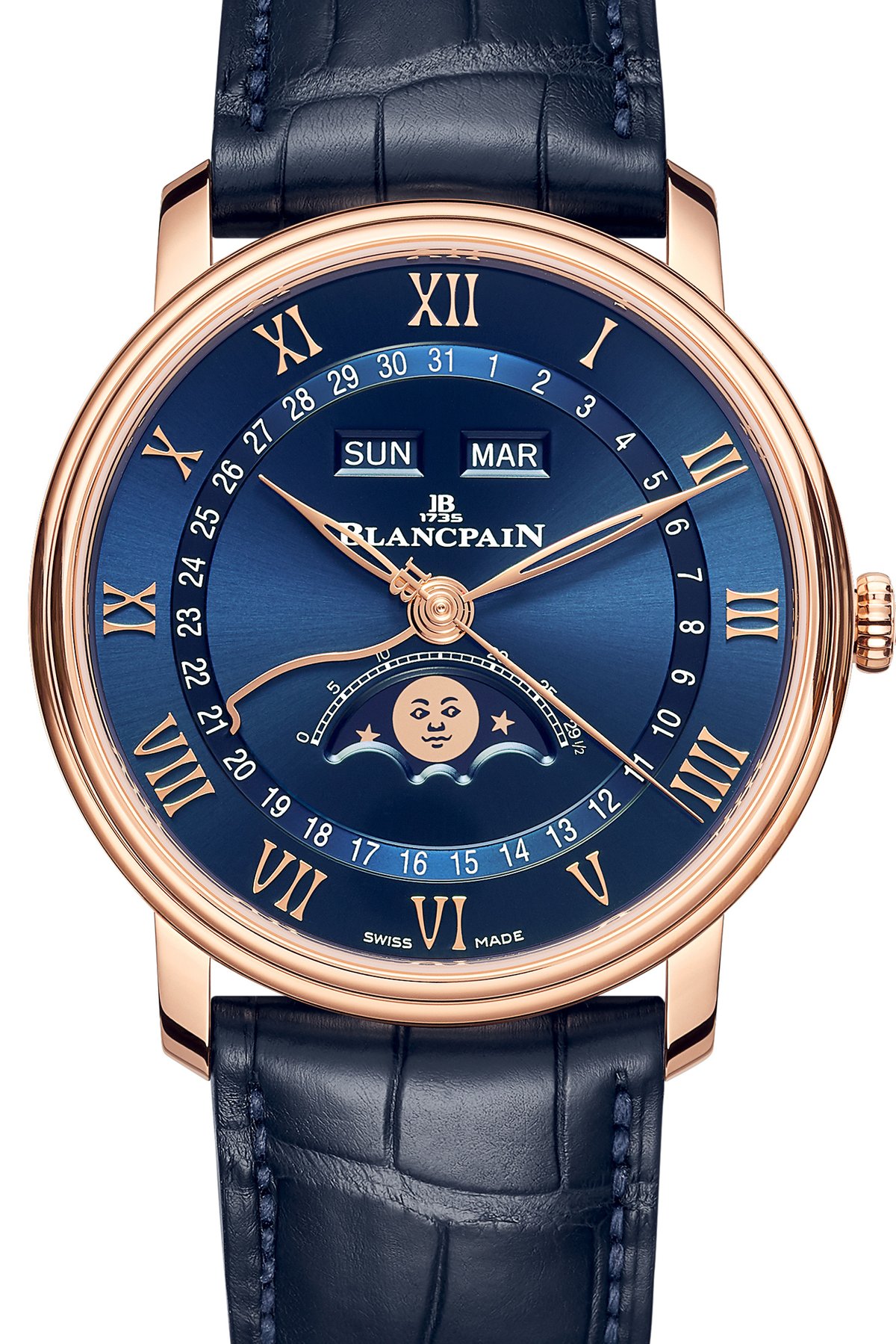
The dial of the 6653Q is a study in balance. At first glance, it appears to be a traditional white dial with Roman numeral indices. However, upon closer inspection, the technical depth reveals itself. The Roman numerals are crafted from solid gold and applied to the dial, providing a depth that printed numerals simply cannot match. The leaf-shaped (feuille) hands for the hours and minutes are skeletonized, a delicate touch that prevents the dial from feeling cluttered.
Two elements elevate this dial from 'standard' to 'exceptional.' First, the date is indicated by a central blue serpentine hand. This hand points to a date scale located just inside the hour markers. The serpentine shape is not merely decorative; historically, it was used to distinguish the date hand from the time-telling hands, ensuring that a quick glance wouldn't lead to confusion. Second, and most importantly, is the retrograde seconds display at 6 o'clock. Unlike a traditional sub-seconds dial that travels in a circle, this hand traverses a 30-second arc before instantly jumping back to zero. This occurs twice a minute, providing a rhythmic, mechanical 'pulse' to the watch that is endlessly fascinating to observe.
Architecture of the Calibre 7663Q
Behind the sapphire crystal caseback lies the Calibre 7663Q, an in-house automatic movement that exemplifies Blancpain’s commitment to high-end movement architecture. The first thing one notices is the 18kt gold oscillating weight, which features a heavy honeycomb guilloché pattern. This is not a standard rotor; it is a piece of art that speaks to the brand's refusal to cut corners, even on components that are hidden while the watch is being worn.
Technically, the 7663Q is a powerhouse. It offers a 72-hour power reserve, a significant feat for a movement featuring a power-hungry retrograde complication. The use of a silicon balance spring is a modern concession that I applaud. Silicon is impervious to magnetism and highly resistant to temperature changes, ensuring that the Villeret maintains its chronometric precision in the environments of the modern world—near laptops, smartphones, and magnetic clasps. The finishing of the movement is exemplary: the bridges feature crisp Côtes de Genève, and the anglage (beveling) is executed with a precision that reflects the hand-finishing traditions of the Vallée de Joux.
On the Wrist: The Collector's Experience
Wearing the Villeret 6653Q is an exercise in understated luxury. At 40mm, it hits the 'sweet spot' for the modern gentleman. While traditionalists might argue for a 36mm or 38mm dress watch, the 40mm diameter of this reference allows the complications room to breathe, ensuring the date scale and retrograde arc remain perfectly legible. The lug-to-lug distance is kept short, which means the strap drops almost vertically from the case, hugging the wrist securely.
The choice of stainless steel for this reference is particularly interesting. While the Villeret is often associated with precious metals, the steel case makes this watch more versatile and, arguably, more durable for daily wear. It takes the 'snobbery' out of high horology, focusing the value on the movement and the dial rather than the melt value of the case. For a young collector building a meaningful rotation, this is a strategic acquisition—it offers the prestige of a top-tier manufacture without the $30,000 entry price of a gold Patek Philippe or Vacheron Constantin.
Final Thoughts on the 6653Q 1127 55B
The Blancpain Villeret Retrograde Seconds is a watch for the person who values the 'how' and the 'why' of watchmaking. It is not a watch bought for social media validation, but for the personal satisfaction of knowing there is a silicon-equipped, retrograde-jumping masterpiece on one's wrist. It bridges the gap between the storied history of the 18th century and the technical requirements of the 21st. In the pursuit of a perfect dress watch, one could spend much more and receive much less horological soul than what is found here.