The Architecture of Time: A Week with the Breguet Tradition GMT
In the world of luxury horology, the word 'Tradition' often implies a certain stuffiness—a reliance on the dusty archives of the past. But when Breguet launched the Tradition line in 2005, it did something radical. It took the internal movement architecture of the 1790s and flipped it upside down, placing the bridges, gears, and the escapement on top of the mainplate for all to see. The Reference 7067 GMT is the pragmatic traveler’s entry into this world, and in its latest boutique-exclusive green enamel guise, it has finally found its personality.
The Case and Lug Geometry
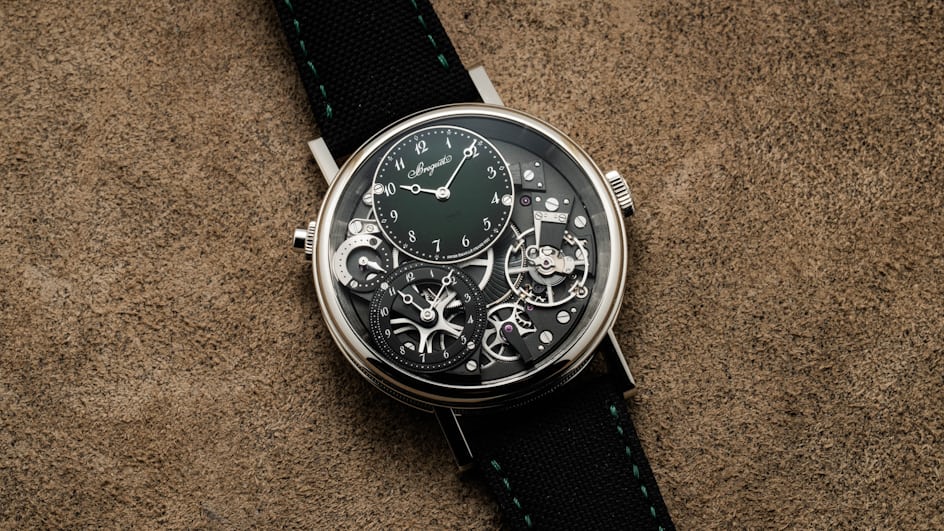
The first thing you notice when strapping on the 7067 is the case construction. Breguet uses a cold-rolled process to create the fluting on the case middle, a texture that feels incredible to the touch and hides the occasional micro-scratch from a shirt cuff. At 40mm in diameter, it occupies the 'Goldilocks' zone for modern collectors. However, at 12.65mm thick, it isn't exactly a 'thin' watch. Much of that height comes from the highly domed sapphire crystal, which is necessary to clear the three-dimensional movement components.
For those with a wrist size under 6.5 inches, the lugs are the main point of contention. Breguet’s signature straight lugs are welded to the case, and they extend outward before dropping. On my 6.75-inch wrist, the 48.2mm lug-to-lug measurement sat perfectly, with the lugs terminating just before the edge of my wrist. The result is a watch that feels 'present'—you never forget you’re wearing it, but it doesn’t rotate or slide, thanks to the grippy nature of the high-quality alligator strap.
Legibility and the Green Enamel Dial
Standard Tradition models often feature a small, hand-guilloché dial at 12 o'clock. While beautiful, the silver-on-silver aesthetic can occasionally wash out in bright sunlight. This is where the Green Enamel variant shines. The 'Grand Feu' enamel process involves firing glass powder at extreme temperatures, resulting in a deep, vitreous forest green that provides a stark, high-contrast backdrop for the white Breguet-style numerals and the 'pomme' hands.
The primary time is read at 12 o'clock, while a second time zone (GMT) is displayed on a smaller enamel sub-dial at 8 o'clock. During my week of testing, which included a quick trip across time zones, I found the legibility to be superior to almost any other skeletonized or open-worked watch on the market. The day/night indicator at 10 o'clock, which alternates between a sun and a moon, adds a romantic but functional touch that prevents you from calling home at 3:00 AM.
The Calibre 507 DRF: A Daily Companion
The movement is where the Tradition GMT justifies its price tag. The Calibre 507 DRF is a manual-wind engine that beats at a leisurely 21,600 vph. While some might prefer a high-beat movement, the slower frequency allows you to actually see the large balance wheel oscillating at 4 o'clock. It is hypnotic. The use of a silicon balance spring and silicon pallets in the escapement means that the watch is largely immune to the magnetic fields of modern life—laptops, tablets, and magnetic bag clasps.
The GMT function is adjusted via a screw-down pusher at 10 o'clock. This is a brilliant ergonomic choice. Unlike many GMTs where you have to pull the crown to a specific position, a simple click of the pusher advances the local time hour hand. It’s tactile, responsive, and can be done without even taking the watch off your wrist. The power reserve indicator is located on the back of the movement, visible through the sapphire caseback, which keeps the front-side architecture from feeling too cluttered.
The Real-World Wear Test
I wore the Tradition GMT through a variety of settings: a formal dinner, a series of board meetings, and even a casual weekend brunch. It is surprisingly versatile. In a suit, the rose gold and green enamel feel like a sophisticated power move. In a casual setting, the industrial, sandblasted finish of the movement plates gives it a 'steampunk' edge that pairs well with a cashmere sweater or a leather jacket.
However, there are caveats. The 30 meters of water resistance is a 'splash-only' rating. This is not a watch for a poolside lounge or a humid tropical hike. It is an urban explorer’s tool. Additionally, as a manual wind watch with a 50-hour reserve, you will need to develop the ritual of winding it every other morning. The crown is large and well-knurled, making this a pleasure rather than a chore, but it is something to consider if you are used to the set-and-forget nature of an automatic.
Investment and Value Proposition
At a retail price of approximately $41,500, the Breguet Tradition GMT sits in a competitive space. It is priced similarly to the Patek Philippe Calatrava or the Vacheron Constantin Patrimony. However, those are 'safe' choices. The Breguet is for the collector who wants to see the engineering. On the pre-owned market, the Tradition line is known for being a 'smart buy.' You can often find them in the mid-30s, where the value-for-money ratio becomes almost unbeatable. You are getting hand-finished components, a grand feu enamel dial, and a complication from one of the 'Big Three' historical houses.
Final Thoughts
The Breguet Tradition GMT Green Enamel is a triumph of design because it refuses to compromise. It doesn't hide its complexity; it celebrates it. For the young collector who values the 'wear' as much as the 'watch,' this piece offers a unique proposition: a high-horology complication that feels robust enough for the rigors of a modern schedule. It is a watch that invites conversation, demands a second look, and ultimately, rewards the wearer with a view of time that is as deep as the green enamel on its dial.