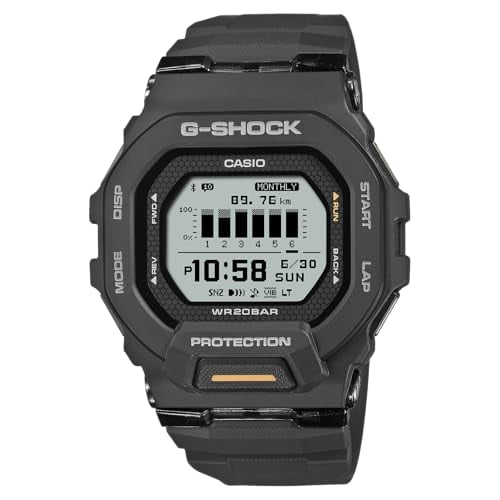
The Evolution of the Square: A New Era for G-Shock
For nearly four decades, the G-Shock 'Square' has been the gold standard for rugged timekeeping. From the original DW5000C to the solar-powered GWM5610, the silhouette has remained largely unchanged—a testament to Kikuo Ibe’s original vision. However, the introduction of the GBD200 marks a significant departure from the traditional twisted-nematic (TN) LCDs we have grown accustomed to. As a reviewer focused on the daily-wear experience, the GBD200 represents the most significant ergonomic and visual upgrade to the Square platform in years.
The MIP Revolution: Legibility Without Compromise
The standout feature of the GBD200 is, without question, the Memory-in-Pixel (MIP) display. Traditional digital watches rely on an LCD that requires a specific viewing angle and often struggles in direct sunlight or low-light conditions without a backlight. The MIP display functions more like an e-reader; it uses ambient light to provide incredible contrast. Whether you are in the harsh glare of high noon or the dim lighting of a cockpit, the GBD200 is legible from nearly 180 degrees.
In practice, this changes how you interact with the watch. There is no more flicking of the wrist or hunting for the light button during a morning jog. The high-resolution screen allows for smaller, crisper text, enabling Casio to pack more information—date, time, step count, and dual time—onto the home screen without it feeling cluttered. For the collector who appreciates the dial clarity of a Panerai or a Sinn, the GBD200 offers a digital equivalent that is equally satisfying.
Ergonomics and the 'Vivir' Week-on-the-Wrist Test
At Vivir, we believe a watch must earn its place through comfort. The GBD200 excels here by addressing the 'stiffness' often associated with resin straps. Casio has utilized a softer urethane for the GBD200, which feels more like silicone than the hard plastic of the DW5600. The inclusion of 'wings'—small resin inserts on the underside of the case—ensures that the watch contours to the wrist. This prevents the 'gap' that often occurs on smaller wrists, making the 48.4mm lug-to-lug feel significantly shorter.
During a week of testing, which included three gym sessions, a flight to Geneva, and daily office wear, the GBD200 proved its versatility. Its 15mm thickness is deceptive; because the case tapers toward the edges, it slides under a sweatshirt or a technical jacket with ease. While it won't replace a Cartier Tank under a French cuff, it is perfectly appropriate for the 'elevated casual' aesthetic favored by today’s young collectors.
The Software Experience: Smart, But Not Too Smart
The GBD200 sits in the 'G-SHOCK MOVE' category, meaning it features Bluetooth connectivity and an accelerometer. It is important to manage expectations here: this is not an Apple Watch. It provides notification alerts (calls, emails, texts), but reading them is a chore due to the multi-button navigation. However, the automatic time syncing via the app is a godsend for those of us who demand precision but don't live within range of a Multiband 6 radio tower.
The step tracker and interval timers are robust and easy to use. For the runner, the watch uses the phone's GPS to calibrate the internal accelerometer, eventually allowing for accurate distance tracking even when the phone is left at home. It is a 'smart-enough' watch that doesn't demand your attention with constant pings, allowing you to remain present in your surroundings.
Durability and Maintenance
True to its heritage, the GBD200 is a tank. The 200-meter water resistance means it is over-engineered for everything from swimming to recreational diving. The mineral crystal is recessed deep within the resin bezel, providing a natural 'roll cage' against impacts. While sapphire would be a welcome addition, at the $150 price point, the mineral glass is a fair compromise and is easily replaced if ever truly damaged.
Maintenance is refreshingly simple. Unlike rechargeable smartwatches that will eventually have a dead lithium-ion battery, the GBD200 runs on a standard CR2032 coin cell. You can expect about two years of life, and the replacement is a five-minute job with a screwdriver. This longevity is a core tenet of why we recommend Casio to our readers—it is a sustainable choice in a world of disposable electronics.
Final Thoughts
The Casio G-Shock GBD200 is a bridge between the analog past and the digital future. It retains the soul of the 1983 original while embracing the display technology of the 21st century. For the sophisticated collector, it serves as the perfect 'reset' watch—the one you put on when you want to stop worrying about scratches, service intervals, or winding. It is a masterclass in functional design, and it has earned a permanent spot in my travel kit.