The Architecture of Modernity: A Deep Dive into the H10334
In the world of high horology, few transformations have been as complete or as impressive as that of Chanel. Once seen as the purveyor of 'style over substance,' the manufacture at La Chaux-de-Fonds has spent the last decade proving that it can compete with the most established names in the Jura Mountains. The Chanel J12 Bleu Diamond Tourbillon, Reference H10334, is the latest proof of this evolution. It is a watch that demands to be judged not by the logo on the dial, but by the movement beating beneath the sapphire crystal.
The Caliber 5: A Circular Symphony
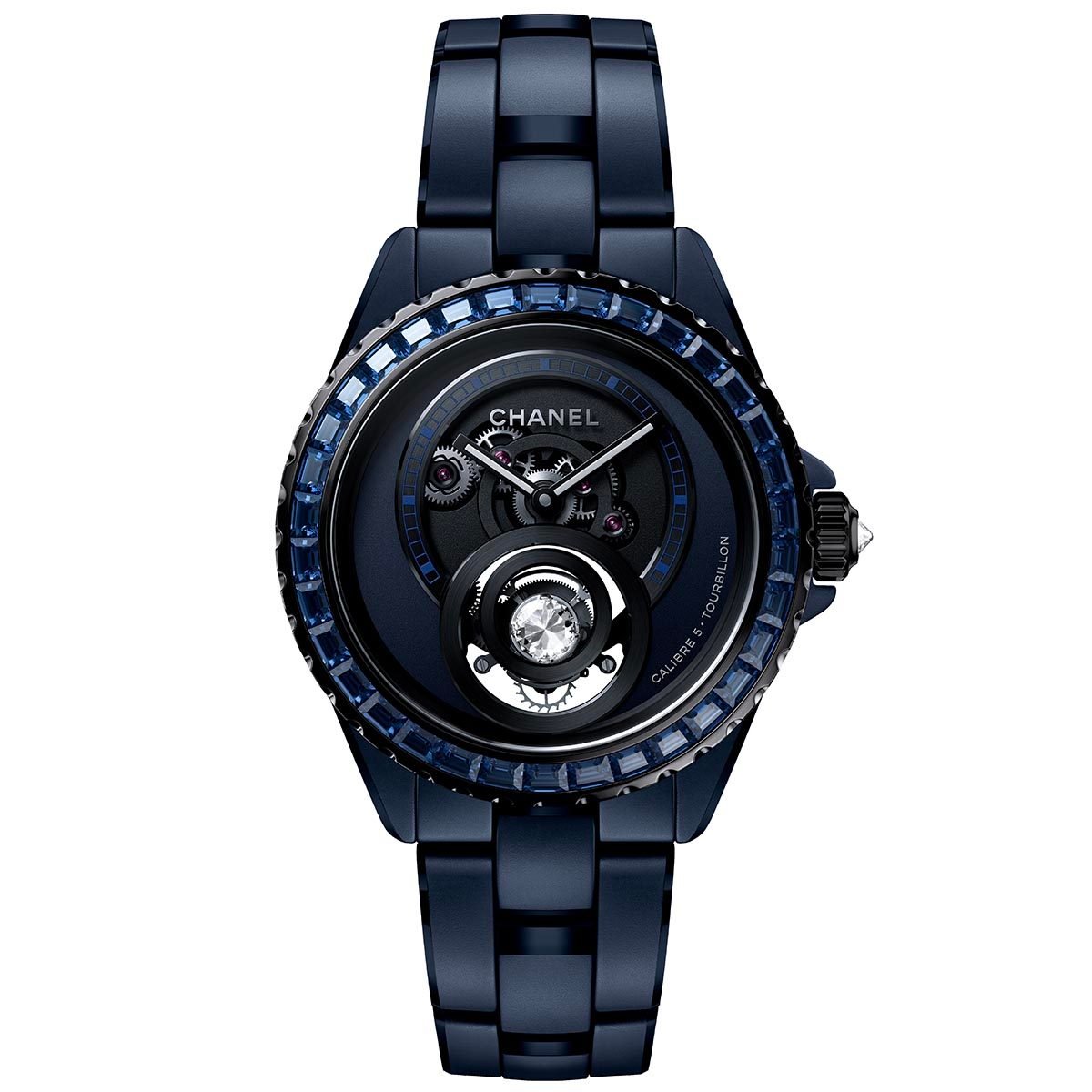
At the heart of the H10334 lies the Caliber 5. This is Chanel’s fifth in-house movement, and its first flying tourbillon. What distinguishes the Caliber 5 is its commitment to circularity. The movement architecture is composed of a series of concentric circles, visible through the open-worked dial. The bridges are treated with a black ADLC (Amorphous Diamond-Like Carbon) coating, providing a stark, architectural contrast to the blue ceramic case.
The flying tourbillon at 6 o’clock is the star of the show. Unlike a traditional tourbillon, a flying tourbillon is supported only from the bottom, giving the illusion that it is floating in space. Chanel has elevated this complication—quite literally—by mounting a 0.18-carat solitaire diamond on the tourbillon cage. The diamond is cut with 57 facets and rotates once every 60 seconds. The technical challenge of balancing the weight of a diamond on a delicate tourbillon cage cannot be overstated; it requires precise counter-weighting to ensure that the escapement's frequency remains stable at 4Hz (28,800 vph).
Material Mastery: The Blue Ceramic Case
Chanel essentially pioneered the use of high-tech ceramic in the early 2000s, and the H10334 showcases their continued leadership in this field. The matte blue ceramic used here is 'highly resistant,' a term Chanel uses to describe its specific formulation which is harder than steel but lighter and more thermally stable. The color is not a coating but is consistent throughout the material, achieved through a complex sintering process at temperatures exceeding 1,000 degrees Celsius.
The choice of a matte finish over the more common high-gloss ceramic is a sophisticated one. It gives the watch a more technical, instrument-like feel, while the blue hue—deep, like the ocean at dusk—provides a canvas that allows the diamond and the movement's black bridges to pop. The 38mm diameter is a masterstroke of proportions. It avoids the oversized 'statement' trend, opting instead for a size that fits comfortably on a variety of wrist shapes, emphasizing the watch's role as a piece of wearable art rather than a mere accessory.
Wrist Experience and Ergonomics
On the wrist, the J12 H10334 is a revelation of ergonomics. Ceramic is naturally hypoallergenic and smooth to the touch. The bracelet links are articulated with a fluidity that mimics the drape of fabric—a nod, perhaps, to the house's couture heritage. The watch weighs significantly less than a gold or platinum equivalent, yet it retains a sense of 'presence' due to the mechanical density of the movement.
The lack of a traditional dial—replaced by the skeletonized view of the Caliber 5—means that the wearer is constantly engaged with the mechanical heartbeat of the watch. The legibility is surprisingly good for a skeletonized piece, thanks to the lancet-shaped hands that are treated with a polished finish to catch the light against the matte background. However, it should be noted that there is no luminous material; this is a watch designed for the light of a gallery or a boardroom, not the darkness of a diving expedition.
The Verdict for the Modern Collector
The Chanel J12 Bleu Diamond Tourbillon is a polarizing piece, but for all the right reasons. It challenges the traditional notions of what a 'manufacture' watch should look like. It replaces the traditional Côtes de Genève and perlage with ADLC and circular geometry. It replaces the heavy metal case with high-tech ceramic. And it does so with a level of finishing and technical competence that is beyond reproach.
For the sophisticated young collector—the 'Vivir' reader who values both the heritage of the past and the technology of the future—the H10334 represents a rare opportunity. It is a limited edition that is unlikely to be seen twice in the same room, powered by a movement that is as much a feat of engineering as it is a work of jewelry. In the H10334, Chanel hasn't just made a watch; they have made a statement about where high horology is headed.