The Intersection of Art and Astronomy
The Van Cleef & Arpels Midnight Planetarium, reference VCARO4J000, is a testament to the enduring fascination humanity holds for the heavens. While many luxury watchmakers attempt to capture the stars through simple moon phase indicators or static celestial charts, the Midnight Planetarium attempts something far more ambitious: the mechanical recreation of our solar system's inner workings. To achieve this, Van Cleef & Arpels turned to the one man capable of translating such vast scales into the confines of a 44mm case—Christiaan van der Klaauw.
Movement Architecture: The Van der Klaauw Module
At the heart of the VCARO4J000 lies a self-winding mechanical movement that serves as the foundation for an incredibly complex astronomical module. This module, comprising 396 individual components, is the result of years of research and development. Unlike a traditional movement where gears drive hands at fixed ratios of 1:12 or 1:60, the gearing in the Planetarium must account for the vastly different orbital periods of the planets.
The precision required is staggering. Each planet is mounted on its own aventurine disc, driven by a series of epicyclic gears. The rotation speeds are calibrated as follows:
- Mercury: 88 days
- Venus: 224 days
- Earth: 365 days
- Mars: 687 days
- Jupiter: 11.86 years
- Saturn: 29.46 years
To witness the movement of Saturn on the dial is to witness a gear train that moves so slowly it is almost imperceptible to the human eye, yet it remains in constant, precise motion. This is the hallmark of Van der Klaauw’s genius—the ability to maintain torque and precision across such a wide range of gear ratios without compromising the 48-hour power reserve of the base caliber.
A Dial of Celestial Depth
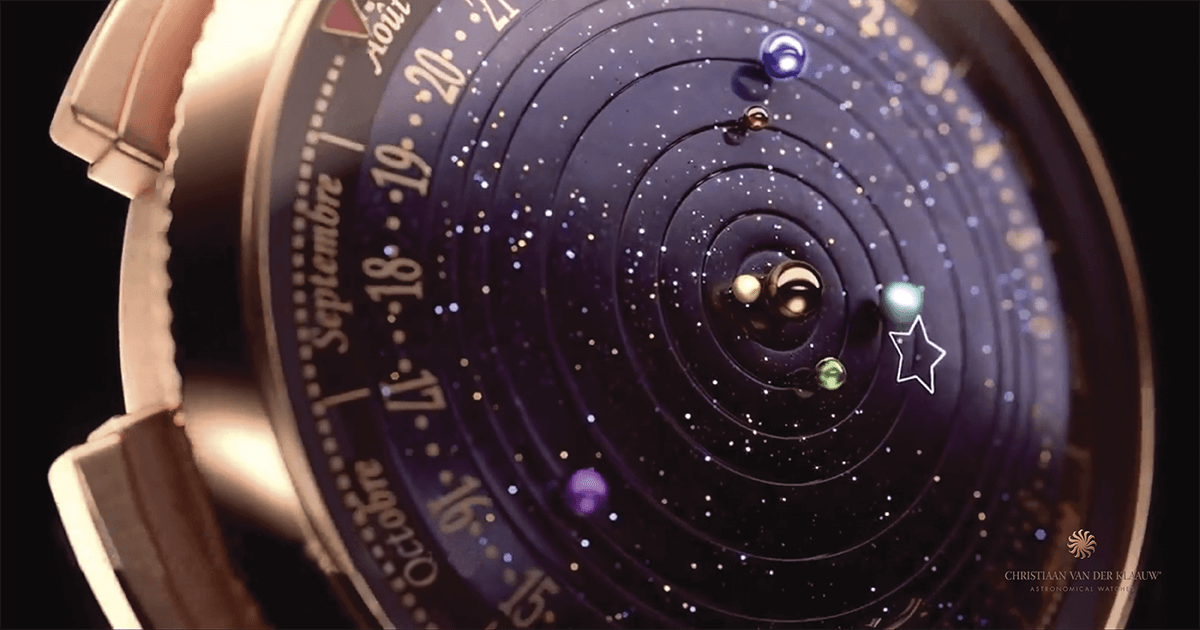
The aesthetic execution of the dial is as technically demanding as the movement itself. The backdrop is crafted from midnight blue aventurine glass, also known as goldstone. This material, which originated in 17th-century Murano, involves a complex process of cooling molten glass infused with copper filings to create a shimmering, star-like effect. In the Midnight Planetarium, several concentric discs of aventurine must be perfectly aligned and balanced to allow for the independent rotation of the planets.
The planets themselves are represented by meticulously carved semi-precious stones, chosen for their evocative colors:
- Mercury: Serpentine
- Venus: Chloromelanite
- Earth: Turquoise
- Mars: Red Jasper
- Jupiter: Blue Agate
- Saturn: Sugilite
The Sun, positioned at the center of the dial, is rendered in polished 18k pink gold. The time is indicated not by hands, but by a shooting star in rose gold that migrates along the outermost scale of the dial, which features a 24-hour track. This design choice reinforces the theme that on this watch, the passage of hours is merely a peripheral event compared to the grand dance of the planets.
The Lucky Star and Calendar Functions
Beyond the planetary orbits, the VCARO4J000 incorporates a 'Lucky Star' complication. By using the rotating bezel, the wearer can position a small triangular marker over a specific date of the year on the outer sapphire crystal. On that chosen day, the Earth—represented by the turquoise sphere—will move directly under the star, symbolizing a day of personal significance or 'luck.' This adds a layer of romanticism to the technical rigor of the watch.
On the case back, the astronomical theme continues. Two apertures display the day, month, and year, set via two push-pieces on the case side. The winding rotor is also a work of art, featuring a sunray finish and an engraved celestial map, visible through the sapphire crystal case back. The finishing across the bridges and the rotor meets the highest standards of haute horlogerie, with clean anglage and perlage that reflect the watch's six-figure pedigree.
Case Geometry and Ergonomics
The 44mm case is crafted from 18k pink gold, polished to a mirror finish. Given the complexity of the module, the 13mm thickness is remarkably contained. The bezel is thin, maximizing the dial aperture and creating an immersive 'porthole' effect into space. The crown at 3 o'clock is used for winding and time setting, while the bezel controls the 'Lucky Star' function. The integrated lugs are short and steeply raked, which is essential for a watch of this diameter to sit comfortably on the wrist. The choice of a black alligator strap with a pink gold folding clasp ensures that the watch remains secure, providing a classic contrast to the vibrant blue of the aventurine dial.
Investment and Collectibility
From an investment perspective, the Midnight Planetarium occupies a unique niche. It is not a high-volume production piece. The labor required to assemble the module and the artisanal skill needed to craft the aventurine and gemstone dial limit annual production significantly. While the MSRP of approximately $245,000 places it in the realm of the ultra-wealthy, its value has remained remarkably stable on the secondary market. Unlike more trend-driven luxury watches, the VCARO4J000 is a 'legacy' complication. Its appeal is rooted in fundamental science and timeless craft, making it less susceptible to the whims of fashion.
Final Thoughts
The Christiaan van der Klaauw Midnight Planetarium for Van Cleef & Arpels is a triumph of horological storytelling. It succeeds because it does not compromise on either its technical or its aesthetic ambitions. For the collector who values the mechanical representation of the universe, there is no finer expression. It is a reminder that while we use watches to keep our schedules, time itself belongs to the stars. The VCARO4J000 is, quite literally, a world apart.