The Dutch Master of the Stars
To understand the Christiaan van der Klaauw Planetarium, one must first understand the landscape of Dutch horology. Unlike the Swiss, who often focus on the industrialization of perfection, the Dutch have a long history of astronomical precision—think Christiaan Huygens and the pendulum clock. Christiaan van der Klaauw founded his atelier in 1974 with a singular focus: to track the heavens on the wrist. This isn't just marketing; it's a lifelong obsession that has earned him a spot in the AHCI (Académie Horlogère des Créateurs Indépendants).
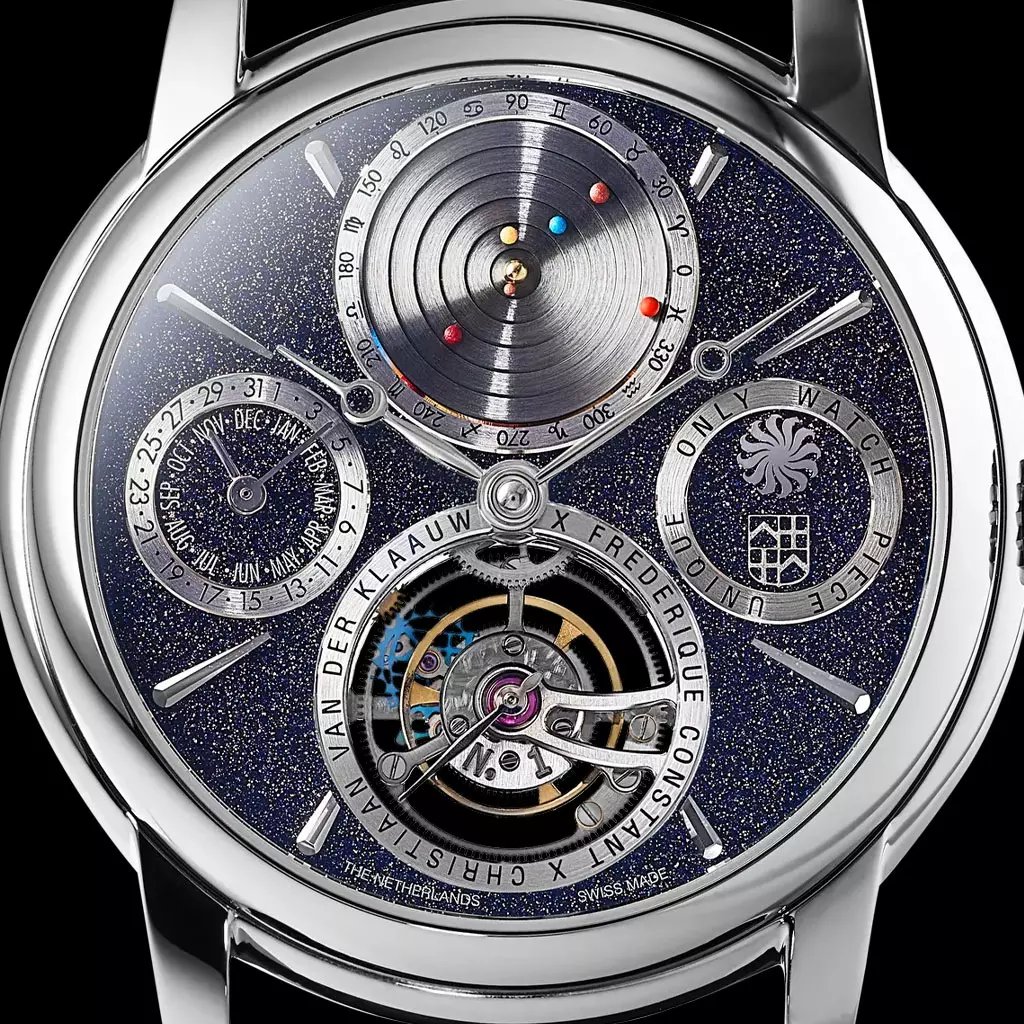
The Planetarium is the crown jewel of this legacy. It doesn't just tell you the time; it tells you where you are in the solar system. At the 6 o'clock position sits a mechanical heliocentric planetarium. It displays the real-time orbits of Mercury, Venus, Earth, Mars, Jupiter, and Saturn around the Sun. To see these tiny spheres move—some taking years to complete a single rotation—is to be reminded of the slow, majestic pace of the universe.
Movement: The CVDK7386 Heartbeat
Under the hood, the Planetarium utilizes the Caliber CVDK7386. While the base is a modified high-end Swiss caliber, the magic happens in the module developed in-house by CvdK. This module is the world's smallest mechanical planetarium. The engineering required to gear down the movement to match the orbital period of Saturn (which takes 29.46 years to orbit the sun) is nothing short of miraculous.
The movement also features twin barrels, providing a 96-hour power reserve. This is crucial for a watch with this many complications; you don't want the universe to stop just because you didn't wear the watch for a weekend. The finishing is exemplary, with a custom rotor often featuring the brand's signature 'Sun with 12 claws' logo, visible through a sapphire caseback.
Design and Aesthetics: Aventurine and Gold
Visually, the Planetarium is a feast. The most sought-after versions feature a Midnight Blue aventurine glass dial. Aventurine, with its metallic inclusions, looks exactly like a star-filled sky. Against this backdrop, the gold planetary discs and the sun at the center of the planetarium module pop with a celestial glow. The upper half of the dial handles the more mundane tasks of timekeeping, with a date and month indicator that frames the brand's logo.
The case, typically 40mm, is available in stainless steel, rose gold, or platinum. The lugs are a standout feature—bold, stepped, and reminiscent of classical architecture. This is a watch that looks as good in a boardroom as it does at an evening gala at the Louvre. It is sophisticated, rare, and carries a 'if you know, you know' status that few other brands can match.
The Cultural Context: Why Now?
Why are we seeing a surge in interest for CvdK? It's the 'Indie' effect. Young collectors are moving away from the 'Instagram watches'—the ones everyone recognizes from a distance. There is a growing desire for watches that tell a story, that require explanation, and that demonstrate a level of hand-craftsmanship that mass-produced luxury brands simply cannot provide. The Planetarium is the antithesis of the 'fast fashion' luxury world. It is slow, deliberate, and deeply academic.
Investment and Value
At a retail price of around $52,000 for the rose gold version, the Planetarium is a significant investment. However, compared to other high-complication pieces from the 'Holy Trinity' (Patek, AP, Vacheron), it offers incredible value. You are buying a piece of independent horology that is produced in very limited numbers. As the brand continues to gain international recognition, the secondary market for these pieces has remained incredibly strong, with some rare configurations even appreciating.
The Verdict
The Christiaan van der Klaauw Planetarium is not for everyone. It’s thick, it’s expensive to service, and it doesn't have the name recognition of a Rolex. But for the collector who wants to own a literal piece of the cosmos, there is no substitute. It is a masterpiece of Dutch engineering and a testament to what can be achieved when a watchmaker looks to the stars for inspiration. It is, quite simply, the ultimate astronomical timepiece.