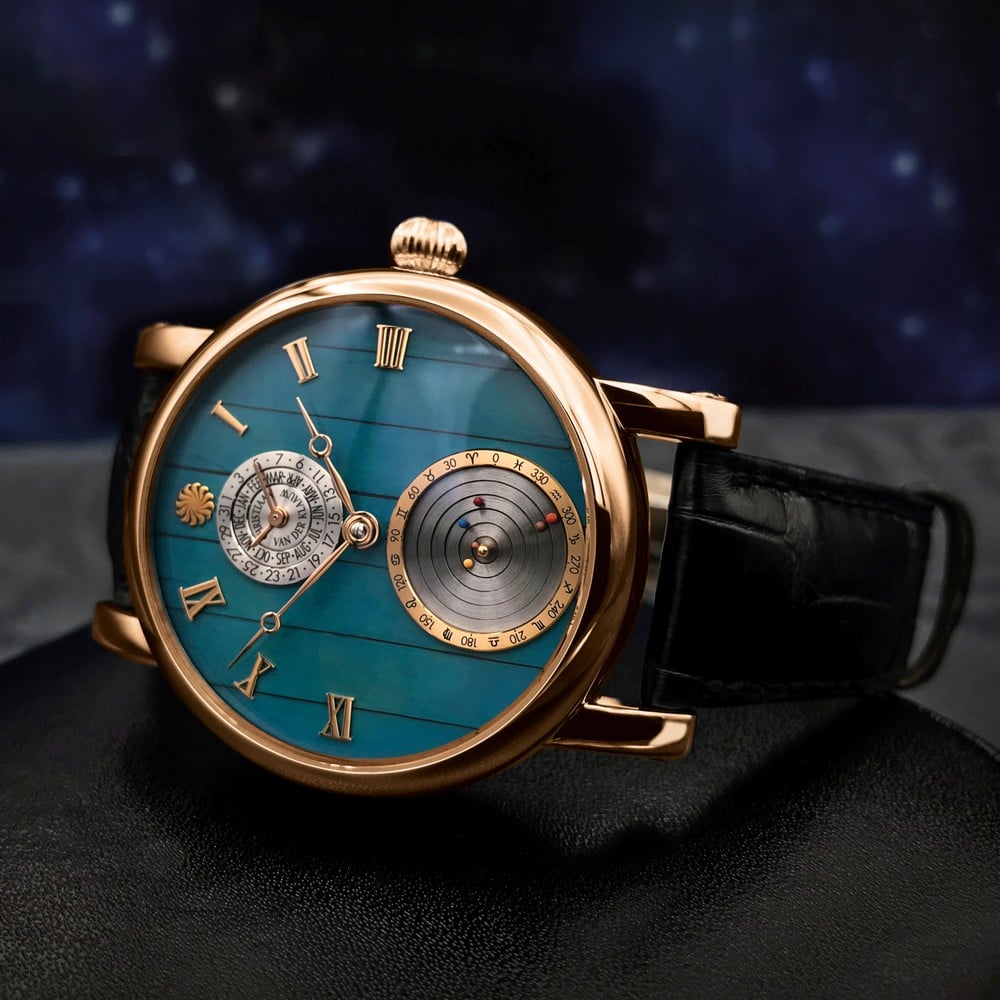
Christiaan van der Klaauw Planetarium Eise Eisinga: A Celestial Microcosm on the Wrist
In the rarefied realm of astronomical complications, Christiaan van der Klaauw stands as a singular luminary. The Dutch manufacture, renowned for its dedication to celestial mechanics, presents the Planetarium Eise Eisinga, reference CVDK7386 – a timepiece that transcends mere time-telling to become a dynamic, wearable model of our solar system. This is not merely a watch; it is a meticulously engineered testament to humanity's enduring fascination with the cosmos.
Named in homage to Eise Eisinga, the Dutch amateur astronomer who constructed the oldest working planetarium in the world within his own living room in the late 18th century, this watch embodies a similar spirit of ingenious precision and profound wonder. It captures the essence of that historical marvel, miniaturizing the celestial dance onto the wrist of a discerning collector. For those who appreciate the confluence of historical ingenuity, mechanical artistry, and astronomical accuracy, the Planetarium Eise Eisinga offers an unparalleled experience.
Manufacture History: A Legacy of Astronomical Precision
Founded in 1974 by Christiaan van der Klaauw himself, in the pastoral landscapes of Joure, Netherlands, the brand swiftly carved a unique niche in the watchmaking world. From its inception, CVDK committed itself exclusively to the creation of astronomical timepieces, a specialization that remains unparalleled. This unwavering focus has allowed the manufacture to develop some of the most intricate and precise celestial complications ever housed within a wristwatch. The brand's philosophy is rooted in a deep respect for classical astronomy and horological innovation, a combination that resonates profoundly in models like the Planetarium Eise Eisinga, making them not just instruments of time, but instruments of the universe.
The Movement: Heart of the Cosmos
At the core of the Planetarium Eise Eisinga, reference CVDK7386, beats the automatic Caliber CVDK7386. This movement is a testament to Christiaan van der Klaauw's engineering prowess, skillfully integrating an in-house developed Planetarium module onto a robust ETA 2892-A2 base. While the base movement provides a reliable foundation, the true horological marvel is the proprietary module that brings the solar system to life.
The movement operates at a frequency of 28,800 vph (4 Hz), ensuring stable timekeeping, and offers a practical 38-hour power reserve. It comprises 35 jewels in total, a figure reflecting the additional complexity introduced by the Planetarium module's numerous gears and pinions. The complications are nothing short of breathtaking: in addition to standard hours and minutes, it features a fully functional planetarium display, meticulously tracking the orbits of Mercury, Venus, Earth, Mars, Jupiter, and Saturn around a central golden sun. Furthermore, Earth is accompanied by its own orbiting moon, completing a full revolution every 29.5 days. A subtle date sub-dial is also integrated, ensuring daily utility.
While not a COSC-certified chronometer, the movement's accuracy is more critically observed in the fidelity of its astronomical indications. Saturn, for instance, completes its orbit in a staggering 29.46 years, Jupiter in 11.86 years, Mars in 687 days, Earth in 365 days, Venus in 224 days, and Mercury in just 88 days. The engineering required to miniaturize and synchronize these complex, disparate cycles within a wristwatch is an extraordinary feat of micro-mechanics. The movement is considered in-house due to the unique and proprietary Planetarium module, which is the defining characteristic of the watch.
Visible through the sapphire caseback, the finishing of the Caliber CVDK7386 is executed to a high standard, befitting its high-horology status. Bridges are adorned with elegant Côtes de Genève, while the mainplate features delicate perlage. All screws are thermally blued, and critical edges are meticulously chamfered and polished (anglage). This attention to detail underscores the manufacture's commitment to both mechanical performance and aesthetic refinement, revealing a movement that is as beautiful to behold as it is complex in operation.
Design and Aesthetics: A Celestial Canvas
The external presentation of the Planetarium Eise Eisinga, reference CVDK7386, is as captivating as its internal mechanics. The 40mm case diameter strikes a perfect balance, offering a substantial presence while remaining eminently wearable as a sophisticated dress watch. Crafted from lustrous 18K Rose Gold, the case exudes warmth and luxury. Its 13.5mm thickness is a necessary consequence of accommodating the multi-layered planetarium module, yet it is beautifully integrated, giving the watch a distinguished profile rather than an unwieldy one. The lug-to-lug measurement of approximately 48mm ensures a comfortable fit on a wide range of wrists.
The dial is the true star of this celestial show. It is typically rendered in a deep, mesmerizing blue aventurine, speckled with glittering inclusions that evoke the vastness of a starry night sky. This cosmic backdrop serves as the perfect stage for the miniature, three-dimensional planets. Each planet is represented by a small sphere, precisely positioned and orbiting its central, golden sun. The Earth, distinguished by its blue sphere and accompanied by its tiny moon, provides a focal point, reminding the wearer of our place within this grand cosmic dance. The dauphine hands, often gold-plated to match the case, provide clear legibility against the dynamic dial, while the date sub-dial is subtly integrated without detracting from the main spectacle.
The watch is protected by a scratch-resistant sapphire crystal, ensuring an unobstructed view of the intricate display. Water resistance is rated at a practical 30 meters (3 ATM), suitable for everyday wear but not intended for swimming or diving—a common characteristic for high-complication dress watches. There is no lume, as this is a timepiece designed for appreciation in well-lit environments, where its intricate details can be fully admired. The watch is typically paired with a luxurious alligator leather strap, often in a complementary blue or black, secured by a matching deployant clasp in 18K rose gold, completing the ensemble with comfort and elegance.
On the Wrist: Experiencing the Universe
Wearing the Christiaan van der Klaauw Planetarium Eise Eisinga is an experience unlike any other. The 18K rose gold case provides a satisfying weight that communicates quality and substance without being overly heavy. The 40mm diameter and carefully sculpted lugs ensure the watch sits perfectly on the wrist, with the high-quality alligator leather strap conforming comfortably over time. The 13.5mm thickness, while noticeable, is proportionate to the watch's diameter and is a small concession for the extraordinary mechanical marvel it contains. It's a watch that feels substantial and purposeful, yet refined.
The true magic, however, lies in the visual engagement. The aventurine dial, with its sparkling depths, creates an immediate sense of wonder. To glance down and witness the slow, deliberate orbits of Mercury, Venus, Earth, Mars, Jupiter, and Saturn, along with our own moon, is to carry a microcosm of the universe on your wrist. It serves as a constant, elegant reminder of celestial mechanics and our place within the cosmos. This profound sense of connection and the sheer beauty of the display elevate the wrist feel from mere comfort to an immersive horological journey. Its Wrist Presence is undeniably 5/5; it commands attention and sparks conversation, not through ostentation, but through its sheer mechanical and aesthetic brilliance.
Accuracy and Practicality
While the underlying ETA base movement provides reliable timekeeping, the horological raison d'être of the Planetarium Eise Eisinga is its astronomical accuracy. The intricate gearing ensures that the planets and moon complete their cycles with remarkable fidelity to their actual orbital periods. This level of mechanical precision, calculating and displaying celestial movements over decades, is the true measure of its accuracy. In day-to-day use, the automatic movement can be expected to maintain time within typical luxury watch parameters, generally within +/- 5-10 seconds per day. Setting the planetarium initially requires careful attention to the current positions of the celestial bodies, but once set, it operates autonomously, providing a continuous, long-term display of the solar system.
The watch is best suited for formal and dress occasions, as well as exclusive gala events, where its unique complication and exquisite craftsmanship can be fully appreciated. Its 30-meter water resistance means it should be kept away from water activities, reinforcing its role as a sophisticated statement piece rather than a utilitarian daily beater. Despite its complexity, the time and date functions are straightforward to operate, making it a surprisingly practical high complication for the discerning collector.
Value Proposition and Collectibility
The Christiaan van der Klaauw Planetarium Eise Eisinga, reference CVDK7386, occupies a unique position in the market. With an MSRP of approximately $75,000 USD for the 18K rose gold variant, and a similar current retail price, it is firmly positioned in the upper echelons of independent high horology. In the pre-owned market, prices typically range from $55,000-$70,000 USD, reflecting a relatively stable trend. This stability is largely due to the brand's niche appeal, the exceptional complexity of its complications, and its limited production numbers.
For collectors, the Planetarium Eise Eisinga represents a significant acquisition in independent high horology. Its hold recommendation is strong for those who appreciate unique mechanical narratives and astronomical artistry. While it may not offer the rapid appreciation seen in some mainstream luxury sports watches, its inherent rarity and specialized complication ensure it will likely maintain its value, serving as a cherished heirloom rather than a speculative asset. There is no major public auction history specifically for the CVDK7386, which is common for such highly specialized, lower-production models, though other CVDK Planetarium models have consistently achieved strong prices within their segment, underscoring the brand's respected standing among collectors of unique complications.
Servicing and Longevity
Given the extraordinary complexity of the Planetarium module, proper maintenance is paramount for the longevity of the Christiaan van der Klaauw Planetarium Eise Eisinga. A service interval of approximately 5 years is recommended. Due to the highly specialized nature of the movement and its unique complication, servicing requires authorized personnel only. The manufacture or an accredited service center with specific training for CVDK's astronomical modules is essential. The approximate cost for a full service is around $1,800 USD, a reflection of the intricate disassembly, cleaning, lubrication, and reassembly required for such a sophisticated mechanism. This specialized servicing ensures the continued precise operation of both the timekeeping and astronomical displays for generations to come.
Final Verdict
The Christiaan van der Klaauw Planetarium Eise Eisinga, reference CVDK7386, is more than a time-telling instrument; it is a profound philosophical statement, a miniature universe meticulously crafted for the wrist. Its exceptional mechanical planetarium, combined with exquisite finishing and a compelling historical narrative, solidifies its position as a masterpiece of high horology. For collectors seeking a watch that pushes the boundaries of mechanical ingenuity and embodies a deep reverence for the cosmos, this timepiece is an unparalleled choice, a constant source of wonder and intellectual engagement.