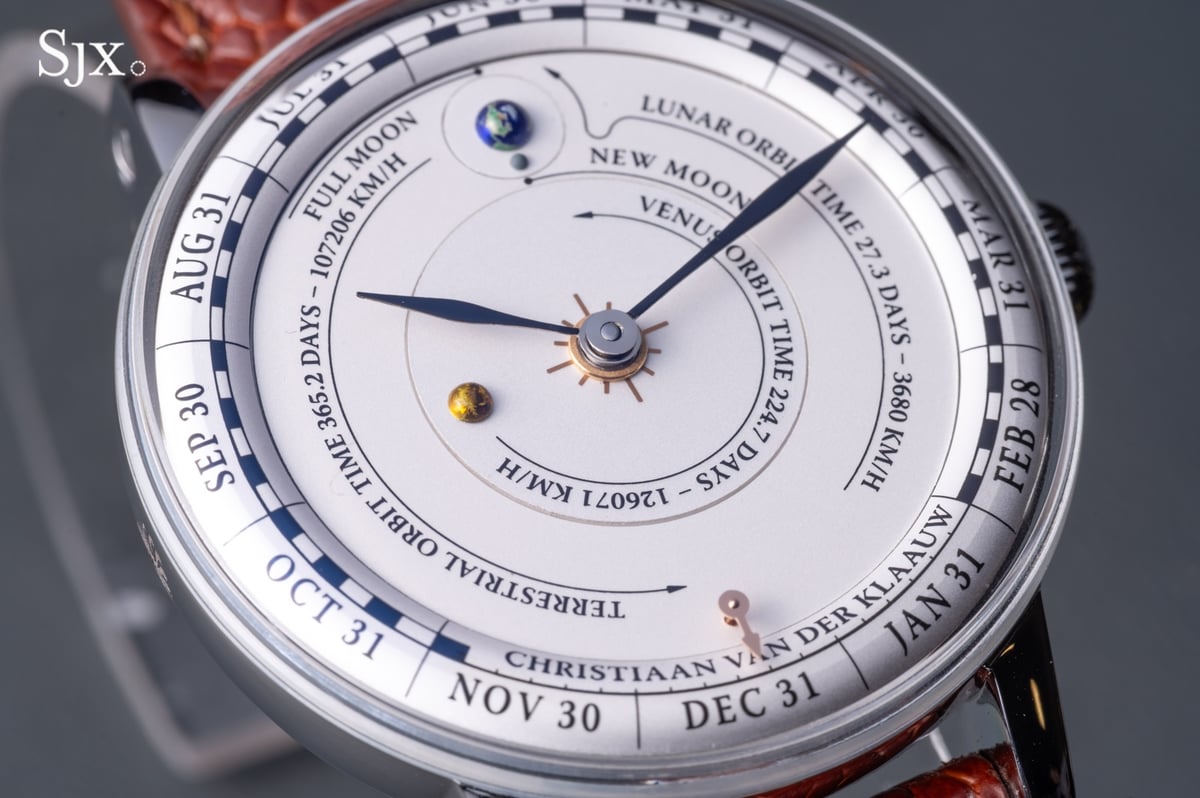
Christiaan van der Klaauw is the quietest famous name in Dutch watchmaking. From an atelier in Leiden, the maison has spent five decades turning orbital mechanics into gear trains — planetariums, real-moon phases, tide indicators. The Venus Annual Calendar, reference CKVN3335, is the piece in that catalogue that asks to be worn rather than displayed.
That distinction matters more than it sounds. Most astronomical watches are objects of occasional admiration: you set them, you admire them, you put them back. An annual calendar is different. It is a complication that pays rent — set it once and it handles the thirty-day months for you, right up until February. Combine that with a dial that does something genuinely unusual and you have a watch with a reason to be on a wrist on an ordinary Tuesday.
What follows is a wear-focused review, and partly by necessity. CVDK does not publish a complete dimensional or technical data sheet for this reference, and we are not going to invent one. Where the maison is silent, we say so. Where the watch speaks for itself — on the wrist, in the hand, across a week of real use — we listen.
The house that watches the sky
Christiaan van der Klaauw founded his workshop in 1974, in Leiden. He came to wristwatches from clocks: astronomical table clocks, regulators and complicated pieces built for people who wanted the sky in a room rather than on an arm. In the late 1990s that work was translated into a wristwatch planetarium, widely described as the smallest mechanical planetarium made for the wrist — and it is that piece, more than any other, that established the house's reputation outside the Netherlands.
The founder has since passed, and the maison continues in Dutch hands, still building in very small numbers and still refusing to treat astronomy as decoration. That is the context you need before you look at the Venus Annual Calendar. This is not a brand that bolts a moon phase onto a stock dial and calls it celestial. When CVDK puts a planet on a watch, the gearing behind it is meant to correspond to something real.
The Venus line narrows that obsession to a single planet. Where the Planetarium tries to hold the whole solar system in one dial, Venus concentrates the idea — one body, one cycle, one story — and leaves room for something the Planetarium does not offer: a calendar you can actually use.
What the Venus Annual Calendar actually is
Strip away the poetry and the CKVN3335 is a dress watch with two jobs. The first is the astronomical display that gives the family its name. The second is an annual calendar, which is the most underrated complication in watchmaking: it knows which months have thirty days, and it only asks to be corrected once a year, at the end of February.
That combination is rarer than it should be. Perpetual calendars are the flex, but they are also expensive, fragile in the wrong hands and often awkward to read. Annual calendars sit in a sweet spot — mechanically interesting, genuinely useful and visually calmer. Put one underneath an astronomical display and you have a dial that is doing real work without looking like a cockpit.
CVDK's dial language is consistent across the collection: deep, textured surfaces, applied markers, slim hands and small apertures that reveal information rather than shout it. The Venus Annual Calendar follows that grammar. The astronomical element is the focal point; the calendar information is placed so that it can be found rather than stumbled over. In daylight, reading the calendar is a glance, not a squint. In low light there is nothing to read by — this watch has no luminous treatment at all, and that is a deliberate choice rather than an oversight. It is a watch for lit rooms and daylight.
The crystal is sapphire, and the dial sits under it with the kind of depth that makes a textured surface change character as you move your wrist. That is the thing photographs of this watch cannot convey. It is not a flat dial with a picture on it; it is a dial with a surface, and the light moves across it.
There is also something worth saying about the concept itself. Wearing a planet on your wrist is a different proposition from wearing a moon phase. A moon phase is a familiar romantic gesture. A Venus display is a piece of astronomy that most people have never thought about, and it invites a question rather than a compliment. That is either the whole appeal or a dealbreaker, depending on the kind of collector you are.
On the wrist: what a week actually feels like
Astronomical watches have a reputation problem. The assumption is that anything with a module inside it must wear like a brick — tall, top-heavy, prone to catching on a cuff. That assumption is worth testing against the Venus Annual Calendar, because the architecture of the watch is dictated by the module, and CVDK has spent a long time learning how to build around one.
The honest answer is that this wears as a dress watch, not as a piece of equipment. It sits close, it disappears under a shirt cuff, and it does not announce itself with mass. The dial is the heaviest visual element; the case is deliberately quiet. If you are used to sports watches, the first hour will feel like you have forgotten to put a watch on. By day three, that is the point.
We are not going to quote you a case diameter, a thickness or a lug-to-lug figure, because CVDK does not publish them for this reference and a made-up number is worse than no number. What we can tell you is what the wearing character is: low, balanced and biased toward the wrist rather than away from it. The strap is leather as delivered, and it is the right call — a bracelet would fight the dial for attention and add weight where the watch does not need it. The clasp is a pin buckle, which keeps the profile slim and the strap supple; if you prefer a deployant, that is a conversation to have with your dealer at the point of order.
Comfort over a full week was, frankly, uneventful — and that is the highest compliment a dress watch can receive. No hot spots, no rotation on the wrist, no need to fiddle. The one thing to plan around is water. CVDK does not publish a water-resistance rating for this reference, and we would not treat it as a watch you swim in regardless. This is a watch you take off before you do the dishes.
The movement
Here is where the review has to be honest about the limits of published information. The Venus Annual Calendar is an automatic, and its astronomical module is the work of the house — that much is core to what CVDK is. But the maison does not publish the base calibre designation, the frequency, the power reserve or the jewel count for this reference, and we are not going to fill those gaps with plausible-sounding numbers.
What can be said is architectural rather than numerical. Astronomical complications are gearing problems, and CVDK's specialism is reducing long periods into compact, reliable trains. The module is the intellectual content of the watch; the base movement is the engine that carries it. Finishing is done in the house's own idiom, and assembly and regulation happen in the Netherlands, which matters more than most buyers realise — it means the people who built the complication are the people who can explain it to you.
Treat the movement as a long-term relationship rather than a spec-sheet comparison. If you need to know the frequency before you can enjoy a watch, this is not the watch for you.
Accuracy in the real world
CVDK does not submit this reference for chronometric certification, and no rate specification is published. That is not a red flag — it is simply how small houses operate. In practice, a well-regulated automatic base driving a low-friction calendar and astronomical module should hold within a handful of seconds a day, and it should do so consistently rather than dramatically. Expect it to be a watch you set once a month out of habit rather than necessity.
The annual calendar itself is the part that demands discipline. Do not adjust the date in the hours around midnight — the general rule of roughly nine in the evening to three in the morning applies here as it does to every calendar mechanism. Set it in daylight hours, set it forward rather than backward where you can, and it will behave for years.
Where it fits in a week
This is not a one-watch collection, and it does not pretend to be. It is the watch you wear to work when work involves a jacket, the watch you wear to dinner, the watch you wear to a wedding where you would rather not look like everyone else, and — genuinely — the watch you wear travelling, because an annual calendar is at its most useful when you cross a month boundary on a plane and cannot remember what day it is.
It is not a sports watch. There is no lume, there is no published water resistance, and there is no scenario in which you should take it to the gym. Accept that and the Venus Annual Calendar becomes one of the most broadly useful dress watches you can own; resist it and you will spend the week worrying.
Buying, owning, servicing
CVDK does not publish list pricing for this reference, and production is small enough that availability is a conversation rather than a transaction. That means the buying experience is closer to commissioning than shopping: you talk to a dealer or to the atelier, you confirm the configuration, you wait. We are not going to quote a number we cannot verify, and we would be suspicious of anyone who does so confidently.
On the secondary market, the picture is thin. CVDK is well known inside collector circles and almost unknown outside them, which cuts both ways: you are unlikely to find a bargain, and you are equally unlikely to see the value collapse. The realistic expectation is stability rather than appreciation. Buy it because you want to wear it, not because you want to sell it.
Servicing runs through the Dutch atelier and its small authorized network. This is not a watch to hand to a general watchmaker, however competent — the astronomical module is the reason the watch exists, and it should only be opened by people who understand it. Expect to send it home when it needs attention, and budget for the inconvenience as part of ownership.
If not this, then what
The obvious comparison is the Patek Philippe 5205G, which is the reference-grade annual calendar and the watch most collectors will mentally price against this one. The Patek is more conventional, more liquid and vastly more recognisable. The CVDK is stranger, rarer and more interesting to live with.
Jaeger-LeCoultre's Master Control Calendar is the quieter classical alternative, and Blancpain's Villeret Quantième Annuel occupies similar territory with a softer silhouette. If the astronomy is what pulls you in rather than the calendar, Van Cleef and Arpels' Midnight Planétarium is the other great astronomical wristwatch — at an entirely different altitude. And if you want the independence without the price, Ochs und Junior's annual calendar is the closest philosophical sibling: mechanically eccentric, quietly brilliant, and built by people who care more about the idea than the logo.
At the accessible end, Frederique Constant's Slimline Annual Calendar proves that a real annual calendar does not require a house deposit, though it offers none of the astronomical content. Longines' Master Collection complete calendar is the other mainstream entry point, though it is a triple calendar rather than an annual one.
Verdict
The Christiaan van der Klaauw Venus Annual Calendar is a watch that rewards the owner who does not need an audience. It combines two things that rarely share a dial — a genuinely unusual astronomical display and a complication you will use every month — and it does so in a case that disappears under a cuff and a dial that keeps giving after the honeymoon.
Its weaknesses are real: no lume, no published water resistance, no published technical specification, and a brand profile that will mean nothing to most of the people who see it. But those are the weaknesses of a specialist, not of a compromise. If you want a dress watch with a brain, and you are comfortable owning something that requires a conversation to explain, this is one of the more interesting ways to spend money in independent horology.