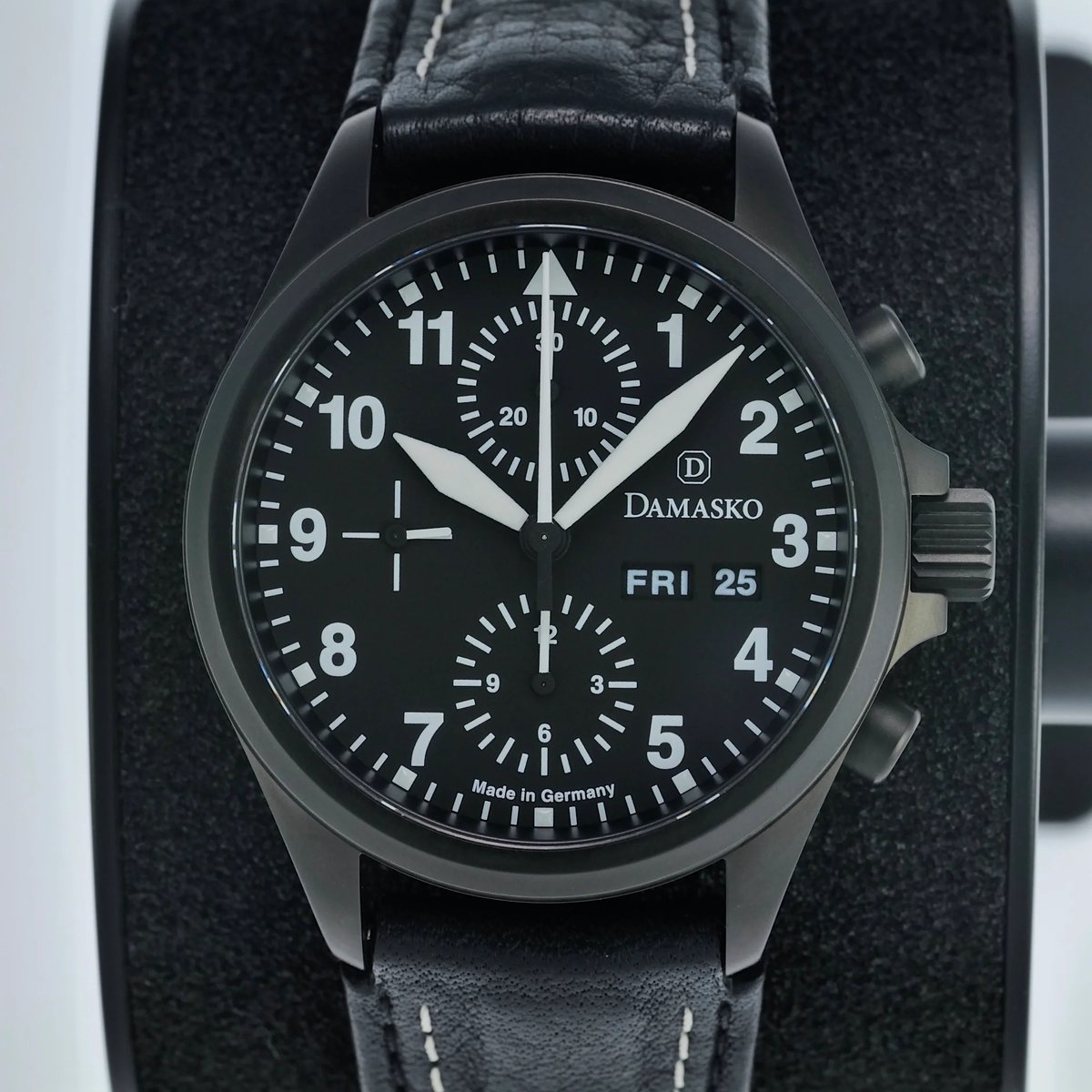
The Brutalist Beauty of Barbing
In the quiet town of Barbing, Germany, Damasko has been quietly disrupting the horological world for nearly three decades. While most watch brands focus on the artistry of the dial or the finishing of the bridges, Damasko focuses on the science of the case. The DC56 is the purest expression of this philosophy. It is a watch that doesn't just tell time; it survives time.
The DC56 gained international fame when it was selected as the official timepiece for the Eurofighter Typhoon test pilots. This wasn't a marketing deal involving millions of Euros; it was a selection based on a rigorous set of technical requirements. The pilots needed a watch that could withstand rapid decompression, extreme magnetic fields, and the physical shocks of a high-performance cockpit. The DC56 didn't just pass; it set a new standard.
Metallurgy as a Complication: Ice-Hardened Steel
The star of the show is Damasko’s patented ice-hardened stainless steel. Unlike 'tegimented' steel, which is a surface treatment, Damasko’s steel is hardened through and through to 60 Rockwell (HRC), or approximately 710 Vickers. This makes the case four times harder than standard 316L stainless steel. You can literally take a screwdriver to the case of a DC56 and it will not leave a mark.
This metallurgical prowess extends to the crown and pushers. The DC56 features a patented crown system that includes a lubrication cell—a permanent lubricant that ensures the gaskets never dry out or friction-weld. The crown is also decoupled, meaning it doesn't engage the movement until it is fully screwed in, preventing any accidental damage to the winding stem.
The Dial: A Study in Legibility
The dial of the DC56 is a masterclass in the Flieger aesthetic. It is a matte black surface with stark white Arabic numerals, providing the kind of high-contrast legibility required by aviators. The day-date complication at 3 o'clock is uniquely positioned just below the brand logo, a quirk of the 7750 layout that Damasko has embraced with perfect symmetry.
The sub-dials for the chronograph are recessed, adding a subtle depth to an otherwise flat, functional plane. The use of Luminova C1 ensures that the watch remains legible in low-light conditions, though it lacks the 'torch-like' brightness of a Seiko diver, opting instead for a steady, reliable glow that won't ruin a pilot's night vision.
The Movement: The Ever-Reliable Valjoux 7750
Inside the DC56 beats the Valjoux 7750. While some modern collectors might turn their noses up at a non-in-house caliber, there is a reason the 7750 remains the industry standard for tool chronographs. It is robust, easily serviced, and capable of incredible accuracy when properly regulated. Damasko doesn't just drop the movement in; they house it within a soft iron cage, providing anti-magnetic protection up to 80,000 A/m.
One cannot discuss the 7750 without mentioning the 'wobble.' Because the rotor only winds in one direction, it can spin freely in the other, creating a distinct vibration on the wrist. For fans of the DC56, this isn't a flaw—it's the heartbeat of a mechanical beast. It reminds you that you are wearing something alive, something mechanical, something that reacts to your every move.
Cultural Context: The Anti-Hype Hero
In the current market, where social media algorithms dictate which watches are 'hot,' the Damasko DC56 is a refreshing palate cleanser. It is the watch of choice for engineers, physicists, and military personnel—people who care about the 'how' and 'why' more than the 'who.' It fits perfectly into the 'Gorpcore' aesthetic—a trend of wearing high-performance outdoor gear in urban environments—but it does so without trying.
When you see a DC56 on someone's wrist at a watch meetup or a tech conference, it immediately starts a conversation. It’s a 'secret handshake' watch. It says that you’ve done your research, that you value durability over name recognition, and that you probably know exactly what 'Vickers hardness' means.
Conclusion: The Ultimate Tool
The Damasko DC56 is not for everyone. If you are looking for a watch with polished chamfers and a display caseback showing off Geneva stripes, look elsewhere. But if you want a watch that can survive a plane crash, a magnetic storm, and a decade of daily wear without showing a single scratch, the DC56 is in a class of its own. It is a testament to what happens when a company prioritizes engineering above all else. At roughly $2,000, it isn't just a great German watch; it's one of the best value propositions in the entire horological world.