Introduction
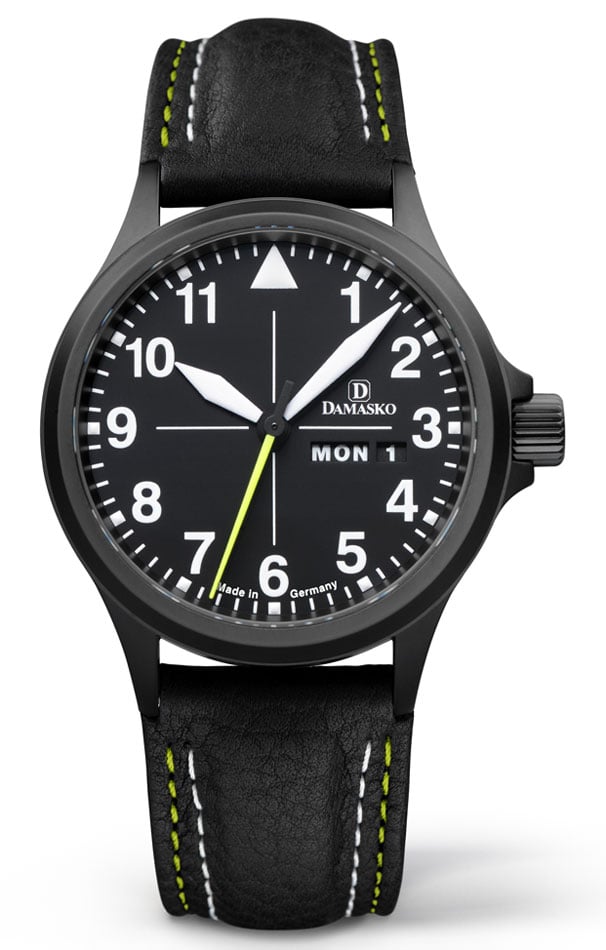
The Damasko DK36 is not a watch that screams for attention. It doesn't have a glossy ceramic bezel, a sunburst dial, or a bracelet that glints under boutique lighting. What it has is a case hardened to 60 HRC, a movement designed and built in-house, and a legibility that borders on the obsessive. After a week on the wrist, through rain, desk work, and a few accidental knocks against door frames, the DK36 proved itself to be the kind of watch you forget you're wearing—until you glance down and remember why you bought it.
Damasko has always been a brand for people who read spec sheets before they read marketing copy. Founded by Konrad Damasko in 1994, the company made its name with ice-hardened steel cases that resist scratches far better than standard 316L. The DK36 is one of the first models to pair that case technology with Damasko's own A26 movement, a step up from the ETA-based calibers of earlier models. The result is a watch that feels less like an assembled product and more like a single, coherent tool.
This review is not about how the DK36 looks in a display case. It's about how it wears on a real wrist, day after day, when you're not thinking about it. That's where the DK36 earns its keep.
Manufacture History
Damasko was founded in 1994 by Konrad Damasko in Regensburg, Germany. The company initially produced hardened steel components for the aerospace and medical industries, where scratch resistance and durability are non-negotiable. In the late 1990s, Damasko turned its attention to watchmaking, applying its proprietary ice-hardening process to watch cases. The result was a case that could withstand daily abuse without showing a single mark—a claim that few brands at any price can make.
The DK36 is a milestone for the brand. It is among the first Damasko models to use the in-house A26 movement, moving away from modified ETA calibers and toward full vertical integration. This shift gives Damasko control over every aspect of the watch, from the case to the balance wheel. For a company that built its reputation on engineering, the DK36 is a statement of independence.
Movement
Inside the DK36 beats the Damasko A26-1, a fully in-house automatic movement. It operates at 28,800 vibrations per hour, has 26 jewels, and offers a 42-hour power reserve. The movement features a bidirectional winding system, hacking seconds, and a quick-set date. There is no COSC certification, but Damasko regulates each movement in-house, and real-world accuracy is excellent—typically within ±3 seconds per day.
The A26-1 is not decorated to haute horlogerie standards, but it is clean and purposeful. The bridges have a light perlage, and the rotor is signed. More importantly, the movement is built for long-term reliability. It uses a balance bridge instead of a balance cock, which improves shock resistance, and a soft iron inner cage protects against magnetic fields. Serviceability is straightforward for any watchmaker familiar with ETA-based architectures.
Specifications
- Case diameter: 40mm
- Case thickness: 12.5mm
- Lug-to-lug: 48mm
- Case material: Ice-hardened stainless steel (60 HRC)
- Crystal: Sapphire, anti-reflective coating on both sides
- Water resistance: 100m
- Lume: Super-LumiNova on hands and hour markers
- Strap: Leather with pin buckle (steel bracelet optional)
Wrist Feel
On the wrist, the DK36 wears exactly as its dimensions suggest: present but never overbearing. The 40mm diameter is the sweet spot for a tool watch, and the 48mm lug-to-lug keeps the watch from overhanging on wrists down to about 6.5 inches. The case thickness of 12.5mm is moderate, but the slab-sided profile and flat sapphire crystal make it sit slightly tall on the wrist. That's not a flaw—it's a deliberate design choice that improves legibility and gives the watch a purposeful stance.
Comfort is excellent on the standard leather strap. The strap is thick but supple, and the pin buckle is simple and secure. The watch head itself is not heavy—around 80 grams without strap—so it doesn't pull or slide. The hardened steel case has a slightly matte, almost bead-blasted finish that feels cool to the touch and resists fingerprints. After a full day, there are no pressure points, no hair pulling, and no need to adjust the watch. It just stays put.
Accuracy
Damasko regulates the A26-1 in-house, and real-world performance reflects that. Over a week of daily wear, the DK36 ran consistently at +3 seconds per day, with no positional variance beyond +1/-1 second. That's well within chronometer territory, even though Damasko does not submit the A26-1 for COSC certification. Expect similar results from any properly serviced example. The movement is also resistant to shocks and magnetic fields, thanks to a soft iron inner cage and a balance bridge instead of a cock.
Occasions and Wrist Presence
The DK36 is a daily wearer first and foremost. It works with jeans and a t-shirt, but it also holds its own with a button-down shirt and chinos. It's not a dress watch—the matte black dial and tool-watch hands are too utilitarian for black tie—but it won't look out of place in a business casual office. For travel, the 100m water resistance and scratch-proof case make it an ideal companion. Wrist presence is a 4 out of 5: quiet confidence, not flash.
Reference Variants and Family
The DK36 is available in two configurations: on a leather strap with pin buckle, or on a hardened steel bracelet with a folding clasp. The bracelet adds about $300 to the price and increases the overall weight, but the hardened links resist scratches just like the case. Within the Damasko family, the DK36 sits alongside the DA36 (predecessor with ETA movement), the DK30 (smaller 39mm version without date), and the DC56 (chronograph sibling). Other notable Damasko models include the DS30 dive watch and the DA46 black PVD version.
Comparisons and Alternatives
If you're considering the DK36, you're likely also looking at the Sinn 556 I, the Archimede Pilot 39, and the Stowa Flieger Classic 40. The Sinn is a close competitor with a similar German tool watch aesthetic, but it uses a Sellita movement and a standard steel case. The Archimede offers a hardened case option but no in-house movement. The Stowa has a traditional flieger design and a top-grade ETA movement, but its case is not as scratch-resistant. For those on a budget, the Seiko 5 Sports SRPE and Orient Defender II offer a similar vibe at a fraction of the price, but they lack the Damasko's engineering pedigree.
Investment Value and Service
The DK36 has an MSRP of $1,900 on leather and $2,200 on the steel bracelet. Pre-owned examples typically sell for $1,200 to $1,800, which is a strong retention for a niche brand. The trend is stable—Damasko does not produce limited editions, so values don't spike, but they also don't crash. Service is recommended every 5 years at a cost of around $400. Independent watchmakers can service the A26, but authorized service ensures access to genuine parts and proper regulation.
Final Verdict
The Damasko DK36 is the rare watch that delivers exactly what it promises. It's not flashy, it's not romantic, and it won't impress your date unless she reads spec sheets. But after a week on the wrist, you'll understand why Damasko owners are so loyal. This is a watch built to be worn, not babied.