Quick take: The Dan Henry 1939 (ref. DH39-C01) is a vintage-military three-hander that nails the mood of a 1930s field watch without the auction premium, the service invoices, or the low-grade anxiety of strapping ninety-year-old radium to your wrist. It is not an investment, and anyone who tells you otherwise is selling something. It is, however, one of the most efficient ways to buy a look that usually costs four figures.
The microbrand math
Start with the business model, because it explains everything about this watch. Dan Henry does not sell through dealers. There is no boutique, no authorized network, no sales associate working a commission. The brand sells direct, online, at prices that sit well below what a comparable Swiss or Japanese heritage piece would cost at retail. That structure removes two layers of margin and one layer of theatre, and what is left is a watch that costs roughly what the components and the design work actually cost, plus a modest profit.
This is not a novel idea in 2020s horology — half the microbrand landscape runs on it — but Dan Henry was early and has been unusually disciplined about it. The result is a catalog of vintage-inspired watches priced in the same bracket as a mid-tier Seiko, with design references that usually live three or four figures higher.
The trade-off is equally structural. A direct-to-consumer brand has no heritage to sell, no archive, no auction record, and no scarcity. What it has is taste. The 1939 is a bet that taste is enough.
Dan Henry, briefly
Dan Henry launched in 2016, built by a lifelong collector rather than a conglomerate. The brand's calling card was the 1963 chronograph, a vintage-racing-inspired piece that found its audience through crowdfunding and word of mouth rather than advertising spend. That origin story matters, because it set the template: find a genuinely good-looking vintage reference, translate its proportions and dial language faithfully, and sell it at a price where the decision takes thirty seconds.
The catalog is named after the decades that inspired each model rather than the years they were produced — 1937, 1939, 1947, 1962, 1963, 1964, 1968, 1970, 1972, 1975, 1987, and so on. It is a neat piece of branding: the numbers read as history even though every watch is contemporary.
What Dan Henry is not is a heritage house. There is no factory in the Jura, no family lineage, no military contract in the archive. If that matters to you — and for a lot of collectors it genuinely does — the 1939 will feel like a costume. If it does not, you get the aesthetic without the ceremony.
What the 1939 actually is
The 1939 is the brand's pre-war military proposition: a compact stainless steel case, a legible dial with period-correct furniture, and a leather strap with a pin buckle. It reads as a field watch from the era before field watches became a marketing category — before oversized cases, before ceramic bezels, before lume that glows like a landing strip.
The design brief here is restraint. The dial is built around legibility rather than decoration, the case is finished in a way that flatters the wrist without shouting, and the sapphire crystal keeps the profile clean and modern even while the rest of the watch plays dress-up. Super-LumiNova on the dial and hands gives you usable low-light legibility without the radioactive-era problem that makes original 1930s pieces a genuine health consideration.
One caveat worth stating plainly: Dan Henry does not publish a full dimensional spec sheet for every reference, and the 1939 is no exception. Case diameter, thickness, lug-to-lug and water resistance are not numbers we can quote with confidence for DH39-C01 specifically. If those figures matter to you — and for a wrist-fit decision they often do — get them in writing from the brand before you order. Do not assume the numbers from a sibling model carry over.
The movement question
The 1939 runs on a Japanese quartz movement. That single fact will determine whether you love this watch or dismiss it outright, and there is no point pretending otherwise.
The case against quartz is emotional and entirely legitimate. There is no rotor spinning, no escapement ticking, no mainspring winding down, no relationship between your body and the mechanism. You will never open the caseback to show a friend. You will never read a service report about amplitude. The watch simply works, and then one day it stops, and you put a battery in it.
The case for quartz is that all of the above is also true of your phone, your car, and your thermostat, and you do not feel diminished by any of them. A quartz field watch is a tool that happens to look excellent. It is accurate within a handful of seconds a month, it does not care how you wear it, it does not need winding, and it does not cost four hundred dollars to service.
Dan Henry does not publish an extensive finishing or architecture sheet for the movement in this reference, and we are not going to invent a caliber number to make the spec sheet look fuller. What we can say is that the brand sources Japanese quartz movements from established mass-market suppliers, and that reliability is not the concern. Character is.
On the wrist
This is where the 1939 quietly wins. The stainless steel case is finished with a mix of polishing and brushing in the places that matter, and the sapphire crystal keeps everything crisp. On the supplied leather strap with a pin buckle, the watch balances well and sits close to the wrist. It is the kind of piece you forget you are wearing by mid-morning, which is precisely the brief for a field watch.
There is no bracelet option to fight with, no deployant clasp to fiddle with, and no heft to manage. If you are used to dive watches and chunky chronographs, the 1939 will feel almost apologetic on the first wear. Give it a week and you will start reaching for it on the days you actually have to think for a living — the days when a two-hundred-gram steel brick on your wrist is the last thing you need.
The flip side is presence. This watch does not announce itself. Nobody at the table will ask about it unless they already know what they are looking at, which is either the whole point or a dealbreaker depending on your psychology. Rate it two out of five for wrist presence and mean it.
Accuracy and daily behaviour
Quartz accuracy is quartz accuracy. Expect the 1939 to hold time within a handful of seconds per month under normal conditions, with temperature swings and battery age doing more to move the needle than anything else. You will not be regulating it, timing it against a reference clock, or thinking about it between battery changes.
The practical upside is significant. It is always right when you pick it up. It survives a weekend in the box without needing to be reset. It does not care whether you wore it yesterday. For a watch that lives in a rotation alongside mechanical pieces, that is a genuine convenience rather than a compromise.
Occasions and styling
The 1939 is a daily wearer first and a dress watch second, but it handles both. On leather it works with a jacket, a knit, or a plain oxford, and it does not look out of place at a dinner where nobody is wearing a tie. It travels well because it does not need a winder and does not need to be babied.
What it is not is a sports watch. Dan Henry does not market the 1939 as a dive watch, and you should treat it as a desk-to-dinner piece rather than something you take into open water. Keep it out of the pool and away from the shower, and it will look new for years.
The lineup and the family
DH39-C01 is the reference under review, and Dan Henry has historically released additional dial and strap configurations within each numbered series. If you are set on a specific dial colour or strap combination, confirm the current variant codes directly with the brand rather than assuming a configuration exists because you saw it in an old review.
Within the wider catalog, the 1939 sits alongside the 1937 Dress and the 1947 in the brand's pre-war lane, while the 1962, 1964, 1970 and 1987 divers and the 1963, 1968 and 1972 chronographs cover the mid-century and racing territory. If you like the 1939's design language but want something with more wrist presence, the divers are the natural next step.
The competition
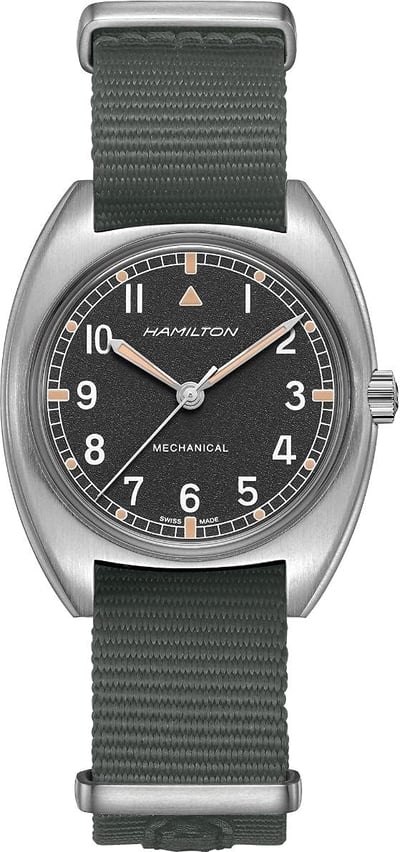
The obvious alternative is the Hamilton Khaki Field Mechanical, which is the benchmark modern field watch and gives you a mechanical movement, real heritage, and a much stronger long-term ownership story. It costs meaningfully more, and it is worth the difference if you care about the mechanism.
If you do not care about the mechanism, the Timex Expedition North Field Post Solar does much of the same job with solar charging and a lower price. Christopher Ward's C65 Sandhurst offers a British military-inspired design with Swiss automatic internals and a noticeably higher finishing ceiling. Laco's Augsburg gives you genuine flieger lineage from one of the original manufacturers. And within the microbrand world, Lorier builds sharper vintage designs with mechanical movements for a modest premium.
What none of them do is exactly what the 1939 does: deliver a specific pre-war military look, in stainless steel with a sapphire crystal, for the price of a nice dinner for two.
The investment question
Let us be blunt, because this is the part most reviews soften. The 1939 is not an investment. It will not appreciate. It will not become collectible. Dan Henry produces these watches in volume, sells them direct, and has no intention of creating artificial scarcity. There is no auction history to point to, no waiting list, no secondary market narrative.
Expect it to trade on the used market somewhere in the region of half to two-thirds of retail, depending on condition and whether the original strap and packaging survived. That is a normal depreciation curve for a microbrand quartz watch, and it is not a scandal — it is what happens when you buy a consumer product rather than a financial instrument.
The correct way to think about the 1939 is as a carrying cost. You are paying a couple of hundred dollars to wear a well-designed watch for several years. Spread that across the ownership period and it is cheaper than a monthly coffee habit. The mistake would be buying it expecting to flip it, or worse, buying two.
The 1939 is a sensible beater. It takes the wear that you would rather not put on the pieces that actually hold value. That is a legitimate portfolio decision, not a compromise.
Service and cost of ownership
Ownership costs are close to nil. Service means battery replacement every few years plus occasional gasket attention, and any competent local watchmaker can handle it. There is no authorized-service bottleneck, no parts scarcity, and no realistic prospect of a repair bill that exceeds the value of the watch.
Compare that with a vintage 1930s field watch, where a single movement service can cost several times the price of this entire piece, and the value proposition becomes clearer. The 1939 is not a substitute for a real vintage watch. It is a substitute for the anxiety of owning one.
Pros and cons
Pros: period-correct vintage-military design at a price that makes mistakes affordable; quartz reliability with essentially no maintenance overhead; sapphire crystal and stainless steel construction that punch well above the price point; genuinely comfortable on the wrist and easy to style.
Cons: no mechanical romance and no collector cachet; immediate depreciation and no path to appreciation; no published dimensional or movement spec sheet for this reference, which frustrates buyers who plan around numbers; minimal wrist presence for anyone who buys watches to be noticed.
Verdict
The Dan Henry 1939 is not a watch you buy to impress a room, and it is certainly not a watch you buy to make money. It is a watch you buy because you like the way a 1930s field watch looks on a leather strap, and you would rather spend the difference on something that actually appreciates. As a wear-it-anywhere piece with zero drama and almost no carrying cost, it earns its place in a serious collection. As an investment, it does not even pretend to compete — and honestly, that is the most refreshing thing about it.