First Impressions: A Chronograph That Refuses to Shout
Unbox a Dan Henry and you understand the pitch within thirty seconds. The 1945 arrives in a slim, well-made travel case, on a strap that has clearly been chosen by someone who has worn a lot of bad straps, and the watch itself has that particular quality vintage-inspired microbrands chase and rarely catch: it looks like it has a history, even though it does not.
The 1945 is a two-register chronograph in the 1940s idiom — a period when chronographs were still relatively small, dials were still relatively uncluttered, and a watch was expected to be read at a glance rather than admired under a loupe. Dan Henry has not tried to reinvent that formula. It has simply executed it at a price that makes the decision easy.
What follows is a wear-focused review. I am less interested in what the 1945 is on a spec sheet than in what it is at 7:40 on a Tuesday morning, when you are late, your shirt cuff is tight, and you need to know whether the strap has broken in yet.
The Brand Behind the 1945
Dan Henry is the rare microbrand with a genuine collector at the helm. Founded by a Brazilian watch obsessive of the same name, the company built its reputation on vintage-homage pieces — racing chronographs, skin divers, dress watches — sold direct to the customer, without the retail markup that usually sits between a watch and the person wearing it.
The model naming is deliberately literal. Each watch is named for the year whose design language it borrows. The 1962 and 1963 look to the golden age of motorsport timing. The 1975 looks to the skin-diver boom. The 1945 looks to the 1940s: a decade of restrained dials, printed Arabic numerals, and chronographs that were tools first and jewellery second.
That framing matters for how you should judge this watch. Dan Henry is not pretending to be a heritage maison with a dusty archive. It is a design-led studio making well-priced watches that borrow confidently from the past. Judge the 1945 on those terms and it is a very strong proposition.
The Movement: Meca-Quartz, and Why That Is the Right Call
The 1945 runs on a Seiko meca-quartz chronograph movement — a hybrid that keeps time with a quartz oscillator but drives the chronograph function through a mechanical module. In practice, this is the single best decision the brand could have made for a watch at this price.
What it means on the wrist is simple. You get quartz accuracy. You also get pushers with a crisp, mechanical start-stop-reset action that feels nothing like the mushy, digital-adjacent click of a conventional quartz chronograph. Press the top pusher and the central chronograph hand snaps into motion with satisfying authority. Press the bottom one and it flies back to zero. It is a small thing. It is also the thing you will notice every single day.
The trade-offs are equally clear. There is no winding, no rotor, no power reserve to obsess over — just a battery that will need replacing every few years. There is no exhibition caseback worth having, and no finishing to admire. If you want to open your watch and look at Geneva stripes, this is not your watch. If you want a chronograph that works every time you pick it up, it absolutely is.
Case, Crystal and Dial
The case is stainless steel, and the finishing is honest: a mix of brushing and polishing that reads convincingly at arm's length and holds up under a close look, which is more than can be said for a lot of watches in this bracket. The crystal is sapphire, a genuinely generous inclusion at this price point, and it means you can stop worrying about the desk-diving scratches that plague acrylic and mineral glass.
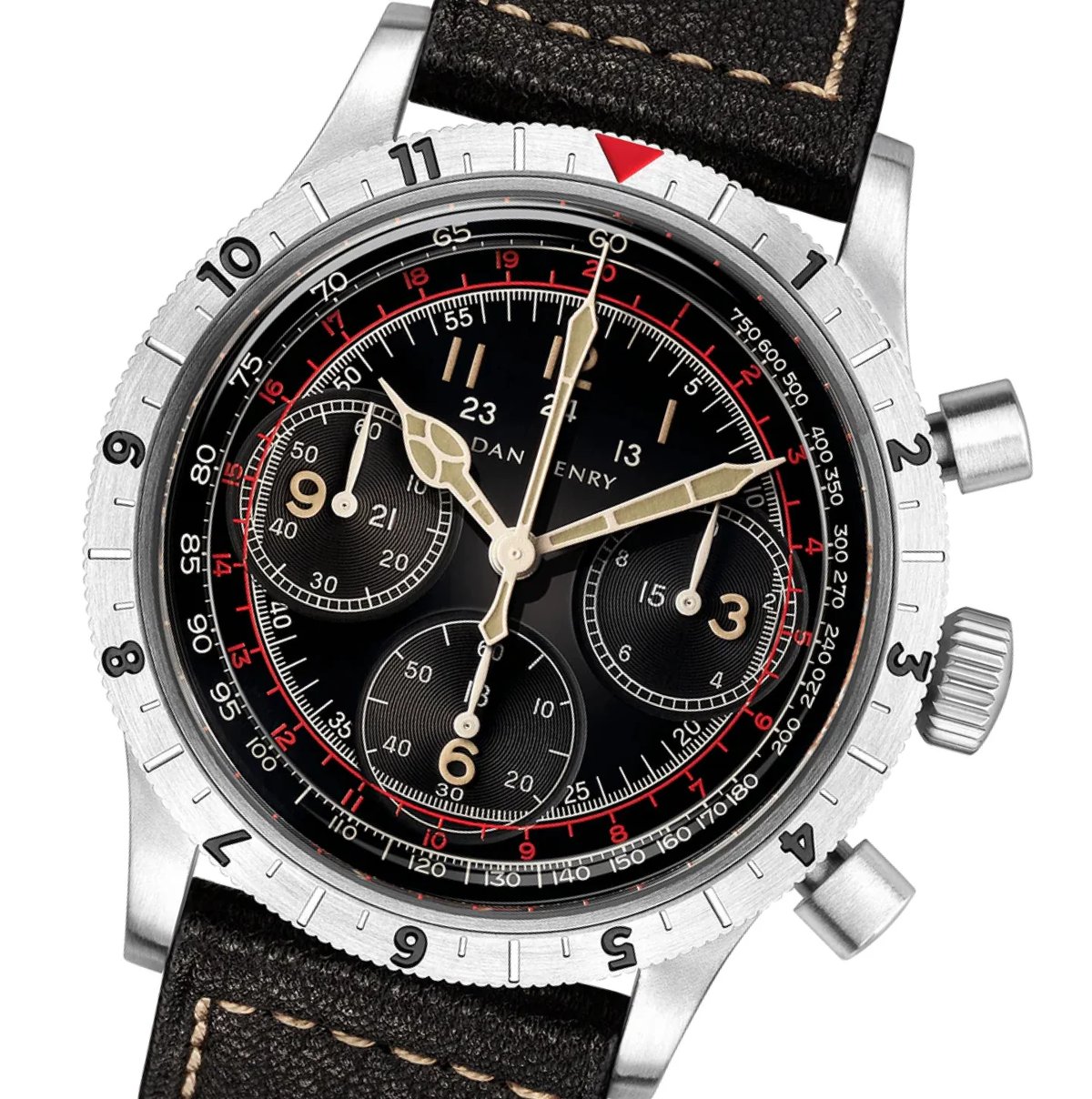
The dial is where the 1945 earns its money. Two registers, clean typography, no superfluous text, and a layout that respects the original 1940s brief rather than modernising it into something blander. The hands are legible, the markers are proportionate, and the lume — Super-LumiNova — is applied where it needs to be rather than smeared everywhere for the sake of a photograph.
It is a dial that photographs well but, more importantly, reads well. That is not always the same thing.
On the Wrist: Comfort, Balance and the Strap Question
Here is where the 1945 separates itself from the crowd of vintage-homage chronographs. A great many watches in this genre are technically correct and physically unpleasant: thick cases that sit proud of the wrist, long lugs that overhang a smaller arm, and straps stiff enough to require a breaking-in period measured in months.
The 1945 avoids all three traps. The case is slim enough to slide under a shirt cuff without a fight, the proportions are restrained enough that it does not feel like a dinner plate, and the balance is right — the watch sits centred on the wrist rather than tipping forward toward the hand. On leather it disappears in the best way: you become aware of it when you check the time and not otherwise.
The strap itself is a leather piece with a pin buckle, and it is the one element I would expect most owners to change. Not because it is bad — it is perfectly decent, supple from the first wear, and appropriate to the 1940s brief — but because the 1945 is a strap monster. Put it on a suede, a shell cordovan, a grey NATO, or a Milanese mesh and it becomes a different watch each time. That versatility is worth more than any single strap the brand could have shipped it on.
Weight is modest. This is not a watch you feel. For anyone who has spent a week with a heavy steel chronograph and ended up with a tender wrist by Friday, that lightness is a feature, not a compromise.
Legibility in Real Life
Legibility is the quiet virtue of the 1940s aesthetic, and the 1945 exploits it fully. The time is readable in a glance, in bad light, at an awkward angle — the three conditions under which most watches are actually consulted. There is no glare problem from the sapphire, no crowding between the hands and the registers, and no need to bring the watch to your face like a jeweller's loupe.
The lume is adequate rather than spectacular. It is there, it glows, it fades. If you need a torch on your wrist at 3 a.m., buy a dive watch. If you need to read the time in a dark cinema, the 1945 will do the job.
The chronograph registers are similarly well judged. They are large enough to be read quickly and small enough not to dominate the dial. For timing a steak, a parking meter, or a meeting that has overrun, it is more than sufficient.
Accuracy and Day-to-Day Ownership
Quartz accuracy is quartz accuracy. Expect the 1945 to hold within a handful of seconds a month, which is to say far better than any mechanical watch at ten times the price. You will set it when the battery is changed and essentially never again. For anyone who has spent years resetting an automatic every time it goes into a drawer for a weekend, this is a genuine luxury.
The ownership experience is correspondingly frictionless. No winder, no timing app, no anxiety about leaving it off the wrist for a fortnight. The 1945 is the watch you grab when you have ninety seconds to get out of the door, and it will be right.
The counter-argument is emotional rather than practical: there is no relationship with a meca-quartz movement. No sense that the watch is alive. Some collectors find that fatal. Others find it liberating, and I suspect the latter group is larger than it admits.
Where It Fits in a Rotation
The 1945 is a daily wearer that dresses up. On leather it is entirely at home with a jacket and a tie; on a NATO it is a weekend watch; on a mesh bracelet it becomes something approaching smart-casual. It is not a sports watch and should not be treated as one — this is a piece for the office, the dinner table, the airport lounge and the long Sunday. Keep it away from the pool and the gym and it will look after you.
For a young collector building a first serious rotation, that flexibility is worth a great deal. One watch that covers daily, dress and travel is a better use of a modest budget than three watches that each do one thing.
Variants and Family
Dan Henry releases the 1945 in a small number of dial colourways, each sharing the same case, movement and strap architecture. The differences are cosmetic — dial finish, hand colour, strap tone — and they change the character of the watch more than you might expect. A cream dial reads warmer and more formal; a darker dial reads sharper and more tool-like.
The wider family is worth understanding too. The brand's 1937 and 1939 dress watches share the same 1940s-adjacent sensibility in a non-chronograph format, while the 1947 field watch takes the military route. Collectors who like the 1945's restraint often end up with one of the others as a companion piece.
Alternatives Worth Considering
If you want a mechanical chronograph in the same vintage idiom, the Baltic Bicompax and the Nivada Grenchen Chronomaster are the obvious step-ups, and both will cost you meaningfully more. Seiko's Prospex Speedtimer line offers solar quartz reliability in a similar price band with a very different design language. Hamilton's Intra-Matic chronographs deliver a genuinely mid-century American feel, again at a higher price.
At the budget end, the Seagull 1963 and the various Sugess and Pagani Design meca-quartz chronographs undercut the Dan Henry considerably. They are also, in my experience, a coin flip on quality control. The 1945 sits in a sweet spot: more expensive than the cheapest options, considerably better finished than most of them, and still a fraction of what a Swiss mechanical equivalent would cost.
Value, Service and the Money Question
Dan Henry sells direct, which is the entire reason the 1945 costs what it does. There is no authorised dealer network taking a margin, no boutique lease to amortise, no advertising budget baked into the price. What you pay is close to what the watch costs to make and ship.
That also means resale is soft. Dan Henry watches are bought to be worn, not flipped, and the secondary market reflects it — expect to lose a meaningful percentage if you sell within a year or two. If you are buying watches as an investment, this is not the brand for you, and honestly, at this price point, no brand is.
Servicing is straightforward. A meca-quartz movement does not need the periodic overhaul a mechanical calibre does; it needs a battery every few years and, eventually, a movement swap if something fails. Any competent watchmaker can handle it, and the cost is a fraction of a mechanical service. This is one of the least stressful watches you can own.
Pros and Cons
Pros: the design is genuinely well judged rather than merely derivative; the meca-quartz movement gives you mechanical pusher feel with quartz reliability; the sapphire crystal is a real value inclusion; the watch is comfortable enough to wear for a full week without complaint; and the strap-changing potential makes it feel like several watches.
Cons: it is not a mechanical watch, and some collectors will never get past that; the lume is adequate rather than excellent; the stock strap is the weakest element; and the resale value is poor.
The Verdict
The Dan Henry 1945 is not trying to be a grail watch, and that is precisely why it works. It is a beautifully judged, genuinely comfortable, thoroughly reliable chronograph that looks like it costs several times what it does. It will not appreciate, it will not impress a room of collectors, and it will not survive a decade of neglect without a battery change.
What it will do is get worn. Every day, without ceremony, without anxiety, and without a single moment of regret. For a young collector who wants the look and feel of a 1940s chronograph without the fragility or the invoice, the 1945 is one of the most sensible purchases in the category.
Buy it to wear. That is what it was built for.