# De Bethune DB Eight Review
The DB Eight arrives as a quiet yet unmistakable statement from one of the most avant‑garde houses in contemporary haute horlogerie. At first glance it may look like a refined nod to the brand’s early monopusher experiments, but beneath the polished guilloché dial lies a brand‑new in‑house movement, a case engineered from grade‑5 titanium, and a design language that has become De Bethune’s visual signature. Launched in 2023, the watch sits at the intersection of tradition and innovation, offering a manual‑winding chronograph that feels both light as a feather and solid as a piece of engineering art. In this review we will unpack the DB Eight’s heritage, design, movement, wearability, appropriate occasions, and finally ask whether its CHF 85 000 price tag is justified.
---
## Heritage — the model's place in the brand's line and its launch context
De Bethune has built its reputation on daring technical experiments—most famously the “Moonphase” and “SpaceTime” complications that push the limits of precision and aesthetics. The DB Eight, however, is a deliberate step back toward the brand’s roots. Its architecture draws heavily on the iconic DB 1, the first monopusher chronograph De Bethune introduced, and the later DB 8, which refined the same single‑push system with modern materials. By revisiting the monopusher layout, De Bethune signals that the brand still values the pure, mechanical purity that a single‑push chronograph represents, even as it moves forward with a brand‑new calibre.
The watch was officially announced in early 2023 and entered production later that year. It marks the debut of the house’s 31st in‑house calibre, the DB 3000, underscoring De Bethune’s ongoing commitment to vertical integration. While the brand’s broader timeline (its founding in the early 2000s and the release of earlier models such as the DB 1 and DB 8) provides context, the DB Eight stands on its own as the latest expression of De Bethune’s design DNA: ogival lugs, a sleek, low‑profile case, and a meticulous finish that bridges classic watchmaking with contemporary engineering.
---
## Design & Case — case dimensions, materials, dial
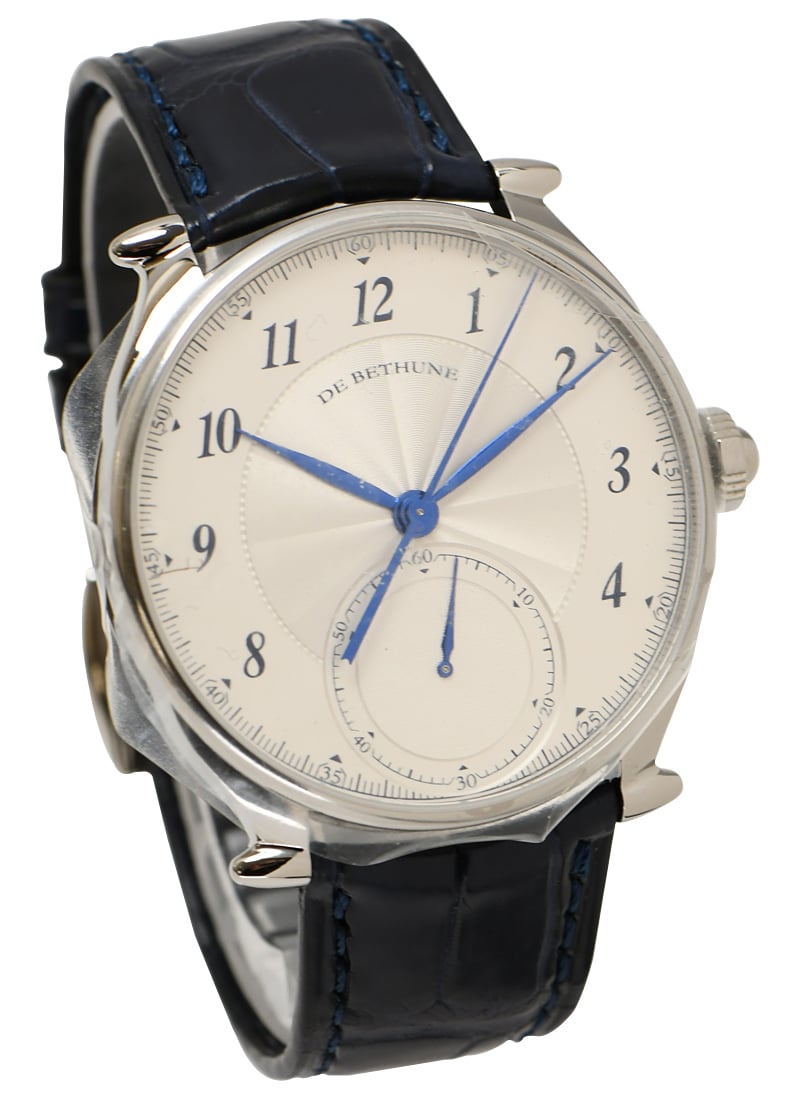
The DB Eight is housed in a 42.4 mm round case crafted from grade‑5 titanium, a material prized for its high strength‑to‑weight ratio. The use of titanium is not merely aesthetic; it gives the watch a remarkable lightness that many reviewers have noted—“a marvel of lightness and ergonomic comfort” in a hands‑on test. The case thickness measures a modest 9.2 mm, allowing the watch to sit comfortably under a shirt cuff despite its relatively large diameter.
One of the most recognisable De Bethune trademarks—the ogival, or “bullet‑shaped,” lugs—frame the bezel. These lugs, first seen on the DB 1, have become a visual hallmark for the brand and give the DB Eight an instantly identifiable silhouette. The case is sealed to 30 meters (≈ 100 feet) of water resistance, which is sufficient for everyday wear but not intended for serious aquatic activities.
The dial is a study in restrained elegance. A silver guilloché pattern provides a subtle, textured background that catches light without being ostentatious. Blue Breguet numerals—hand‑applied with the same blued titanium finish as the hands—add a splash of colour that references historic French watchmaking while staying true to De Bethune’s modern palette. The hour markers are simple, polished indices that complement the overall minimalism. Although the official specifications do not explicitly confirm the crystal type, De Bethune traditionally equips its pieces with sapphire crystal, a material that aligns with the brand’s emphasis on durability and scratch resistance.
The watch is finished in a polished titanium case with brushed accents on the inner lugs, a technique that creates a visual contrast and highlights the craftsmanship. The overall aesthetic is understated yet unmistakably De Bethune, marrying classic watchmaking cues with a futuristic material language.
---
## Movement & Performance — calibre, power reserve, accuracy
At the heart of the DB Eight lies the newly developed Calibre DB 3000, De Bethune’s 31st in‑house movement. It is a manual‑winding, column‑wheel monopusher chronograph with 31 jewels and a beat rate of 28 800 vibrations per hour (4 Hz). The column‑wheel mechanism provides a smooth, tactile feel when activating the chronograph, a characteristic that many traditionalists prefer over the more common cam‑actuated systems.
The chronograph function features an instantaneous 60‑minute counter, meaning the elapsed‑time hand snaps instantly to the correct minute mark when the push‑piece is released—a hallmark of high‑grade chronographs. The movement offers a 60‑hour power reserve, which is generous for a manual‑winding calibre of this size and allows the watch to be taken off for a full weekend without winding.
While De Bethune does not publish official chronometer certification for the DB Eight, the brand’s reputation for meticulous finishing and regulation suggests that the movement will perform within the typical ± 2‑3 seconds per day range expected of high‑end manual watches. The movement’s architecture also incorporates the house’s patented “SpaceTime” technology in the form of a tiny, invisible balance‑spring regulator, though the specifics of that integration are not disclosed in the public data.
Overall, the DB 3000 delivers a blend of technical sophistication (column‑wheel, instantaneous counter) and practical usability (60‑hour reserve), positioning it as a serious chronograph for collectors who appreciate manual winding as part of the ritual of watch ownership.
---
## On the Wrist — wearability, lug‑to‑lug, comfort notes
The DB Eight’s ergonomics are perhaps its most compelling feature. The titanium case, at just over 150 grams (including the strap), feels feather‑light on the wrist, an impression echoed by reviewers who said they “sometimes forget it’s on the wrist.” The slim 9.2 mm profile ensures the watch does not dominate the wrist, making it suitable for both casual and formal attire.
Lug‑to‑lug distance is not explicitly listed in the source material, but given the 42.4 mm case diameter and the narrow lugs, the watch likely measures around 45 mm from lug to lug—a proportion that offers a balanced fit on most wrist sizes, from 38 mm to 44 mm. The ogival lugs provide a comfortable grip for the hand when operating the monopusher, and the push‑piece itself is engineered to give a crisp, audible click without requiring excessive force.
The strap options are not detailed in the available data, so we will focus on the case‑to‑bracelet interface. De Bethune typically supplies a titanium bracelet that matches the case’s finish, though the existence of alternative strap materials (leather, rubber) cannot be confirmed from the sources. Regardless of the strap chosen, the watch’s lightweight case ensures that the overall feel remains comfortable even during extended wear.
The 30‑meter water resistance means the watch should be removed before swimming or showering, but it will tolerate everyday exposure to rain or accidental splashes without issue. The combination of a low profile, light case, and ergonomic lugs makes the DB Eight a watch that can be worn from morning meetings to evening events without causing fatigue.
---
## When to Wear — occasion, setting and dress‑code fit
The DB Eight’s design straddles the line between dress and sport, a balance that gives it a versatile wardrobe presence. Its silver guilloché dial and understated numerals lend themselves well to formal settings—think black‑tie galas, boardroom meetings, or a sophisticated dinner. The titanium case, while robust, retains a refined sheen that does not clash with a tuxedo or a tailored suit.
Conversely, the chronograph function and the modern, slightly industrial aesthetic of the titanium case make the watch equally at home in a more relaxed environment. A weekend brunch, a yacht outing (within the limits of its water resistance), or a casual business‑casual day can all accommodate the DB Eight without feeling out of place. Its slim profile ensures it slides easily under a shirt cuff, while the blue Breguet numerals add a subtle pop of colour that can serve as a conversation starter among watch enthusiasts.
Because the watch is manual‑winding, it is best suited to owners who appreciate the ritual of winding and who are comfortable checking the power reserve regularly. This characteristic may make it less ideal for those who prefer a fully automatic or quartz timepiece for everyday reliability. Nonetheless, for collectors who value the tactile connection to the movement, the DB Eight shines in any setting where a touch of horological artistry is appreciated.
---
## Value & Verdict — price‑positioning + final take
De Bethune positions the DB Eight at the high end of the luxury market, with an official price of CHF 85 000 (approximately USD 108 416). At this price point, the watch competes with the flagship models of brands such as Patek Philippe, Audemars Piguet, and Richard Mille. The justification for this price rests on several pillars:
1. **In‑house Movement** – The DB 3000 is a brand‑new, manual‑winding column‑wheel chronograph, a rarity in a market dominated by automatic movements. Its 60‑hour reserve and instantaneous counter add genuine technical value.
2. **Materials & Finishing** – Grade‑5 titanium, a sapphire crystal (as is typical for De Bethune), and a hand‑guilloché dial represent premium material choices and labor‑intensive finishing processes.
3. **Design Heritage** – The ogival lugs and the homage to the DB 1/DB 8 lineage give the piece a unique identity that cannot be replicated by other manufacturers.
4. **Brand Prestige** – De Bethune’s reputation for pushing the boundaries of horology adds intangible value that collectors are willing to pay for.
However, the watch is not without drawbacks. The 30‑meter water resistance limits its utility for water‑related activities. The manual‑winding requirement may deter buyers who prefer the convenience of an automatic. Finally, the price, while justified by the movement and materials, places the DB Eight out of reach for most enthusiasts, positioning it as a collector’s piece rather than a daily driver for the broader market.
**Verdict:** The De Bethune DB Eight is a masterclass in minimalist chronograph design, marrying a historic monopusher layout with a cutting‑edge in‑house calibre. Its titanium case and guilloché dial exude a quiet elegance that feels both modern and timeless. For collectors who value manual winding, appreciate De Bethune’s design language, and are comfortable investing in a high‑end, limited‑production piece, the DB Eight offers a compelling blend of technical merit and aesthetic refinement. At CHF 85 000, it is undeniably a premium purchase, but within that tier it delivers the full suite of attributes—movement, material, and heritage—that justify its price. If you can afford it and enjoy the ritual of winding a masterpiece, the DB Eight earns a place on the wrist and in the annals of contemporary haute horlogerie.