The Dawn of a New Era: Understanding the DB10
When Denis Flageollet and David Zanetta founded De Bethune in 2002, they didn't set out to build another watch company; they set out to create a laboratory of horological research. The DB10 was the first fruit of this labor. To the uninitiated, it looks like a classic dress watch. To the collector, it is the Rosetta Stone of the De Bethune design language. Over my week wearing the DB10, I found that its charm lies in its subtlety. It doesn't scream for attention like a DB28 with its articulating lugs and polished mirrors. Instead, it whispers of quality through its ogival lugs and the mesmerizing depth of its dial.
Case Architecture and the 'Bullet' Lugs
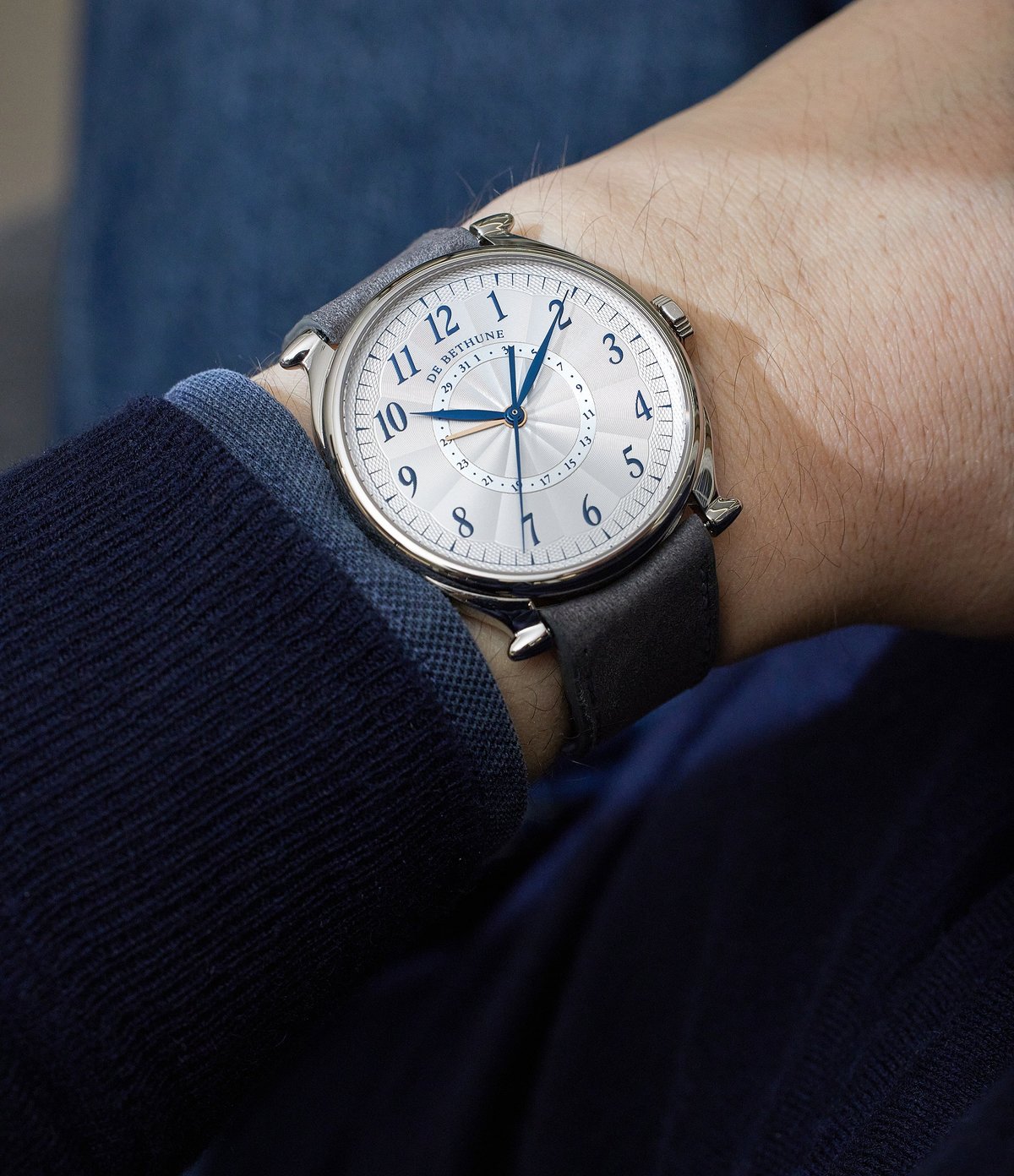
The 42mm case is crafted from 18k white gold, giving it a weight that feels significant but never cumbersome. In my daily wear tests, the most impressive feature was the lug design. These 'ogival' or bullet-shaped lugs are a signature of the brand. While they are fixed on the DB10, their geometry is calculated to wrap around the wrist bones. At 51mm lug-to-lug, this watch should, on paper, be too large for my 16.5cm wrist. However, the aggressive downward slope ensures that the strap meets the wrist at a sharp angle, eliminating the dreaded 'lug overhang' that plagues many 42mm watches.
The polishing on the case is mirror-perfect. De Bethune is known for their finishing, and even on this early model, the quality is evident. The bezel is thin, which allows the dial to take center stage, making the watch appear slightly larger than its dimensions suggest. During a Tuesday morning board meeting, the watch sat discreetly under a French cuff, only revealing its unique profile when I reached for my espresso. It is the definition of 'if you know, you know' horology.
The Dial: A Masterclass in Guilloché
The dial of the DB10 is a silvered masterpiece. The central zone features a hand-turned guilloché pattern that radiates from the center, creating a play of light that changes from matte silver to a brilliant white depending on the overhead lighting. This isn't the stamped pattern you find on entry-level luxury watches; the crispness of the lines indicates a true rose-engine turning process. Surrounding the guilloché is a brushed chapter ring with Roman numerals. The typography is elegant, reminiscent of 18th-century marine chronometers, which was a major inspiration for Zanetta.
Then there are the hands. De Bethune’s flame-bluing process is legendary. The hands on the DB10 are not painted; they are thermally treated steel, resulting in a deep, iridescent cornflower blue. In the office, under harsh fluorescent lights, they appear almost black. But outdoors, in the afternoon sun, they glow with an intensity that provides perfect legibility against the silver backdrop. The central seconds hand is impossibly thin, sweeping across the dial with a grace that hides the vintage heart beating beneath.
The Movement: Vintage Soul, Modern Refinement
Inside the DB10 is the Calibre DB 2101. For this debut model, Flageollet chose to use a vintage A. Schild (AS) 1321 ebauche as the foundation. This might surprise some who expect a fully in-house movement at this price point, but one must understand Flageollet’s philosophy. He views these vintage calibers as the peak of mechanical reliability. He didn't just 'drop' the movement in; he stripped it down, re-engineered the bridges, and applied De Bethune’s signature finishing.
The movement features 21 jewels and beats at a leisurely 18,000 vph. This lower frequency gives the watch a distinct, rhythmic 'tick' that feels alive. Winding the watch each morning became a ritual during my week of testing. The crown is small, but the winding action is buttery smooth, with just enough resistance to let you know the mainspring is gaining tension. While the power reserve is a modest 42 hours, it is more than sufficient for a daily wearer that you'll likely want to put on every morning anyway.
A Week on the Wrist: The Real-World Test
Monday & Tuesday: The Corporate Grind
The DB10 is an exceptional office companion. Its 11mm thickness means it never catches on a sleeve. I found the legibility to be top-tier; the contrast between the blued hands and the silver dial is so sharp that a quick glance is all that's needed to check the time during a presentation. The date window at 6 o'clock is small and unobtrusive, preserving the symmetry of the dial.
Wednesday: The Travel Day
I took the DB10 on a short flight to Paris. While it lacks a GMT function, its comfort during long periods of wear was notable. The alligator strap is of the highest quality—soft enough to be comfortable from day one, but stiff enough to support the gold case. One downside: the 30m water resistance. I was caught in a sudden downpour on the Rue du Faubourg Saint-Honoré and felt a genuine spike of anxiety. This is not a watch for the beach or the pool; it is a metropolitan instrument.
Thursday & Friday: Social Engagements
At a gallery opening on Thursday night, the DB10 finally got the attention it deserved. A fellow collector recognized the lugs from across the room. This is the joy of owning a De Bethune; you aren't wearing a status symbol for the masses, but a secret handshake for the cognoscenti. It pairs as well with a cashmere sweater and dark denim as it does with a tuxedo.
Investment and Value: The Collector's Perspective
For years, the DB10 was the 'value' entry into De Bethune, often trading in the $15,000 to $20,000 range. Those days are gone. As the brand has ascended to the top tier of independent horology—alongside the likes of F.P. Journe and Akrivia—collectors have begun to look back at the early models. The DB10 is the 'Reference 3919' of De Bethune; it is the foundation. Current market prices are reflecting this, with clean examples in white or rose gold fetching upwards of $40,000 at auction. Given the low production numbers of these early pieces, I expect the trend to continue upward. It is a 'blue-chip' independent.
Final Thoughts
The De Bethune DB10 is a rare beast: a watch that feels like a piece of history on the wrist while remaining perfectly suited for modern life. It lacks the technical wizardry of the brand's later silicon escapements and triple-parachute shock systems, but it makes up for it with soul. It is a testament to what happens when a master watchmaker and a visionary designer decide to ignore the trends of the day and build something timeless. If you have the opportunity to add one to your collection, do not hesitate. It is a watch that will still be relevant, and beautiful, fifty years from now.