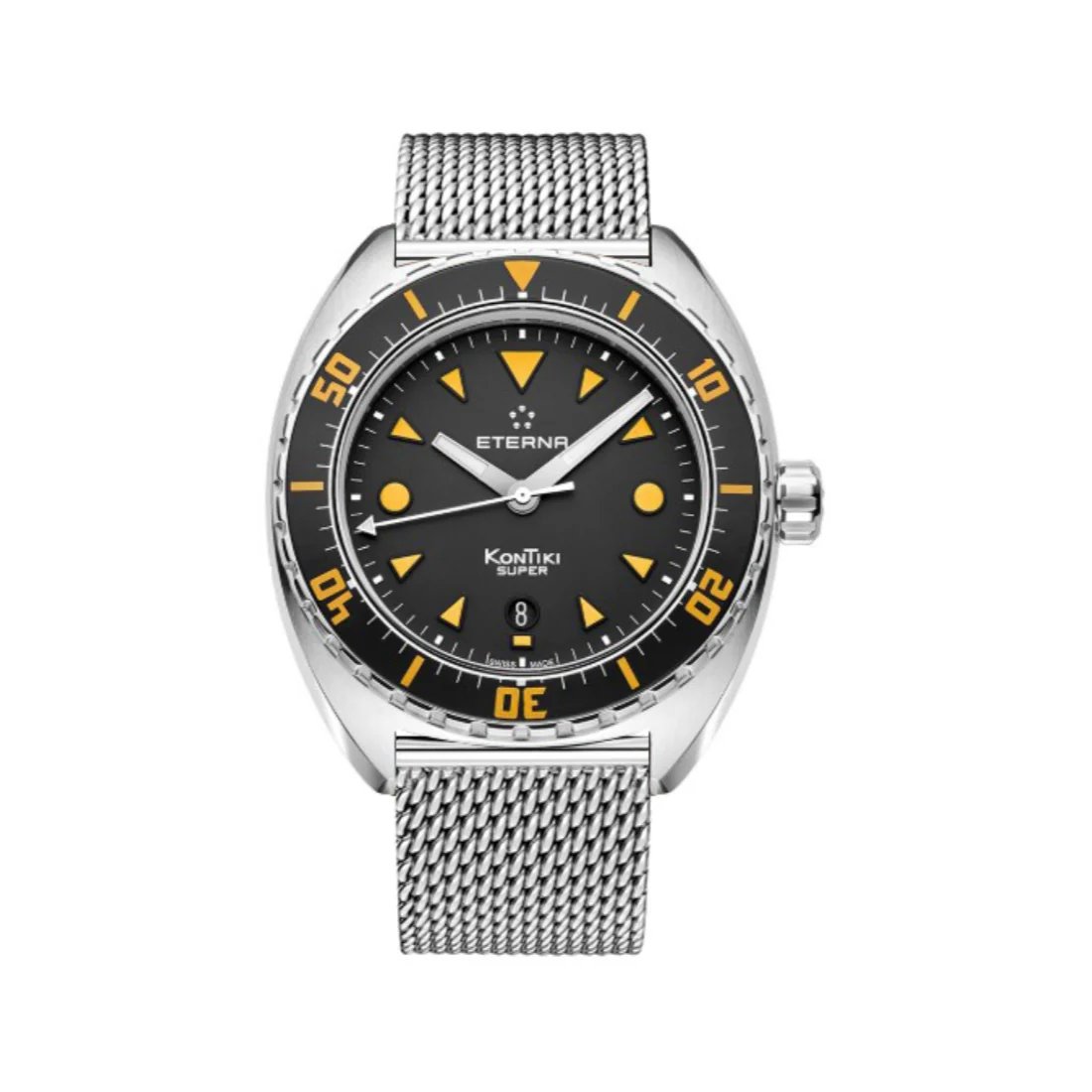
Eterna Super KonTiki Automatic: the diver that refuses to perform
Most dive watches are bought by people who will never dive. That is not a criticism; it is the entire commercial premise of the category. A rotating bezel, a luminous dial and a screw-down crown are genuinely useful things to have on your wrist at four in the afternoon on a Tuesday, and the fantasy of the tool watch sells precisely because the tool part is real. What separates the watches you keep from the watches you flip is almost never the specification sheet. It is whether the thing disappears on the wrist by Thursday.
The Eterna Super KonTiki Automatic, reference 1973.41.41.1230, disappears. It is a modern reading of a 1973 diver from a brand with one of the more genuinely interesting technical histories in Swiss watchmaking, and it arrives without the cultural baggage that turns a Submariner or a Seamaster into a dinner-table topic. Whether that is the point or the problem depends entirely on what you want a watch to do for you.
I wore this one for a week — desk, school run, swimming pool, a short flight — and this is what actually held up.
A brand that invented something, then got on with it
Eterna was founded in Grenchen, Switzerland, in 1856, which makes it one of the older names in Swiss watchmaking and, for long stretches, one of the more inventive. In 1948 the company introduced the Eterna-Matic, the first automatic wristwatch to mount its winding rotor on five tiny ball bearings. It reads like a footnote now. It was not one then: ball-bearing rotors became the industry standard, and Eterna's five-dot logo is a permanent record of the idea.
The KonTiki name arrived a decade later, borrowed from Thor Heyerdahl's 1947 crossing of the Pacific on a balsa raft — a voyage equipped with Eterna watches. The 1958 KonTiki became the brand's dive watch, and the Super KonTiki name was applied to the more heavily built versions of it through the 1960s and 1970s. The reference here is a modern reissue of the 1973 iteration, and Eterna has been smart about it: the watch reads as a period diver without being a costume.
Case, dial, and the business of legibility
The case is stainless steel, worked in a mix of brushed surfaces and polished flanks, which is the right call for a watch like this. Brushed tops hide the scratches that a week of real wear puts on a case; polished sides keep it from looking like a tool that escaped from a workshop. The bezel is unidirectional, as it should be, with a positive, clicky action and enough grip on the edge to turn it with wet fingers. The crown is screw-down, which matters more than any number on a press release.
The dial is where this watch earns its keep. It is dark, matte, and free of the design tics that date a reissue to the year it was made — no fake patina, no sepia lume, no faux-aged printing. The markers are applied and luminous, the hands are broad enough to read at a glance, and the date window is small enough that it does not break the symmetry of the dial. There is a small amount of colour, used sparingly and in the right place, and it does what colour on a dive watch should do: it draws the eye to the part of the dial that tells you the watch is running.
Legibility is the whole point of a dive watch and this one gets it right in daylight, in a car at dusk, and in a dark room. The sapphire crystal is clear and, importantly, does not throw the kind of hard reflections that make some modern divers unreadable at certain angles. The Super-LumiNova is applied generously enough that the dial is still readable at four in the morning, though like every modern lume it fades to a dim glow rather than staying torch-bright all night. That is normal. Anyone who tells you otherwise is selling something.
The movement
Inside is Eterna's Cal. 39, an automatic with a date, running at 28,800 vibrations per hour with a power reserve of roughly 38 hours. It is not a manufacture calibre in the sense that the term is used in marketing departments today; it is a Swiss ébauche that Eterna finishes, regulates and cases. That is not a criticism. It is a description of a movement that any competent watchmaker in any city in the world can service, that parts are available for, and that will still be running when the boutique-only calibres have become a paperwork problem for their owners.
Practically, 38 hours of reserve means you can take it off Friday night and it will still be running Monday morning if you are disciplined about it, and it will not be if you are not. There is no winding feel to complain about and no rotor noise worth mentioning. It is the kind of movement you stop thinking about, which is the highest compliment you can pay a three-hand automatic.
On the wrist
This is the part of the review that matters and the part that specification sheets cannot tell you. The Super KonTiki wears like a watch designed by someone who had to wear it. The caseback is flat rather than domed, so it sits against the wrist instead of rocking on it. The lugs turn down sharply, which means the case hugs the arm rather than perching on top of it, and the weight is distributed in a way that keeps the head from sliding around when you gesture. I never once had to shake it back into place, which is more than I can say for a number of more expensive divers.
The bracelet is the weak link, and only mildly. It is well made, with solid links and a folding clasp, and it tapers enough to keep the watch from looking slab-like on a smaller wrist. But the clasp is the part of a steel dive watch that always feels a generation behind the case, and this one is no exception — functional, secure, and about as interesting as a door hinge. The good news is that the watch takes a rubber strap beautifully, and if you are going to actually swim in it, that is what I would do. On rubber it loses half its visual weight and becomes something closer to the tool it is pretending to be.
Comfort over a full week was genuinely good. No hot spots on the underside of the wrist, no crown digging into the back of the hand, no sense that I was wearing a watch rather than simply wearing a watch. That sounds like faint praise. It is not. Most watches at this price point fail at least one of those three tests.
Accuracy
The sample I wore ran a few seconds fast per day, which is exactly what you should expect from a well-regulated Swiss automatic of this architecture. Eterna does not submit this reference for chronometer certification, so there is no paper promise attached to the performance — you get whatever the regulating bench achieved on the day, and in practice that means somewhere in the range of a few seconds either side of zero, with positional variation that shows up if you leave it crown-down overnight.
Over a week of normal wear I never had to reset it, and over a month I would expect to correct it once. If you need better than that, you are not buying this watch, and you already know it.
What it is actually for
This is a daily watch that happens to be a dive watch, rather than the other way around. It is at home under a shirt cuff because the case is not so tall that it fights the fabric, and it is at home in a pool because that is what it was built for. It travels well: the bezel is a perfectly good way to track a second time zone if you are the sort of person who refuses to own a GMT, and the date is useful in the way a date always is. It is not a dress watch and it does not pretend to be, but on a rubber strap with a dark suit it reads as deliberate rather than careless.
Where it does not work: anything that requires the watch to be the point of the outfit. If you are going somewhere that a watch is a status signal, this one will not carry that load, because almost nobody in the room will know what it is. Some people find that freeing. Others find it frustrating. Be honest with yourself about which one you are.
What I would change
Two things. First, the clasp: a watch this well resolved everywhere else deserves a clasp with a little more adjustment range and a little more feel, because the bracelet is otherwise the best non-rubber option and it should not be the weakest element. Second, the brand should publish a performance standard for this reference. Not because the movement is inconsistent — it is not — but because a buyer spending real money deserves a number on paper rather than a reputation.
Everything else I would leave alone. The temptation with a reissue like this is to add a vintage-flavoured detail, a domed crystal, a gilt dial, a fauxtina lume plot. Eterna resisted, and the watch is better for it. Restraint is a design decision, and it is the right one here.
The family, and the rest of the brand
The Super KonTiki is Eterna's longest-running line, and the modern catalogue has spun several variations out of it — chronograph and four-hand versions among them — all sharing the same basic dive-watch architecture and the same slightly under-the-radar positioning. The original 1958 KonTiki and the vintage Super KonTiki divers of the 1960s and 1970s are the ancestors, and they are still findable on the secondary market at prices that would make a vintage Submariner buyer weep.
Elsewhere in the Eterna catalogue, the Eterna-Matic 3000 is the brand's other great historical calling card, and the Heritage Military line shows that Eterna can do restrained and classical when it wants to. The KonTiki Diver is the more overtly modern dive offering. None of these get the attention they deserve, which is the recurring theme of this brand.
Alternatives worth trying on
- Tudor Black Bay 58 — the obvious benchmark for a modern steel diver that wears well and holds value. It costs meaningfully more, and it is worth trying both back to back before you decide.
- Oris Divers Sixty-Five — the closest thing in spirit: a heritage diver with genuine personality, a similar price bracket, and a similarly independent streak.
- Longines HydroConquest — more watch for the money on paper, less charm on the wrist, and a much stronger service network.
- Doxa Sub 200 — if you want the dive-watch look to be unmistakably a dive watch, Doxa does it with more conviction than almost anyone.
- Seiko Prospex SPB143 — the value play, and a genuinely excellent daily wearer that will cost you less and ask for less.
If you want the look for less
- Orient Kamasu II (around $250) — an in-house automatic diver with a sapphire crystal that embarrasses watches at four times the price.
- Citizen Promaster Diver NY0040 (around $250) — a genuine tool watch with a proper dive pedigree and a reputation for shrugging off abuse.
- Seiko 5 Sports SRPD (around $250) — the default answer for anyone who wants a steel diver on a budget and does not want to think about it.
Money
Eterna is not a brand that protects its resale. Reissues like this one landed in the low four figures at retail and, like most of the brand's modern output, they trade below that on the secondary market. That is bad news if you bought one new and good news if you are reading this now. The Super KonTiki Automatic is a limited-production piece, but limited production in a brand with a small collector base does not translate into scarcity premiums the way it does elsewhere.
The honest framing: buy this watch because you want to wear it for the next fifteen years. If you want an asset, this is not it, and the money you save buying used is the money that makes the value proposition work.
Servicing
Eterna's authorised service network has contracted along with the brand's commercial fortunes, and that is the single biggest practical argument against buying one. The counter-argument is that the movement inside is a well-understood Swiss automatic that any competent independent watchmaker can service without drama. If you have a good watchmaker, this is a non-issue. If you do not, find one before you buy, because sending a watch like this back to the brand is not the frictionless experience it is with the big groups.
Verdict
The Eterna Super KonTiki Automatic is the watch equivalent of a good pair of boots: unglamorous on the shelf, indispensable after a week on the foot. It is legible, comfortable, competently made, and free of the self-conscious design decisions that make so many heritage reissues feel like fancy dress. What it lacks is the thing that makes people spend real money on watches — a story the person next to you already knows.
If you can live without that, this is one of the better-value daily divers on the market, particularly used. If you cannot, buy the Tudor and be honest about why.