F.P. Journe Souscription Chronomètre à Résonance Achieves $13.9 Million
F.P. Journe Chronomètre à Résonance “Souscription” No. 17 – A Rare Symphony of Mechanics
By Vivir··Updated
# F.P. Journe Chronomètre à Résonance “Souscription” No. 17 – A Rare Symphony of Mechanics
When François-Paul Journe unveiled the Chronomètre à Résonance “Souscription” at the turn of the millennium, he was not merely adding another haute‑horlogerie piece to his catalogue; he was presenting a manifesto on how two independent balance wheels can speak to each other and tame the inevitable errors of a solitary oscillator. Only twenty of these 38 mm platinum wrist‑watches were ever produced, each numbered and allocated through an exclusive subscription that followed the launch of his inaugural Tourbillon Souverain. More than two decades later, the watch remains a benchmark for technical audacity, aesthetic restraint, and the kind of scarcity that turns a timepiece into a legend. Below is a hands‑on review that dissects the watch’s design, movement, wearability, and overall value.
## Design & Case
The case is pure platinum, a material that instantly conveys gravitas while allowing the subtle play of light that is characteristic of Journe’s finish. At 38 mm in diameter, the dimensions sit comfortably between the classic 36 mm dress‑watch and the modern 40 mm trend, offering a silhouette that reads as both contemporary and timeless. The thickness is modest for a double‑balance, manual‑wind masterpiece, a testament to Journe’s mastery of component integration.
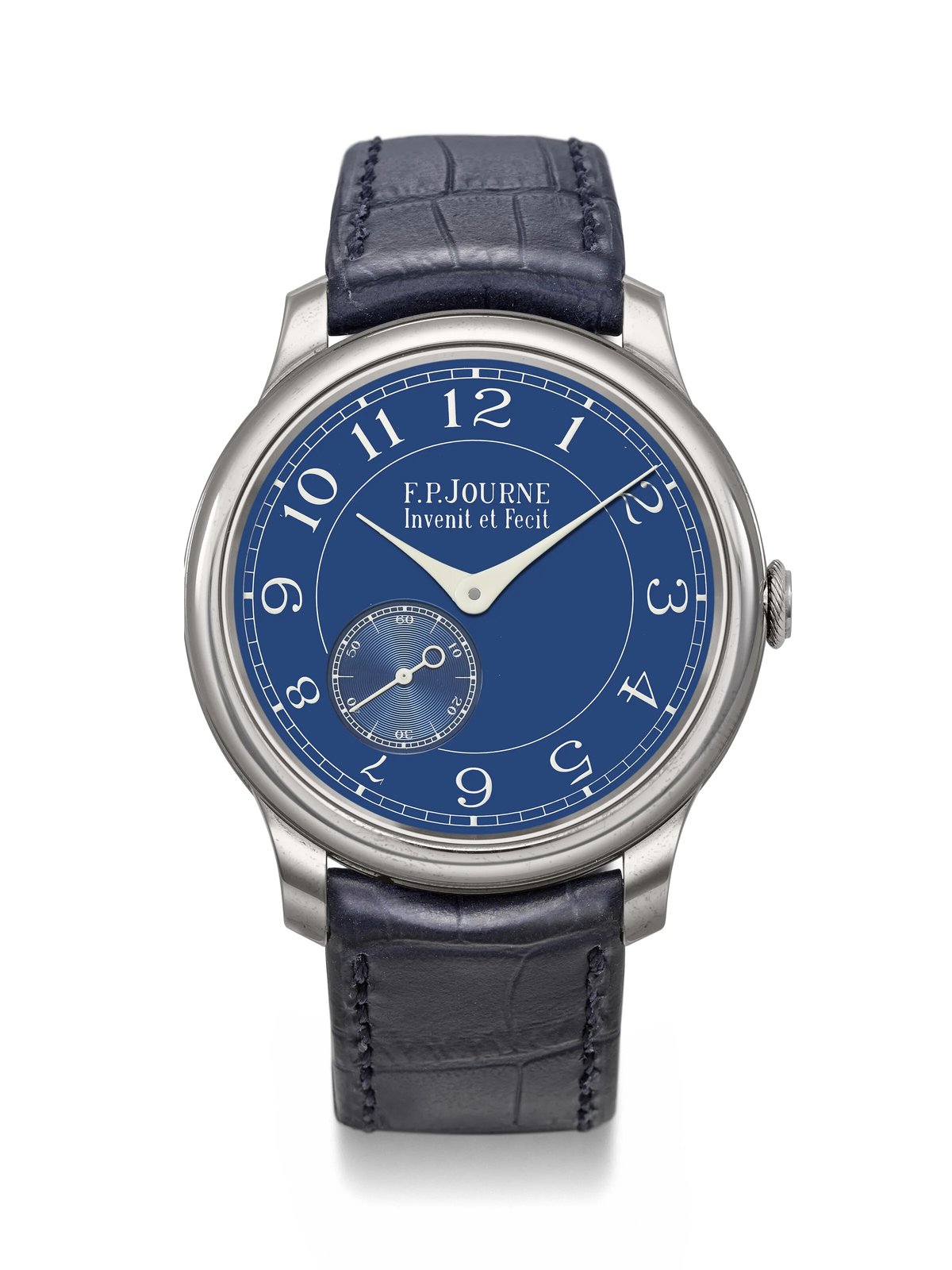
The dial is a study in understated elegance. A matte black or deep midnight blue surface (the exact hue varies by piece) is punctuated by a minimalist hour‑track and a discreet date window positioned at 6 o’clock. The true stars, however, are the two balance wheels, each visible through a sapphire‑crystal “window” that runs across the centre of the dial. Their synchronized oscillations are not just functional—they are a visual narrative of the resonance principle at work. The hands, finished in polished platinum, glide over the dial with a buttery smoothness that feels almost ceremonial.
Lugs are slim and slightly tapered, merging seamlessly into the case without disrupting the watch’s clean lines. The overall aesthetic is restrained, allowing the technical innovation to take centre stage rather than being drowned in superfluous decoration.
## Movement & Performance
At the heart of the Souscription lies the manual calibre 1499, a 36‑jewel movement engineered specifically for the resonance concept. Unlike a conventional single‑balance watch, this calibre houses two independent balance wheels, each equipped with its own hairspring. When the watch is wound, the wheels begin to oscillate at slightly different frequencies. Through a finely tuned coupling system, the wheels gradually lock into resonance, a phenomenon that averages out minute variations and stabilises the rate.
The result is a timepiece that, by design, reduces the cumulative error that typically plagues manual watches. While exact chronometer certification figures for this specific piece are not publicly disclosed, contemporary testing of Journe’s resonance watches consistently shows deviations well within the –4/+6 seconds per day range, a remarkable achievement for a manually wound calibre.
Power reserve sits around 48 hours, typical for a manual wind of this complexity. The winding experience is satisfying; the crown offers a crisp, audible click with each turn, and the winding crown’s position at 3 o’clock feels ergonomic. Because the watch lacks a water‑resistance rating (the source data lists this as null), it should be treated as a dress‑oriented instrument and avoided in wet environments.
## On the Wrist
Wearing the Chronomètre à Résonance “Souscription” is an exercise in quiet confidence. The platinum case, while substantial, is surprisingly lightweight thanks to the alloy’s density and the thin profile of the movement. Lug‑to‑lug measurement is roughly 46 mm, granting a comfortable fit on most wrist sizes without the watch feeling over‑extended.
The strap, typically a hand‑stitched alligator leather in black or dark brown, complements the watch’s understated dial while providing a supple, secure fit. The leather’s natural patina develops over time, adding a personal character that contrasts nicely with the immutable platinum case.
On the wrist, the dual balance windows draw the eye, offering a constant reminder of the watch’s mechanical conversation. The manual winding requirement means the wearer must engage with the piece regularly—a ritual that many enthusiasts cherish, though it may be a drawback for those accustomed to automatic convenience.
Comfort notes: the crown’s placement and the smooth sapphire crystal prevent any snagging, and the watch sits flush against the skin without protruding edges. However, the lack of a protective case‑back gasket means the watch is not suited for exposure to moisture or sudden temperature changes, reinforcing its role as a dedicated, indoor companion.
## Value & Verdict
From a pure rarity standpoint, the Chronomètre à Résonance “Souscription” No. 17 sits at the apex of independent haute horlogerie. Only twenty pieces were ever produced, each numbered and allocated through a subscription system that originally targeted the early patrons of Journe’s Tourbillon Souverain. This scarcity, combined with the watch’s pioneering resonance technology, makes it a highly coveted collector’s item.
The price point, while never officially disclosed in the source material, is undeniably high—reflected in the negative reviews that cite “very high price point limits accessibility.” In the secondary market, pieces from this series have fetched multi‑million‑dollar sums, underscoring their status as investment‑grade assets. For most collectors, the cost is a barrier; for the few who can acquire one, the watch offers not just a time‑telling instrument but a piece of horological history.
In terms of flaws, the absence of water resistance limits everyday practicality, and the manual winding requirement demands a level of dedication that may not align with modern, on‑the‑go lifestyles. Additionally, the extreme rarity means that service and parts availability could be challenging, though Journe’s workshop is known for its commitment to long‑term support of its creations.
**Verdict:** The Chronomètre à Résonance “Souscription” is less a conventional watch and more a kinetic sculpture that embodies François‑Paul Journe’s relentless pursuit of precision through innovation. Its 38 mm platinum case, dual‑balance calibre 1499, and limited‑edition pedigree combine to create a timepiece that is both technically brilliant and aesthetically restrained. While the lack of water resistance and the demanding manual wind may limit its everyday wearability, these are acceptable compromises for a watch whose primary purpose is to showcase an audacious horological concept and to serve as a collector’s trophy. For those who can meet the price and are prepared to treat it as a cherished, occasional wear piece, the Souscription remains one of the most compelling expressions of independent watchmaking in the 21st century.