The New Guard of Geneva: Contextualizing the FC-723WR3S6
In the world of high horology, geography is destiny. To be a 'Manufacture' in Plan-les-Ouates is to live in the shadow of giants. When Frederique Constant broke ground on their facility there, they weren't just building a factory; they were making a statement of intent. The Slimline Manufacture Power Reserve (ref. FC-723WR3S6) is the culmination of that intent. It is a watch that challenges the status quo of the Swiss watch industry by proving that the prestigious 'Manufacture' label doesn't have to be synonymous with a five-figure price tag.
For the modern collector—the person who grew up on a diet of tech-disruption and the democratization of information—the story of Frederique Constant resonates. Founded in 1988, they are infants compared to the centuries-old maisons. Yet, their lack of baggage is their strength. They aren't beholden to 200 years of 'doing things one way.' This allows them to iterate quickly, resulting in pieces like the FC-723WR3S6 that blend classical aesthetics with modern production efficiencies.
Aesthetics: The Architecture of the Dial
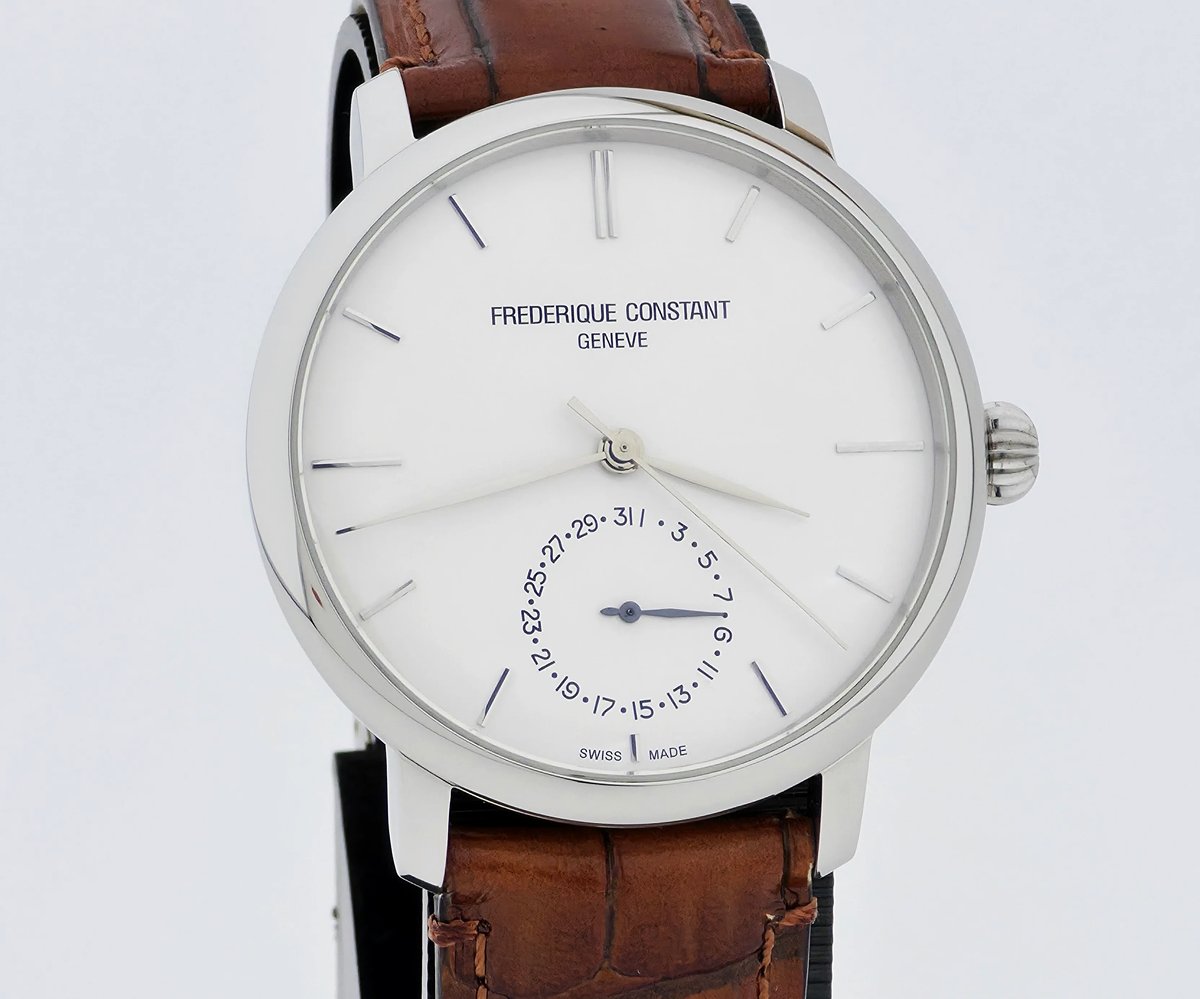
The first thing that strikes you about the FC-723WR3S6 is the dial. It is a masterclass in balance, despite its asymmetrical layout. The silver-colored dial features a subtle sunray finish that catches the light without being ostentatious. The printed black Roman numerals provide a stark, intellectual contrast, leaning into a 'Breguet-lite' aesthetic that feels timeless rather than dated.
The power reserve indicator at 10 o'clock is the star of the show. In a world of symmetrical dials, this complication adds a layer of visual interest that invites the eye to linger. Opposite this, at 6 o'clock, is the date pointer subdial. By eschewing a traditional date window, Frederique Constant maintains the dial's elegant texture and avoids the 'hole in the dial' look that plagues many modern dress watches. The hand-polished black hands are leaf-shaped, a choice that reinforces the watch's classical DNA.
Under the Hood: The Caliber FC-723
To understand this watch, you have to look through the sapphire caseback. The FC-723 is not a modified ETA or Sellita movement with a module slapped on top. It is an in-house caliber developed, produced, and assembled by Frederique Constant. This is a significant distinction. In the $3,000 to $4,000 price bracket, most brands are still relying on third-party movements. Frederique Constant’s ability to offer a manufacture movement with a power reserve complication is a feat of industrial engineering.
The finishing is surprisingly high-end for the price point. You’ll find circular Côtes de Genève on the bridges, perlage on the baseplate, and an open-worked gold-toned rotor. While these are likely executed by machine rather than a master artisan with a boxwood tool, the effect is nonetheless stunning. It provides that 'mechanical soul' that collectors crave. The frequency of 28,800 vph ensures a smooth sweep of the seconds hand, and the 50-hour power reserve is a welcome upgrade from the standard 38-42 hours found in entry-level Swiss movements.
The Wrist Experience: Elegance vs. Reality
There is a common misconception that 'Slimline' means 'Ultra-Thin.' At 12.2mm, the FC-723WR3S6 has some meat on its bones. However, the way the case is shaped—with a tapered mid-case and a rounded bezel—allows it to wear much thinner than the calipers suggest. It is a watch designed for the boardroom and the gala. It feels substantial on the wrist, a reminder that you are wearing a piece of serious machinery, yet it never feels cumbersome.
The 40mm diameter is the modern standard for a dress watch. While purists might argue for 37mm or 38mm, the 40mm size gives the complications room to breathe. The lug-to-lug distance is kept short, which prevents the watch from overhanging the wrist. This is a crucial design choice, as it allows the watch to maintain its formal silhouette even on slender wrists. The black alligator leather strap is of high quality, featuring a deployant clasp that is both secure and elegantly branded with the Frederique Constant crest.
The Competitive Landscape
When you look at the competition, the value proposition of the FC-723WR3S6 becomes even clearer. A Jaeger-LeCoultre Master Ultra Thin with a similar power reserve complication will cost you upwards of $10,000. While the JLC offers superior hand-finishing and a thinner profile, the Frederique Constant provides 80% of the experience for 30% of the price. Even compared to brands like Nomos, which also offers in-house movements, Frederique Constant wins on 'traditional' Swiss aesthetics. Nomos is Bauhaus and modern; Frederique Constant is Genevan and classical.
For the discerning buyer or the young professional looking for their first 'real' watch, this reference is a strategic choice. It shows a level of discernment. It says you didn't just buy what was trending on Instagram; you did your homework on movements and manufacture pedigree.
Investment and Longevity
Let’s be real: you aren't buying a Frederique Constant to flip it. These watches do not see the vertical price action of a Patek Nautilus or a Rolex Daytona. However, they represent a stable asset in a collection. Because the movement is in-house, the watch will always have a baseline value to collectors who appreciate technical merit. The serviceability is also a plus; Frederique Constant has built a global service network, ensuring that this watch can be a multi-generational piece if properly maintained.
Final Verdict: A Modern Classic
The Frederique Constant Slimline Manufacture Power Reserve (FC-723WR3S6) is a triumph of 'accessible luxury.' It bridges the gap between the entry-level Swiss brands and the high-end maisons. It offers a sophisticated complication, a manufacture movement, and a timeless aesthetic in a package that is attainable. For the collector who values the 'how' and 'where' of a watch's creation, there is perhaps no better value on the market today. It is a quiet flex, a stealth-wealth staple, and a testament to the fact that the future of Swiss watchmaking is as much about innovation in production as it is about tradition.