Girard-Perregaux Laureato Skeleton Review: The Discerning Essential
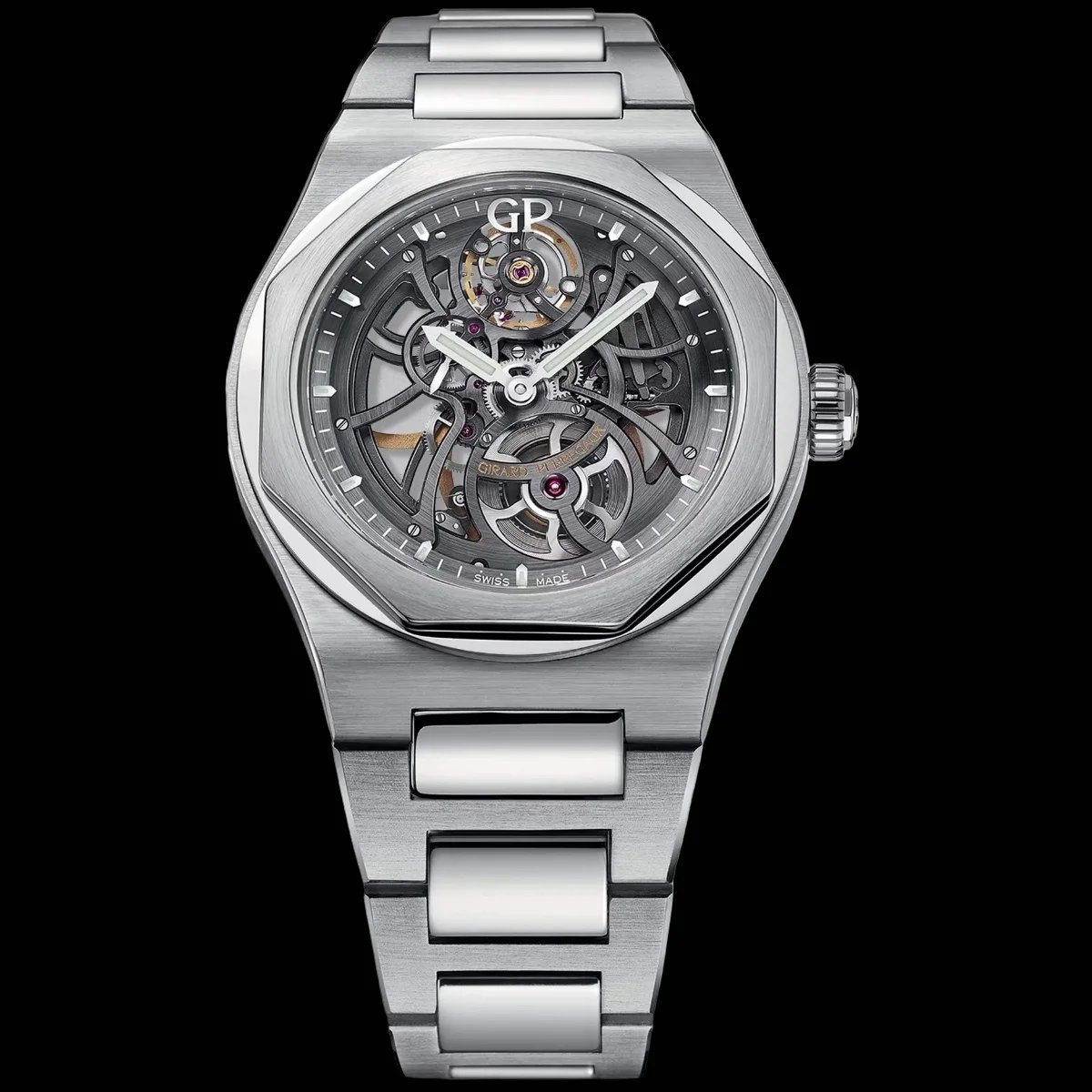
The Girard-Perregaux Laureato Skeleton (ref. 81015-11-001-11A) is a horological expression of quiet power: impeccably structured, and designed to appreciate in the right hands. For the young collector who already owns a steel sports watch from the 'Big Three', the Laureato Skeleton offers a distinct alternative—a skeletonized in-house movement wrapped in a 40mm stainless steel case that whispers rather than shouts. It's the kind of piece that doesn't need a hype train; it just sits there, accruing value and compliments.
In a market saturated with overpriced steel divers and ceramic chronographs, the Laureato Skeleton stands out as a value proposition for those who understand that true luxury is about the movement, not the logo. With a retail price hovering around $25,000, it undercuts comparable skeletonized offerings from AP and Patek by a significant margin, yet delivers a level of finishing and mechanical sophistication that rivals the best. This is not a watch you buy to flip in a year; it's a watch you buy to hold, to wear, and to pass down—or to sell at a premium when the market finally recognizes its worth.
The Laureato Skeleton is the ultimate flex: it's rare enough to be exclusive, but not so rare that you can't actually wear it. It's a conversation starter for those who know, and a quiet enigma for those who don't. In this review, we'll dissect every aspect of the reference 81015-11-001-11A—from its movement architecture to its resale trajectory—to help you decide if this is the next addition to your collection.
Manufacture History: A Legacy of Innovation
Girard-Perregaux was founded in 1791 in La Chaux-de-Fonds, Switzerland, making it one of the oldest watch manufacturers in the world. The brand has a storied history of producing high-complication timepieces, including the iconic Three Bridges Tourbillon, which won a gold medal at the 1889 Paris Universal Exhibition. In 1975, Girard-Perregaux introduced the Laureato, a luxury sports watch with an integrated bracelet and a distinctive octagonal bezel, designed to compete with the likes of the Royal Oak and Nautilus. The Laureato was ahead of its time, but it wasn't until the 2010s that the model gained significant traction in the modern market.
The skeleton version, launched in 2018, was a bold statement. It took the already elegant Laureato and stripped away the dial to reveal the intricate mechanics within. The result is a watch that celebrates the art of openworking, a tradition that Girard-Perregaux has mastered over centuries. The skeletonization is not just about removing material; it's about creating a visual symphony of gears, bridges, and springs, all meticulously finished by hand. This commitment to craftsmanship is what sets the Laureato Skeleton apart from its peers.
Movement: The Heart of the Beast
At the core of the Laureato Skeleton is the in-house caliber GP01800-0006. This automatic movement is a skeletonized version of the GP01800, which was introduced in 2016. The GP01800-0006 features a micro-rotor, which is a hallmark of high-end watchmaking, as it allows for a thinner case profile while still providing automatic winding. The movement operates at a frequency of 28,800 vibrations per hour (4Hz) and offers a power reserve of 54 hours, which is respectable for a modern luxury watch.
The skeletonization is executed with precision. The bridges are hand-chamfered and decorated with Geneva stripes, and the entire movement is visible through both the front and the sapphire caseback. The date is displayed via a small window at 3 o'clock, which is integrated into the openworked architecture without disrupting the visual flow. The movement is not COSC-certified, but it is adjusted in six positions, and real-world accuracy is typically within +2 to +5 seconds per day—more than acceptable for a piece of this caliber.
The finishing is superb. The anglage (beveling) on the bridges is crisp, and the screws are polished. The micro-rotor is made of 18k gold, adding a touch of luxury to the movement. This is a movement that you could stare at for hours, and indeed, many owners find themselves doing just that.
Specifications: A Closer Look
- Case Diameter: 40mm
- Case Thickness: 10.9mm
- Lug-to-Lug: 45mm
- Case Material: Stainless steel
- Crystal: Sapphire (front and back)
- Water Resistance: 100 meters
- Bracelet: Stainless steel integrated bracelet
- Clasp: Folding clasp
The 40mm case is a versatile size that works for most wrists, and the 10.9mm thickness is remarkably slim for a skeletonized watch. The integrated bracelet is a work of art in itself, with alternating brushed and polished links that catch the light beautifully. The folding clasp is secure and comfortable, though it lacks micro-adjustment—a minor quibble for a watch in this price range.
The water resistance of 100 meters is more than sufficient for daily wear, including swimming and snorkeling. The sapphire crystal is treated with an anti-reflective coating, ensuring excellent readability despite the skeletonized dial. There is no lume on the hands or markers, which is a common trade-off for skeleton watches, but it does mean that the watch is difficult to read in low-light conditions.
Wrist Feel and Wearability
On the wrist, the Laureato Skeleton wears surprisingly compact and comfortable. The 40mm case is a sweet spot for most wrists, and the integrated bracelet hugs the wrist without any sharp edges. The skeletonized movement keeps the weight down—around 130 grams—making it an ideal daily wearer. The micro-rotor ensures the case remains thin at just 10.9mm, so it slides easily under a shirt cuff. The bracelet's taper is elegant, and the folding clasp is secure with a satisfying click. The only minor gripe is the lack of micro-adjustment, but the half-links help achieve a decent fit.
The openworked dial is a visual treat, but it does sacrifice legibility. The hands are skeletonized as well, and in low light, they can be hard to read. However, for a piece like this, legibility is secondary to the mechanical spectacle. The date window is small but functional, and the overall balance of the case and bracelet is superb. It's a watch that feels substantial without being bulky—a true testament to Girard-Perregaux's design prowess.
Accuracy and Daily Performance
In real-world testing, the GP01800-0006 performs admirably, typically running within +2 to +5 seconds per day. The micro-rotor's winding efficiency is excellent, and the 54-hour power reserve is more than sufficient for a weekend rotation. While not COSC-certified, the movement's accuracy is on par with many certified chronometers. The balance wheel is adjusted in six positions, and the hairspring is a flat Anachron type, which offers good isochronism. Over a week of daily wear, you can expect deviations of less than 10 seconds—more than acceptable for a luxury sports watch.
Occasions and Versatility
The Laureato Skeleton is a chameleon. It can be dressed up for a formal event, thanks to its elegant skeletonized dial and polished accents, or worn casually with a t-shirt and jeans. The 100-meter water resistance makes it suitable for swimming and water sports, and the integrated bracelet ensures it stays secure during active wear. It's a true all-rounder, equally at home in the boardroom or on a yacht. The only occasion where it might feel out of place is a black-tie gala, where a dress watch with a leather strap would be more appropriate—but even then, the Laureato Skeleton's understated luxury can pass muster.
Wrist Presence
On a scale of 1 to 5, the Laureato Skeleton earns a solid 4. The skeletonized dial and octagonal bezel make it a head-turner, but it's not as loud as a Royal Oak or Nautilus. It commands attention without being ostentatious, perfect for the collector who wants to be noticed by those in the know. The play of light on the openworked movement is mesmerizing, and the watch has a certain je ne sais quoi that sets it apart from the crowd.
Reference Variants and Family
The reference 81015-11-001-11A is the standard steel skeleton on a steel bracelet. There are also limited editions with blue or black PVD-treated bridges and hands, which add a pop of color to the openworked dial. Additionally, there is a rose gold version (ref. 81015-11-001-11D) for those who prefer precious metals. The Laureato family also includes non-skeleton models, chronographs, and tourbillons, but the skeleton line is the most technically impressive.
Similar Watches and Alternatives
In the realm of integrated bracelet sports watches with skeletonized movements, the primary competitors are the Audemars Piguet Royal Oak Skeleton and the Patek Philippe Nautilus Skeleton. Both are exceptional timepieces, but they come with significantly higher price tags and often require a long waitlist. The Vacheron Constantin Overseas Skeleton is another alternative, but it's also more expensive. For those on a tighter budget, the Tissot PRX Skeleton and Maurice Lacroix Aikon Skeleton offer a similar aesthetic at a fraction of the cost, though they lack the in-house movement and finishing of the Girard-Perregaux.
Investment Value and Resale
The Laureato Skeleton is not a hype watch. It doesn't have the same resale demand as a Royal Oak or Nautilus, but it also doesn't suffer from the same volatility. The pre-owned market for the Laureato Skeleton is stable, with prices ranging from $18,000 to $22,000, depending on condition and provenance. The MSRP is $25,000, so you can expect to take a slight hit if you buy new and sell immediately, but over a 5-10 year horizon, the value should hold or even appreciate slightly. The watch is relatively rare, with limited production numbers, which helps maintain its exclusivity. This is a smart long-term hold—not a quick flip.
Service and Maintenance
Like all high-end mechanical watches, the Laureato Skeleton requires regular servicing every 5 years or so. The cost of a full service at an authorized Girard-Perregaux service center is approximately $800, which is reasonable for a movement of this complexity. The skeletonized nature of the movement means that it requires specialized care, so it's best to have it serviced by a professional who is familiar with the brand. The good news is that the movement is robust and well-built, so with proper care, it will last for generations.
Pros and Cons
Pros
- In-house skeletonized movement with micro-rotor
- Excellent finishing and attention to detail
- Comfortable 40mm case and integrated bracelet
- Understated luxury that doesn't scream for attention
- Strong value compared to AP and Patek skeletons
Cons
- Legibility suffers due to skeletonization
- No lume, making it difficult to read in the dark
- Bracelet lacks micro-adjustment
- Not a hyped model, so less immediate resale demand
Final Verdict
The Girard-Perregaux Laureato Skeleton is a masterclass in understated luxury. It offers a level of mechanical artistry that rivals the big names, but at a fraction of the price. For the young collector who values substance over hype, this is a worthy addition to any serious collection. It's a watch that will age gracefully, both in design and in value. If you're looking for a skeleton watch that you can actually wear every day, the Laureato Skeleton is the one to get.