The Saxon Philosophy of Time
In the quiet valley of Glashütte, time is measured differently. It is not merely the passage of seconds, but the meticulous accumulation of mechanical refinements. The Glashütte Original PanoMaticLunar (ref. 1-90-02-42-32-61) is the physical manifestation of this philosophy. While the Swiss often lean into the romanticism of the watchmaker at the bench, the Germans—and Glashütte Original specifically—lean into the engineering of the movement as a structural marvel. This reference, with its ruthenium-coated dial, offers a monochromatic, architectural look that feels both modern and deeply rooted in 19th-century chronometry.
The Dial: A Study in the Golden Ratio
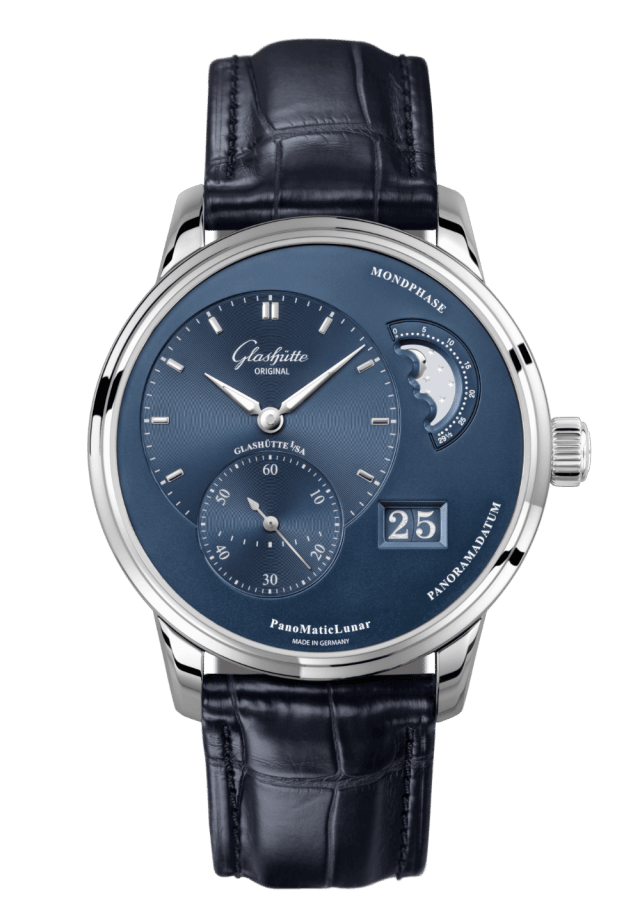
The first thing one notices about the PanoMaticLunar is the asymmetry. To the uninitiated, it might seem chaotic, but the layout is governed by the 'Golden Ratio'—the mathematical proportion of 1:1.618 that has guided artists and architects from the Parthenon to Leonardo da Vinci. The centers of the time and date displays are aligned on a vertical axis, while the moon phase and the Panorama Date occupy the right hemisphere of the dial. This creates a visual tension that is resolved by the sheer balance of the elements.
The dial itself is produced in Pforzheim, at Glashütte Original’s dedicated dial manufactory. The galvanic ruthenium finish is a masterclass in texture. Depending on the light, it shifts from a charcoal grey to a deep, shimmering slate. The concentric 'azurage' finish on the hour and minute sub-dials adds a layer of depth that contrasts with the satin-brushed surface of the main dial. The moon phase, located at 2 o'clock, features a silver moon against a midnight blue sky, providing the only pop of color in an otherwise austere and sophisticated landscape.
The Panorama Date: Clarity Through Complexity
One cannot discuss Glashütte Original without mentioning the Panorama Date. Unlike the standard date windows found on most Swiss watches, which utilize a single disc or two overlapping discs at different heights, the Panorama Date uses two concentric discs mounted on the same plane. This eliminates the 'step' between the two digits, creating a seamless and highly legible display. The mechanical snap of the date at midnight is a tactile reminder of the torque and precision required to move these larger components. It is, quite simply, the most legible date complication in the world of high horology.
The Calibre 90-02: Behind the Sapphire Caseback
While the dial is a work of art, the true soul of the PanoMaticLunar lies in the Calibre 90-02. This is an in-house automatic movement that showcases the hallmarks of Glashütte watchmaking. The first thing to catch the eye is the three-quarter plate, a traditional Saxon design that provides greater stability to the gear train compared to the multiple bridges found in Swiss movements. The plate is decorated with Glashütte stripes—a wider, bolder version of Côtes de Genève.
The centerpiece of the movement is the duplex swan-neck fine adjustment. While a single swan-neck is used to adjust the rate (the speed at which the watch runs), the duplex system allows for the adjustment of the beat (the symmetry of the balance wheel's swing). This is not just a functional component; it is a decorative one. The balance bridge is hand-engraved with a floral motif, meaning that no two PanoMaticLunar movements are exactly alike. The skeletonized rotor, featuring a 21-carat gold oscillation weight, ensures that the movement remains wound while allowing an unobstructed view of the finishing below.
Wrist Presence and Ergonomics
On the wrist, the 40mm case is the 'Goldilocks' size for the modern collector. It has enough presence to be noticed but remains elegant enough for formal occasions. The 12.7mm thickness is a result of the complex movement architecture, but the stepped bezel and curved lugs help to mask the height. The stainless steel case is finished with a mix of polished and brushed surfaces, highlighting the sharp lines of the Saxon design.
The choice of a grey Louisiana Alligator strap for this ruthenium reference is inspired. It creates a cohesive, monochromatic look that emphasizes the technical nature of the watch. The deployant buckle is substantial and feels over-engineered in the best way possible, providing a counterweight to the watch head that keeps it centered on the wrist.
The Value Proposition in a Crowded Market
In a world where steel sports watches often trade for multiples of their retail price based on hype alone, the PanoMaticLunar offers a refreshing return to substance. When compared to its neighbor in Glashütte, A. Lange & Söhne, the PanoMaticLunar provides about 85% of the finishing and 100% of the Saxon soul for roughly 30% of the price of a Lange 1. For the young, sophisticated collector, this is an entry into the highest levels of horology without the gatekeeping or the astronomical price tags associated with Swiss 'Holy Trinity' brands.
Conclusion: A Modern Classic
The Glashütte Original PanoMaticLunar 1-90-02-42-32-61 is not a watch for someone who wants to blend in. It is a watch for someone who appreciates the 'why' behind the 'what.' It is for the collector who spends their Sunday evenings under a loupe, tracing the hand-engraved lines of the balance bridge and watching the slow, poetic transition of the moon phase. It is a masterpiece of Saxon engineering that deserves a place in any serious collection.