The Genesis of the 24-Hour Dial
To understand the Glycine Airman, one must first understand the specific requirements of mid-century long-haul aviation. In 1953, the Douglas DC-4 was the workhorse of the skies. Pilots were navigating across multiple time zones, often relying on radio signals and celestial navigation. The need for a watch that could display Greenwich Mean Time (GMT) alongside local time—or simply track time on a 24-hour scale to avoid AM/PM confusion—was paramount.
While the Rolex GMT-Master (developed for Pan Am) famously utilized a fourth hand to track a second time zone, Glycine took a more radical approach. The 'Purist' Airman utilized a movement where the hour hand completed only one revolution per day. This layout allowed the pilot to read the time directly off a 24-hour scale, mirroring the way flight logs and navigation charts were written. It was a purely technical solution to a technical problem, devoid of the marketing gloss that would later define the luxury watch industry.
Movement Architecture: The GL293
The heart of the modern Airman is the Caliber GL293. For the technical enthusiast, this movement is a fascinating study in adaptation. Based on the Sellita SW330-2, the GL293 is an automatic, hacking movement with a frequency of 28,800 vibrations per hour (4Hz). This high beat rate ensures a smooth sweep of the seconds hand, a critical feature for pilots timing maneuvers or fuel consumption.
In the 'Purist' models, Glycine’s watchmakers modify the gear train to reduce the hour hand's rotational speed by 50%. This modification is seamless but requires a recalibration of the date change mechanism to ensure it triggers at the 24:00 mark. The movement is finished with rhodium plating and perlage on the bridges, visible through many modern Airman casebacks. While the finishing is industrial rather than artisanal, it is executed with a precision that speaks to the watch's utilitarian roots. The use of 21 jewels and a Nivaflex hairspring ensures long-term reliability and resistance to magnetic interference—a common hazard in the cockpit environment.
The Case and the Locking Bezel
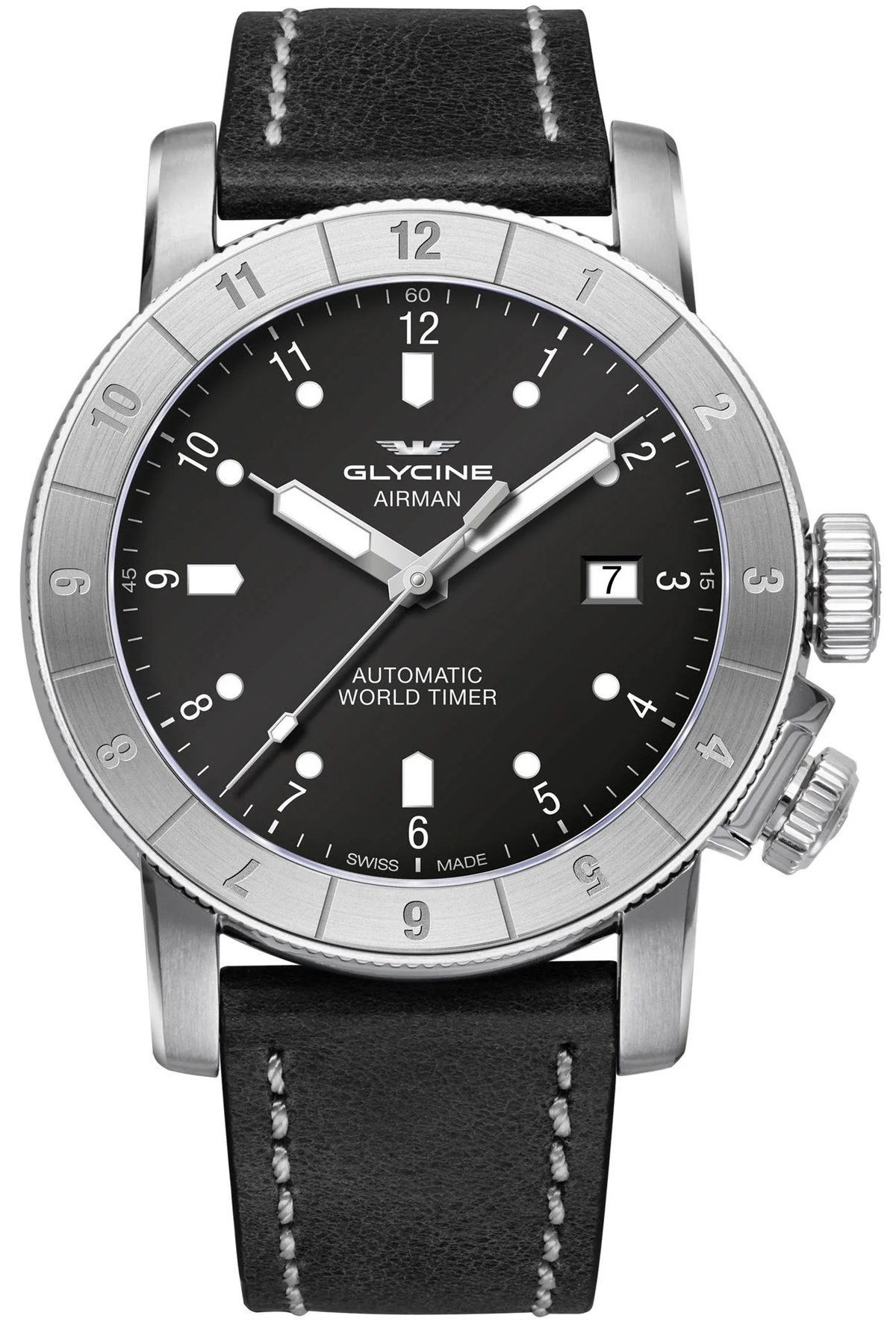
The most distinctive physical feature of the Airman is the secondary crown at the 4 o'clock position. This is not a crown in the traditional sense, but a locking nut for the bidirectional 24-hour bezel. This mechanism is a masterclass in fail-safe engineering. Once the pilot has aligned the bezel to track a second (or third) time zone, tightening the 4 o'clock crown clamps a small hatch over the bezel's edge, preventing accidental adjustment during flight.
The case itself, particularly in the No. 1 and The Chief iterations, retains the classic 1950s proportions. The 40mm diameter is the 'sweet spot' for the modern collector, offering presence without the bulk of contemporary 'overbuilt' pilot watches. The lugs are drilled, a nod to the watch's tool-watch heritage, allowing for quick strap changes in the field. The transition from the polished top surfaces to the brushed flanks is sharp, indicating a high level of machining quality that belies the watch's relatively accessible price point.
Dial Legibility and Lume
Reading a 24-hour dial requires a cognitive shift. Noon is at the bottom (6 o'clock position on a standard watch), and midnight is at the top. Glycine aids this transition through a masterfully printed dial. The Arabic numerals are crisp, with a font that has remained largely unchanged for seven decades. The 'syringe' hands are filled with Super-LumiNova, providing a green glow that ensures legibility in low-light conditions.
The date window at 3 o'clock (or 6 on a 24-hour scale) is often magnified by a cyclops on certain references, though purists often prefer the clean lines of the non-magnified sapphire crystal. The use of a matte finish on the dial prevents glare, a crucial consideration when flying toward a setting sun at 30,000 feet.
Wrist Feel and Ergonomics
On the wrist, the Airman is a lesson in balance. The 12.2mm thickness allows it to slip under a shirt cuff, making it a viable candidate for daily office wear. However, it truly shines when paired with a rugged NATO strap or a vintage-style leather band. The long lugs ensure that the watch sits flat on the wrist, distributing its weight evenly. For the collector who finds the modern 44mm+ pilot watches too cumbersome, the Airman offers a refined, historically accurate alternative that doesn't sacrifice technical capability.
Investment and Value Proposition
In a market where prices for 'heritage' models from major brands are skyrocketing, the Glycine Airman remains an outlier. It offers genuine, documented military and aviation history at a fraction of the cost of its contemporaries. While it is unlikely to see the meteoric price appreciation of a vintage Daytona, it possesses a stable value underpinned by a dedicated global cult following. The Airman is a 'stealth-wealth' choice—a watch that signals deep horological knowledge rather than just deep pockets.
Final Verdict
The Glycine Airman is not merely a watch; it is a navigational instrument that has survived the transition from the mechanical age to the digital age without losing its soul. Its 24-hour movement and unique locking bezel are reminders of a time when watches were essential tools for survival. Whether you are a frequent traveler or a technical enthusiast, the Airman provides a unique perspective on time—one that is measured not just in hours and minutes, but in the history of human flight.