Why the One Hertz Still Matters
In 2011, two Dutch brothers entered the Grand Prix d'Horlogerie de Genève with their first serially produced wristwatch and left with a prize. The watch was the Grönefeld One Hertz, catalogued as reference 1896, and the whole idea was in the name: one hertz. One beat per second. A seconds hand that jumps.
Deadbeat seconds — seconde morte — is not a new idea. Precision pocket watches used it in the nineteenth century because a hand that lands on a mark once a second is easier to read and easier to time against than one that sweeps. The problem is mechanical. A jumping seconds hand needs a big slug of torque at the instant it trips, and on a conventional movement that torque is stolen from the going train. The balance gets disturbed, the rate wanders, and the complication becomes a party trick that quietly ruins the timekeeping.
Grönefeld's answer was to give the jumping seconds its own gear train and its own energy source, isolating it from the escapement entirely. That is the technical heart of the One Hertz, and it is why the watch still gets pulled out of safes and argued about at dealer dinners. It is also why the 1896 has quietly become one of the more interesting positions in an independent-heavy collection.
The House: Grönefeld
Tim and Bart Grönefeld are brothers from Oldenzaal, in the eastern Netherlands, from a family with deep roots in Dutch watchmaking. Before launching their own brand in 2008, both worked at the highest end of the Swiss complication trade, including time at Renaud & Papi, the complications workshop behind some of the most expensive watches ever made.
That pedigree matters for the 1896. The One Hertz was not a first attempt by enthusiastic amateurs; it was the debut of two men who had spent years building tourbillons and repeaters for other people's brands. The house has since become known for the 1941 Remontoire, the Parallax Tourbillon, the 1941 Grönograaf and the 1941 Principia — all small-production, all hand-finished, and all trading well above original retail on the secondary market.
The Movement: A Deadbeat Seconds Done Properly
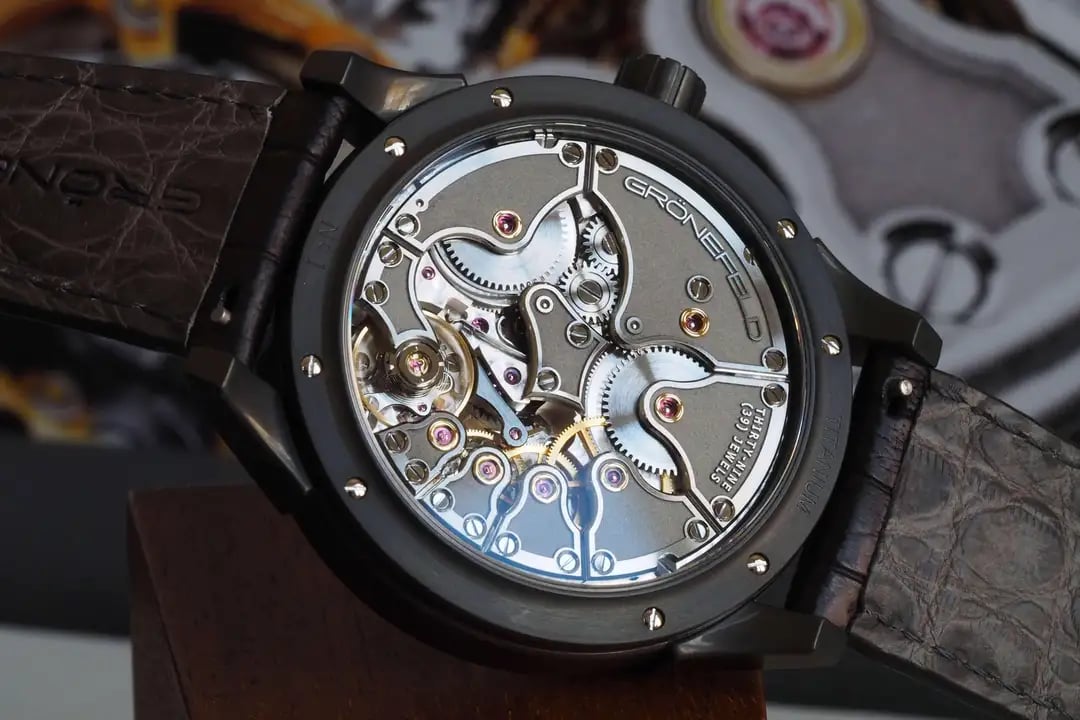
The One Hertz is hand-wound, in-house, and built around the deadbeat seconds display. The architecture is the point: the jumping seconds runs off a dedicated gear train with its own energy source, so the moment of the jump never touches the balance's supply of power. The result is a seconds hand that snaps from mark to mark once per second without the amplitude dip you would normally expect from a jumping display.
That separation is the difference between a watch that displays a deadbeat seconds and a watch engineered around one. Most jumping-seconds watches — and there are only a handful — either accept the rate penalty or hide it behind a constant-force device. Grönefeld simply removed the conflict.
Finishing is at the level you would expect from a brand that spent its formative years in the complications atelier. Bridges are hand-bevelled, steel components are black-polished, and the whole assembly is put together to a standard that stands comfortably next to the Vallée de Joux's best. Because the caseback is sapphire, you get to look at it — which, for a watch at this level, is half the reason you bought it. Grönefeld does not chase chronometer certification on this model, and it does not need to. The One Hertz is a horological statement first and a rate certificate second.
Case, Dial and Wrist Feel
The 1896 is a round, sculpted case with a stepped bezel and the kind of softly faceted lugs that read as expensive from across a room. In stainless steel — the material of the launch edition — it has real presence on the wrist without the flash of a gold case. The titanium version is the one to look for if you actually wear your watches: it disappears on the wrist in the way titanium always does, and it lets the dial do the talking.
The dial layout gives the jumping seconds the centre stage it deserves, with the hours and minutes pushed into an off-centre subdial and the seconds hand sweeping the full diameter of the dial. It is a legible, confident design that does not look like anything else in the independent space, which is rarer than it sounds.
On the wrist, the One Hertz feels like a piece of precision machinery rather than a piece of jewellery. The case sits flat and balanced, the hand-stitched alligator strap softens quickly, and the whole package has the density you want from a watch with this much going on inside. It is not a subtle watch, but it is not a loud one either — the kind of thing that gets noticed by the two people in the room who matter and ignored by everybody else.
Accuracy and Daily Ownership
Here is the honest version: the deadbeat seconds does not make the watch more accurate. The balance and escapement are conventional and well executed, and the jumping hand is a display complication, not a rate-improving one. What you get is a properly regulated independent movement that should hold within a handful of seconds a day in normal wear, and a seconds hand that makes setting the watch against a reference clock genuinely satisfying.
Ownership is where the 1896 demands commitment. Servicing goes back to the Netherlands, lead times at small independents are measured in months rather than weeks, and there is no meaningful third-party parts channel. If you are the kind of collector who wants a watch you can hand to any high street watchmaker, this is not it. If you are the kind of collector who keeps a relationship with the brand, it is a non-issue.
The Variants
The One Hertz family is small. The launch edition arrived in stainless steel with a light, silvered dial and an alligator strap — the purist's choice and, in my view, the one that will always be the most collectible because it is the reference that won Geneva. A titanium variant followed with a darker dial, lighter on the wrist and marginally more casual in character. Then there is the One Hertz 1912, a later limited edition with a vintage-leaning dial treatment, produced in a reported run of twelve pieces.
Because total production across all variants is believed to be measured in the dozens rather than the hundreds, which variant you buy matters less than which example. Condition, completeness and provenance will drive the price more than the dial colour ever will.
The Market: Hold vs. Flip
Let's talk money, because that is why you are here.
The One Hertz launched at roughly the mid-$30,000s, which for a hand-finished, in-house, award-winning independent was aggressive at the time and looks like a bargain in hindsight. It is long out of production, so there is no retail channel — every example is a secondary-market transaction, and supply is tiny enough that market price is really whatever the last two dealers agreed on.
When examples surface, asking prices generally sit in the $40,000 to $70,000 band depending on variant, condition and completeness. That is a meaningful premium over original retail, and it has held rather than spiked and collapsed. The auction record is thin — this is not a watch that appears at public sale often enough to build a proper price graph — which cuts both ways. Thin records mean less transparency, but they also mean no public ceiling has been set, and independents with genuine scarcity tend to grind upward rather than moon.
The bull case is straightforward. This is the first watch from a brand that has since become one of the most respected names in independent horology. It won a Grand Prix. It contains a genuinely novel mechanism. Total production is minuscule. Every one of those factors is the kind of thing that gets repriced upward when a brand's later work becomes unobtainable.
The bear case is equally simple. It is a deadbeat seconds watch, which is a connoisseur's complication, not a mainstream one. It is not a Nautilus or a Royal Oak and it will never have that kind of liquidity. If you need to sell in a hurry, you will be selling to a small pool of buyers who already know exactly what the watch is worth.
My take: hold. This is not a flip. The flip window on the One Hertz closed years ago, and the people who make money on it are the ones who bought it because they wanted it and then discovered, a decade later, that the market had come to them. If you find a complete example in steel at a sane price, buy it and put it in the rotation. If you are buying it as a trade, you are late.
Alternatives and the Homage Question
If you want a deadbeat seconds and the One Hertz is out of reach, the shortlist is short. Habring²'s Dead Second is the accessible entry point — Austrian, independent, properly made, and a fraction of the price. Jaquet Droz's Grande Seconde Deadbeat is the more formal, more heavily decorated alternative. And if what you actually want is an independent technical showpiece rather than a jumping seconds specifically, Romain Gauthier's Logical One scratches the same itch with a chain-and-fusee constant force instead.
Homages, thankfully, do not exist. Nobody is making a $250 copy of a Dutch deadbeat seconds, because the mechanism is the entire point and the mechanism is not cheap to fake. The closest thing to a budget analogue is a quartz watch, whose seconds hand ticks once per second by definition. A Mondaine or a Braun gives you the visual rhythm of a one-hertz display for pocket change — which is a fun thing to own, and absolutely not the same thing.
The Verdict
The Grönefeld 1896 One Hertz is the rare independent debut that has aged into a blue-chip position. It is technically serious, visually distinct, produced in numbers that guarantee scarcity, and backed by a brand whose later work has only made the first watch more desirable. It is not liquid, it is not cheap, and it is not for someone who wants a one-call exit.
But for the collector who already has the mainstream pieces and is looking for something with a real story, a real mechanism and a real chance of appreciation, the One Hertz is one of the better answers in the independent market. Buy the steel, keep the papers, wear it, and let the market come to you.
Pros and Cons
Pros: a genuinely novel mechanism with the deadbeat seconds isolated on its own gear train and energy source; the first watch from a brand that became a major independent; award-winning, tiny production and long out of catalogue, so scarcity is structural rather than manufactured; a hand-finished in-house movement visible through a sapphire caseback; and steel and titanium options that keep it wearable rather than a safe queen.
Cons: not liquid, with a small buyer pool that already knows the value; a connoisseur's complication rather than a mainstream one, which caps the upside; servicing that requires shipping back to the Netherlands with long lead times and no third-party parts channel; an opaque, dealer-dependent price picture thanks to a thin auction record; and no retail channel at all, so every purchase is a negotiation.