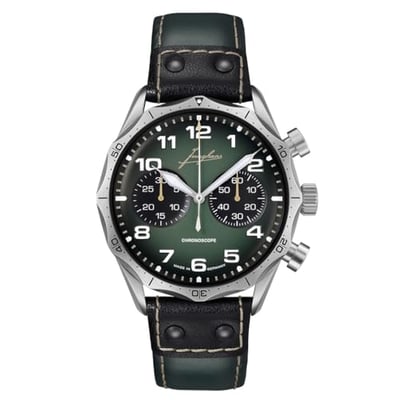
Grönefeld 1941 Quadrivium: The Quietest Flex in Watchmaking
There are two ways to spend six figures on a wristwatch. The first is to buy the thing everyone at the table recognises — the Nautilus, the Royal Oak, the Daytona — and let the market do your talking. The second is to buy the thing nobody at the table recognises, and then spend the next four years quietly enjoying the fact that the one person who does recognise it is the one person whose opinion you actually care about.
Grönefeld lives in the second category. The Dutch atelier of brothers Tim and Bart Grönefeld has been building watches in tiny numbers since the late 2000s, and the 1941 Quadrivium — the most complicated expression of the house's core 1941 line — is about as pure an example of the type as you can buy. It is not a watch you buy to be seen. It is a watch you buy because you know what a hand-bevelled bridge looks like under a loupe, and you want one on your wrist.
This is a review for people who already understand that. We'll cover the house, the watch, the movement, how it wears, and — because this is Vivir — what it does to your balance sheet.
The House: Two Brothers in Oldenzaal
Grönefeld is not a marketing exercise with a workshop attached. It is a workshop that happens to have a brand attached. Tim and Bart Grönefeld grew up in Oldenzaal, in the eastern Netherlands, in a family of watchmakers and clock restorers. Before they ever put their own name on a dial, they spent years at the bench with antique clocks and complicated pocket watches — the kind of work that teaches you what a real interior angle looks like, because you have to file one yourself.
The brand as such took shape around 2008. The breakthrough piece was the One Hertz, a deadbeat-seconds watch that announced the brothers as genuine movement architects rather than assemblers of bought-in ébauches. From there the house built the 1941 collection, named for a 1941 milestone in the family's horological lineage, and that collection became the core of the brand: the 1941 Remontoire with its constant-force remontoire visible on the dial, the 1941 Principia as the automatic entry point, and the 1941 Grönograaf as the chronograph.
The Quadrivium sits at the complication-heavy end of that family. And the production numbers matter enormously here. Grönefeld does not make thousands of watches a year — it makes dozens, at most a small hundred. That single fact drives almost everything else about owning one: the finishing, the pricing, the service experience, and the fact that there is no meaningful secondary market to speak of.
What the Quadrivium Actually Is
The name is the giveaway. The quadrivium was the medieval four-fold curriculum — arithmetic, geometry, music and astronomy — the four subjects that came after the trivium. A watch named for it is a watch about four functions, and Grönefeld's 1941 line has always been the place where the brothers put their complication work.
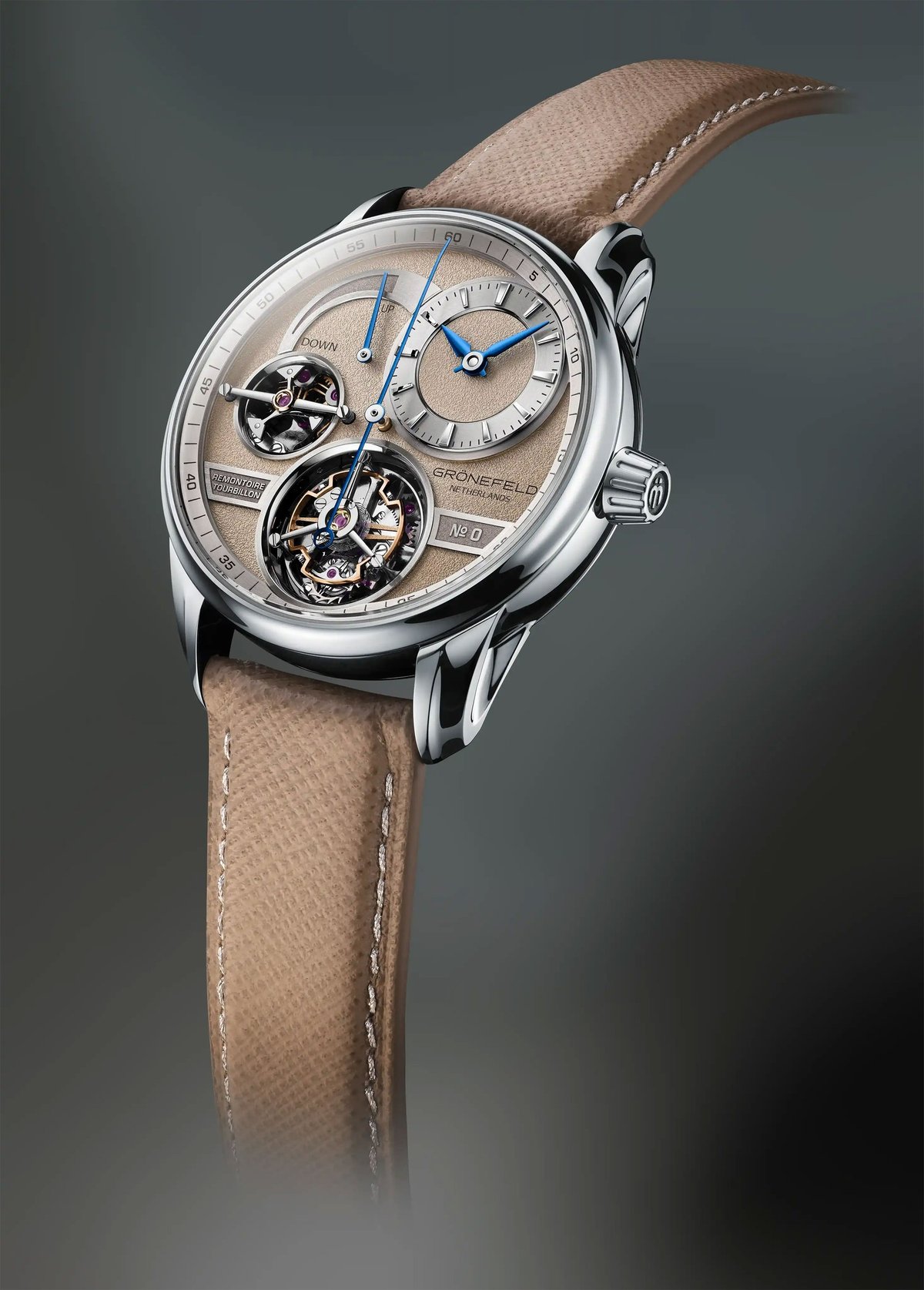
What you are buying, fundamentally, is a hand-wound independent with a movement built in Oldenzaal and finished to a level that most of the Swiss industry abandoned decades ago. The 1941 design language runs through it: a rounded case profile, restrained dial furniture, and a general refusal to shout. It is the kind of watch that reads as a plain dress piece from three feet away and as an object of genuine craft from six inches.
One important caveat for anyone shopping from a screen: Grönefeld does not publish a full technical sheet for the Quadrivium. There is no public case diameter, no thickness figure, no lug-to-lug measurement, no stated water resistance, and no published rate specification. That is not an oversight — it is how small independent houses operate. They sell through relationships and appointments, not through spec sheets designed to win a comparison table. Treat every number you find on a forum or a grey-market listing as unverified until the atelier confirms it.
The Movement
Grönefeld is a genuine manufacture. The calibres are designed and built in-house, which puts the house in a very small club at this price point and above. The 1941 line's signature pieces are hand-wound, and the Quadrivium follows that convention.
The point of the movement is not its architecture on paper — it is what has been done to it by hand. Grönefeld's finishing is the reason collectors pay attention: black-polished steel components, hand-bevelled bridges, and interior angles that most manufacturers quietly avoid because they take hours and cannot be done by machine. If you have never spent time with a loupe over a properly finished independent movement, this is one of the best places to start. The difference between a well-machined movement and a hand-finished one is not visible in photographs, which is precisely why the market prices them so differently.
What the movement is not is certified. Grönefeld does not submit to COSC, and there is no published rate specification. That is worth saying plainly, because it means you cannot buy this watch on the strength of a tolerance card. You buy it on the strength of the work.
On the Wrist
Grönefeld's 1941 cases are built around a soft, rounded profile and gently curved lugs — the correct architecture for a watch meant to disappear under a shirt cuff rather than announce itself across a room. The result is a piece that sits low and close, with the weight concentrated toward the centre of the wrist rather than tipping outward. It is a dress-adjacent object, not a sports watch, and it wears like one: you notice it when you look at it, not when you move.
Because the manufacture does not publish case dimensions for the Quadrivium, the honest advice is the same advice you would give anyone buying an independent: get it on your wrist before you commit. Grönefeld's production is small enough that the atelier will generally work with a client on strap length, and a hand-finished piece like this is worth a fitting session. Do not buy it from a photograph and a spec sheet that does not exist.
In terms of presence, this is a four out of five — but the presence is intellectual rather than visual. Nobody in the room will clock it. The two people who do will want to talk about it for an hour. For a certain kind of collector, that is the entire point.
Accuracy and Ownership Reality
You are not buying a Quadrivium for its rate. Independent watchmaking at this level is not about chronometric competition — it is about craft. Expect what you get from any well-regulated, hand-finished calibre: competent timekeeping in daily wear, sensitivity to how you wear it and how often you wind it, and a real benefit from a proper regulation at service rather than a factory tolerance card.
Service is the part of independent ownership that nobody talks about until they need it. This watch should go back to the atelier or an authorised representative. Hand-finished independent movements are not a job for the local mall watchmaker, and the wait times reflect that. Grönefeld does not publish a service interval or cost for this reference, so build in the assumption that a return trip to the Netherlands is part of the ownership model. If that sounds like a hassle rather than a privilege, this is not your watch.
The Market: What It Costs and What It Does
Here is where the wealthy collector angle gets uncomfortable, and where we have to be honest. Grönefeld does not publish list pricing for the Quadrivium. It is quoted on application. The secondary market is thin, private, and brokered rather than listed — which means there is no reliable pre-owned range to quote, and no meaningful auction history to point to. Anyone who tells you otherwise is guessing.
What we can say is directional. Small-production independents with genuine in-house movements and serious hand-finishing have held up far better than the hype-driven steel sports segment over the last several years. The reason is simple: supply is structurally tiny and the buyer base is patient. There is no flipping culture around Grönefeld because there is nothing to flip — you cannot buy one at retail and immediately relist it at a premium when the retail price is a private conversation.
That cuts both ways. It means the watch is unlikely to collapse in value, and it also means you cannot exit quickly if your circumstances change. This is an illiquid asset. Treat it as a piece of art you happen to be able to wear, not as a position you can unwind.
The hold recommendation is straightforward: hold, and hold for a long time. Independents at this production level do not reward flipping. They reward the collector who keeps the watch, keeps the papers, and keeps the relationship with the atelier. That relationship is worth more than any spread you could ever capture.
What Else to Look At
If you are shopping at this level, the shortlist is short. Kari Voutilainen's Vingt-8 is the other great finishing benchmark, with the same hand-made-at-the-bench ethos and a similarly thin secondary market. Romain Gauthier's Logical One offers a similarly engineering-forward personality. F.P. Journe's Chronomètre Souverain is the one genuine alternative that actually trades like a blue chip — if liquidity matters to you, that is the honest answer. Laurent Ferrier's Galet Micro-Rotor delivers a comparable restrained aesthetic with slightly larger production and a much easier secondary market to navigate.
There is no meaningful homage market for a Grönefeld — the volumes are too small and the finishing too specific for the copyists to bother. The closest thing to a cheap ticket into the same mindset is a Nomos Tangente, which shares the understated, small-batch independent sensibility and none of the mechanics. That is not a substitute. It is a placeholder.
The Verdict
The Grönefeld 1941 Quadrivium is not a watch you buy because it will go up. It is a watch you buy because a small number of people in the Netherlands spent a very long time making it properly, and because owning it puts you in a conversation with them rather than with a boutique.
If you want liquidity, buy a Journe. If you want the best finishing per dollar in independent watchmaking and you intend to keep the thing, this is one of the most rewarding purchases available. And if you want a watch that nobody at the table will recognise — that is not a bug. That is the feature.
Pros
- In-house movement finished to a standard that embarrasses watches costing multiples more
- Production measured in dozens, which makes it genuinely rare rather than merely limited
- Understated enough to wear anywhere without inviting a conversation you did not want
- Direct relationship with the atelier — you are buying from the people who made it
- The 1941 line has a coherent design language and a real collector following
Cons
- No published technical specification, which is charming until you need to insure it
- Secondary market is thin, private and illiquid — you cannot exit quickly
- Service requires returning the watch to the atelier, with the wait that implies
- Not a watch for anyone who needs their spending to be recognised
- Pricing is opaque, which makes value comparison nearly impossible