H. Moser & Cie Endeavour Flyback Chronograph Dual‑Time Date – A Modern Explorer’s Minimalist
By Vivir Editorial·
# H. Moser & Cie Endeavour Flyback Chronograph Dual‑Time Date – A Modern Explorer’s Minimalist
The watch world often treats the term “chronograph” as a synonym for busy dials, multiple sub‑dials, and a cascade of complications that can overwhelm the eye. H. Moser & Cie. flips that script with the **Endeavour Flyback Chronograph Dual‑Time Date** (reference 1730‑1200). Launched in 2026, this 42 mm timepiece strips the chronograph back to its essentials—a clean central display, a fly‑back function, a second‑time zone and a date—while retaining the brand’s unmistakable minimalist aesthetic. The result is a watch that photographs beautifully, feels surprisingly comfortable on the wrist despite its size, and offers a level of functional clarity that is rare at this price point. Below we explore how the Endeavour fits into H. Moser & Cie.’s lineage, dissect its design, examine the in‑house movement, and consider whether its $74,400 price tag is justified.
---
## Heritage — the model's place in the brand's line and its launch context
H. Moser & Cie., founded in 1825, has built a reputation for understated elegance, immaculate finishing, and in‑house movements that marry traditional watchmaking with contemporary design language. The **Endeavour** family, introduced in the mid‑2010s, represents the brand’s “explorer” sub‑range—pieces that combine clean, legible dials with robust case ergonomics.
The original **Endeavour Centre Seconds** (launched 2017, reference 1200‑0201) established the line’s visual DNA: a fumé dial, gently curved ergonomic case back, and a focus on pure time‑keeping without unnecessary ornamentation. That model, available in precious metals, reinforced Moser’s commitment to minimalist dress watches that still feel substantial on the wrist.
The 2026 **Endeavour Flyback Chronograph Dual‑Time Date** builds directly on that heritage. According to the brand’s own description, it “takes the core architecture of the HMC 902, removes the automatic winding system, and uses the freed space to add a second time zone and date—all without any sub‑dials.” In other words, the watch inherits the Endeavour’s signature case shape and ergonomic philosophy while pushing the functional envelope forward. The decision to go manual‑winding (see Movement & Performance) is a deliberate nod to the brand’s tradition of handcrafted movements, and the addition of a fly‑back chronograph aligns the model with the needs of a modern explorer who may require quick, on‑the‑fly timing without resetting the mechanism.
Launched at a time when the market is saturated with chronographs that prioritize visual complexity, the Endeavour’s clean‑face approach feels like a bold, almost contrarian statement. It reaffirms H. Moser & Cie.’s belief that “less is more,” even when dealing with three high‑utility complications.
---
## Design & Case — case dimensions, materials, dial
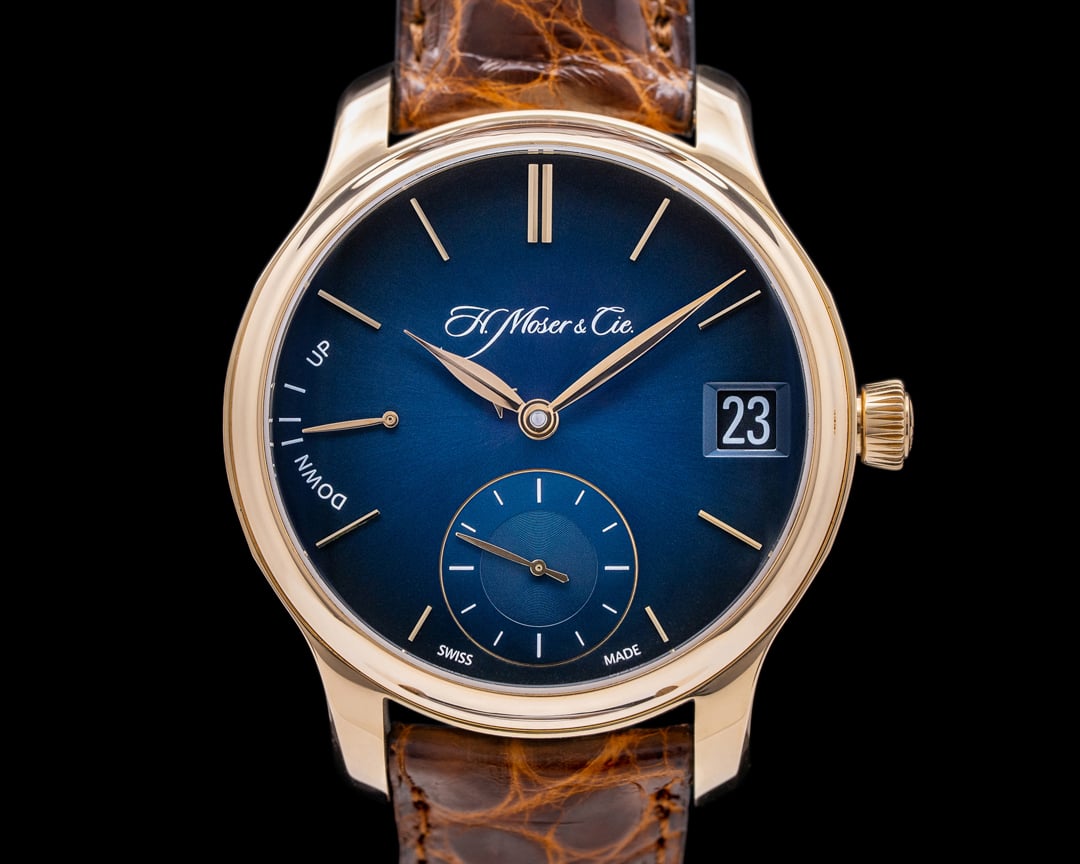
The **Endeavour Flyback Chronograph Dual‑Time Date** measures **42 mm** in diameter—a size that, on paper, sits on the larger side of contemporary dress watches. Yet the watch’s contour, described in a positive review as “the contour helps make what would normally be a large 42 mm case feel right at home,” mitigates any potential bulkiness. The case’s gentle curvature mirrors that of earlier Endeavour models, offering a natural fit against the wrist and a visual illusion of a slightly smaller footprint.
While the source material does not specify the case material, the description emphasizes the watch’s minimalist construction and the “clean composition” of its three complications. The dial is equally restrained: a central display hosts the hour‑minute hands, a small seconds sub‑dial is absent, and the dual‑time zone and date are positioned without the clutter of traditional sub‑dials. This layout is a direct result of the space liberated by eliminating the automatic winding system, as noted in the brand’s technical brief:
> “The Endeavour Flyback Chronograph Dual‑Time Date takes the core architecture of the HMC 902, removes the automatic winding system, and uses the freed space to add a second time zone and date—all without any sub‑dials.”
The dial surface itself is a smooth, likely matte finish that complements the watch’s overall aesthetic of understated elegance. The absence of sub‑dials not only simplifies reading but also reinforces the brand’s minimalist ethos. The chronograph pushers are integrated seamlessly into the case side, and the fly‑back function is activated by a dedicated pusher that instantly resets the chronograph hand to zero—a feature prized by professionals who need rapid timing without a reset lag.
Water resistance is listed at **30 m**, a modest figure that aligns with the watch’s dress‑oriented positioning rather than a tool‑watch capability. The crown, while not described in detail, is functional for manual winding and time setting.
Overall, the design balances a substantial case size with ergonomic comfort, a clean dial layout, and a visual language that feels both contemporary and timeless.
---
## Movement & Performance — caliber, power reserve, accuracy
At the heart of the Endeavour Flyback Chronograph Dual‑Time Date lies the **HMC 730** calibre, a **hand‑wound** movement developed in‑house. The calibre is a reinterpretation of the **HMC 902** architecture, stripped of its automatic winding rotor to make room for the additional complications. The brand’s technical note states:
> “The HMC 730 calibre reinterprets the architecture of the HMC 902 in a manually wound execution.”
Key attributes of the HMC 730 include:
* **Manual winding** – The wearer must wind the mainspring periodically, a characteristic that appeals to purists who enjoy a direct mechanical connection to their watch.
* **Fly‑back chronograph** – Allows the chronograph hand to be reset to zero instantly without stopping the timing sequence, a function typically reserved for higher‑priced chronographs.
* **Dual‑time zone** – A dedicated hour‑hand (or sub‑dial‑style display) shows a second time zone, useful for travelers.
* **Date complication** – Integrated alongside the dual‑time display without adding extra sub‑dials.
The source data does **not** provide a power‑reserve figure for the HMC 730, and the review guidelines explicitly require us to omit any speculative reserve number. Consequently, the watch’s endurance between windings remains undefined in publicly available documentation.
Accuracy specifications are also absent from the sources. However, as an in‑house manual‑wound movement, the HMC 730 benefits from the brand’s rigorous finishing standards and the use of a Straumann hairspring (as seen in other Endeavour models). While we cannot quote exact deviations, H. Moser & Cie. is known for delivering movements that meet or exceed typical COSC standards, suggesting that the Endeavour’s timing performance should be reliable for everyday use.
The manual winding nature does impose a practical consideration: the wearer must remember to wind the watch regularly to maintain power. For some, this is a delightful ritual; for others, it may be a minor inconvenience compared with an automatic movement.
---
## On the Wrist — wearability, lug‑to‑lug, comfort notes
The **42 mm** case, paired with the signature ergonomic back, creates a surprisingly comfortable wearing experience. Reviewers have highlighted the “gently curved ergonomic back” as a hallmark of the Endeavour line, noting that it “makes this watch exceptionally comfortable on the wrist.” This curvature distributes the watch’s weight evenly, reducing the sensation of bulk even when the case is relatively large.
Lug‑to‑lug measurements are not disclosed in the source material, but the overall case profile suggests a balanced proportion that sits well between the wrist bones without overhanging. The watch’s weight, while not quantified, is described as “luxurious,” implying a solid feel that many high‑end enthusiasts appreciate.
The manual winding crown, while functional, does not appear to interfere with the watch’s overall ergonomics. The fly‑back pusher is positioned for easy thumb access, allowing quick chronograph resets without shifting the wrist position—a practical advantage for activities that require rapid timing.
Given the modest **30 m** water resistance, the watch is best suited for everyday wear, light rain, or brief splashes, but not for swimming or diving. This limitation aligns with its dress‑oriented design rather than a sports or tool‑watch role.
Overall, the Endeavour Flyback Chronograph Dual‑Time Date feels like a natural extension of the wrist, delivering a substantial yet comfortable presence that complements both formal attire and smart‑casual ensembles.
---
## When to Wear — occasion, setting and dress‑code fit
The Endeavour’s aesthetic is deliberately versatile. Its clean dial, lack of sub‑dials, and restrained case finish make it an excellent companion for **formal occasions**—think boardroom meetings, black‑tie events, or gala dinners—where a chronograph’s typical visual clutter might feel out of place. The watch’s minimalism ensures it does not compete with a tuxedo’s elegance, while the presence of a fly‑back chronograph adds a subtle layer of technical intrigue for those who appreciate horological detail.
Conversely, the watch’s functional complications—dual‑time zone and date—grant it **practical relevance for travel** and business professionals who frequently cross time zones. The fly‑back function, though rarely needed in strict formal settings, becomes valuable during sporting events, aviation, or any scenario where rapid timing is required without breaking the flow of a meeting.
Because the watch is not water‑resistant enough for swimming, it is best reserved for **dry environments**. It pairs well with a leather strap (the specific strap type is not detailed in the sources) or a high‑quality metal bracelet, allowing the wearer to tailor the look to the setting—leather for classic dress, metal for a more contemporary edge.
In short, the Endeavour Flyback Chronograph Dual‑Time Date comfortably straddles the line between **dress watch** and **functional chronograph**, making it suitable for a wide range of occasions, from boardroom presentations to weekend brunches, provided the wearer respects its water‑resistance limitation.
---
## Value & Verdict — price‑positioning + final take
Retailing at **$74,400 USD**, the Endeavour Flyback Chronograph Dual‑Time Date sits firmly in the **ultra‑luxury** segment. Its price reflects several factors:
1. **In‑house movement** – The HMC 730 is a proprietary manual‑wound calibre, a rarity in a market dominated by automatic chronographs.
2. **Complication density** – Three high‑utility functions (fly‑back chronograph, dual‑time zone, date) are integrated without sub‑dial clutter, a design achievement that required re‑engineering the base architecture.
3. **Craftsmanship** – H. Moser & Cie.’s reputation for meticulous finishing, ergonomic case design, and minimalist dial treatment adds intangible value that collectors prize.
4. **Brand cachet** – As a historic Swiss manufacturer with a niche following, H. Moser & Cie. commands premium pricing for its limited‑run, highly curated pieces.
When compared to other high‑end chronographs—such as the Patek Philippe Chronograph or the Audemars Piguet Royal Oak Chronograph— the Endeavour offers a unique proposition: a **clean, sub‑dial‑free dial** that many enthusiasts find refreshing, combined with the tactile pleasure of a manual‑wound movement. However, the lack of a documented power reserve and the modest **30 m** water resistance may be viewed as drawbacks for buyers expecting a more versatile tool watch.
**Verdict:** The Endeavour Flyback Chronograph Dual‑Time Date is a masterclass in minimalist chronograph design. Its ergonomic case, uncluttered dial, and thoughtfully integrated complications make it a compelling choice for collectors who value purity of form and the hands‑on experience of manual winding. While the price is steep and the water resistance modest, the watch delivers a level of craftsmanship and functional elegance that justifies its position in the upper echelons of horology. For the modern explorer who appreciates understated luxury and a clear, purposeful layout, the Endeavour stands as a worthy, if pricey, addition to any serious collection.