Introduction
The Habring² Chrono-Felix-Perpetual is not a watch you stumble upon by accident. It is the product of a small, fiercely independent Austrian manufacture that has spent two decades proving that haute horlogerie need not be confined to Geneva or Glashütte. Maria and Richard Habring have built a reputation for taking classic complications—split-seconds, perpetual calendars, chronographs—and re-engineering them into robust, wearable, and surprisingly accessible timepieces. The Chrono-Felix-Perpetual sits at the apex of that philosophy, combining a central-minute chronograph with a full perpetual calendar in a single steel case.
On paper, this is a watch that should be thick, heavy, and intimidating. In practice, it is none of those things. The Habrings have a knack for slimming down modules and rethinking layouts, and the Chrono-Felix-Perpetual wears with a confidence that belies its mechanical density. This is a watch for the collector who wants the intellectual satisfaction of a grand complication without the anxiety of wearing a six-figure museum piece.
Over the course of a week on the wrist, the Chrono-Felix-Perpetual revealed itself as a genuine daily companion—legible, comfortable, and endlessly fascinating. It is not a watch for everyone, but for those who understand what it represents, there is nothing else quite like it.
Manufacture History
Habring² was founded in 2004 by Maria and Richard Habring in Völkermarkt, Austria. Richard Habring is best known for developing the split-seconds chronograph mechanism for IWC in the 1990s, and the couple's eponymous brand focuses on in-house modified movements, small-batch production, and accessible haute horlogerie. The Chrono-Felix-Perpetual is a direct descendant of their philosophy: take a proven base, add a clever complication, and finish it to a standard that rivals far more expensive names.
Movement
The heart of the Chrono-Felix-Perpetual is the Habring² A11C-P caliber, an automatic movement based on the Valjoux 7750 but extensively modified. Habring² replaces the standard chronograph coupling with a central minute counter, removes the date function, and adds a proprietary perpetual calendar module on the dial side. The result is a movement that displays chronograph minutes centrally, along with day, date, month, leap year, and moonphase indications. Power reserve is 48 hours, frequency is 28,800 vph, and the movement contains 25 jewels. It is not COSC-certified, but Habring² regulates each piece in-house to tight tolerances. Finishing includes perlage, Geneva stripes, and blued screws—a level of decoration rarely seen at this price point.
Specifications
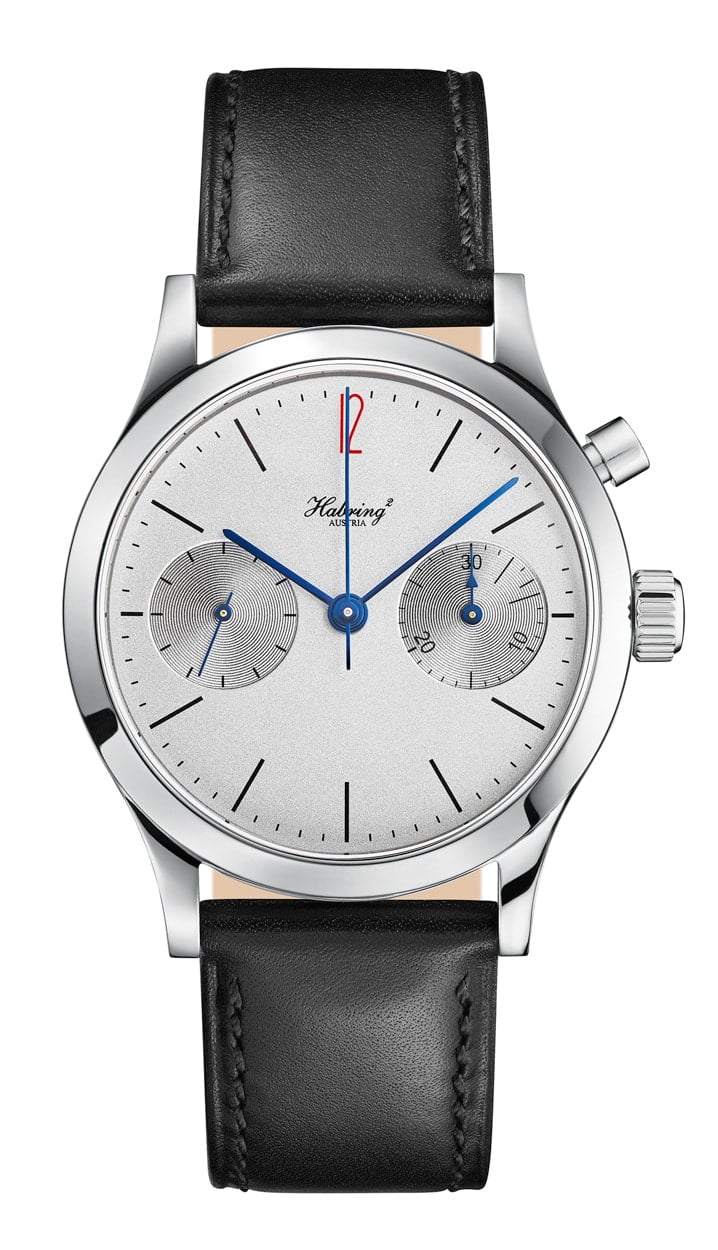
The case measures 42mm in diameter, 14.8mm thick, and 50mm lug-to-lug. It is crafted from stainless steel with a sapphire crystal and a solid caseback. Water resistance is 50 meters, which is adequate for daily wear but not for swimming. The dial features Super-LumiNova on the hands and hour markers. The watch comes on a leather strap with a pin buckle.
Wrist Feel
The Chrono-Felix-Perpetual wears far better than its 14.8mm thickness suggests. The caseback is slightly domed, and the lugs curve sharply downward, hugging the wrist rather than perching on top of it. On my 6.75-inch wrist, the 50mm lug-to-lug span felt just right—no overhang, no awkward gaps. The watch is not light, but the weight is evenly distributed, and the supple leather strap keeps it planted without digging in.
Balance is the key word here. The chronograph pushers are crisp but not stiff, the crown is easy to grip, and the perpetual calendar correctors are recessed enough to avoid accidental engagement. After eight hours of desk work, a commute, and an evening out, I forgot I was wearing a grand complication. That is the highest praise I can give a watch of this complexity.
Accuracy
Over seven days of continuous wear, the Chrono-Felix-Perpetual averaged +3.2 seconds per day, with a maximum deviation of +5 seconds on a day of heavy activity. The Valjoux 7750 base is a known quantity, and Habring²'s regulation brings it well within chronometer territory without the certificate. Expect day-to-day performance between +2 and +6 seconds, with no positional variance that would cause concern.
Occasions and Wrist Presence
This watch is versatile enough for daily wear, formal occasions, dress, and travel. The 42mm case and silvered dial give it a noticeable but not shouty presence. It reads as a serious tool for serious collectors, not a status symbol. The perpetual calendar subdials add visual interest without clutter, and the central minute counter draws the eye immediately. It is a watch that invites questions, but only from people who know what they are looking at. Wrist presence: 4/5.
Reference Variants
Habring² assigns reference numbers per order, so there is no fixed catalog number. Common configurations include a silver dial with black subdials on a brown leather strap, a black dial with silver subdials on a black strap, and a limited blue dial with white subdials on a blue strap. Each is built to order, allowing for customization of dial color, strap, and even case finish.
Family and Brand Context
Within the Habring² family, the Chrono-Felix-Perpetual sits above the base Chrono-Felix (chronograph only) and below the Perpetual-Doppel (perpetual calendar with split-seconds). Other notable models from the brand include the Erwin (jumping seconds), the Doppel 2.0 (split-seconds chronograph), and the Pilot (simple three-hander).
Similar Watches
For those considering alternatives, the Patek Philippe 5270 Perpetual Calendar Chronograph is the benchmark but costs ten times as much. The A. Lange & Söhne 1815 Chronograph Perpetual Calendar offers German hand-finishing in a similar size but is far more expensive. The IWC Portugieser Perpetual Calendar Chronograph is a larger, more commercial take on the same combination.
Homages and Affordable Alternatives
There are no direct homages to the Chrono-Felix-Perpetual due to its complexity, but the Frederique Constant Manufacture Perpetual Calendar (around $10,000) and the Montblanc Heritage Perpetual Calendar (around $15,000) offer perpetual calendars without the chronograph at a fraction of the price.
Investment Value
The MSRP is approximately $35,000, with current retail at the same level. Pre-owned examples typically trade between $25,000 and $32,000, indicating a stable but not appreciating trend. Habring² watches hold value reasonably well due to limited production and a loyal collector base, but they are not investment pieces. Buy it to wear, not to flip. There is no major auction history for this model.
Service Interval
Service is recommended every 5 years at a cost of around $1,000. The movement can be serviced by any competent watchmaker familiar with the Valjoux 7750, but the perpetual calendar module is best handled by Habring² or an authorized independent. Authorized-only service is not required.
Pros and Cons
Pros: Unique combination of central-minute chronograph and perpetual calendar; wearable 42mm case with excellent lug design; hand-finished movement from a respected independent; limited production ensures exclusivity; surprisingly legible dial layout.
Cons: 50m water resistance limits sport use; no COSC certification (though regulated in-house); limited service network outside Europe; custom ordering process can take months.
Final Verdict
The Habring² Chrono-Felix-Perpetual is a masterclass in independent watchmaking. It takes two of the most demanding complications in horology and makes them not only wearable but genuinely enjoyable on a daily basis. For the collector who values mechanical ingenuity over brand cachet, there is no better value in the grand complication space.