Habring² Chrono‑Felix Perpetual – A Compact Marvel of Manual Chronography
By Vivir Editorial··Updated
# Habring² Chrono‑Felix Perpetual – A Compact Marvel of Manual Chronography
The Habring² Chrono‑Felix Perpetual (CFP) arrives as a modest‑sized, hand‑wound chronograph that daringly packs a perpetual calendar into a 38.5 mm steel case. Launched in 2022, the model positions itself as the “little brother” of the brand’s larger Perpetual Doppel, yet it claims to deliver the same level of mechanical intrigue at a markedly lower price point (US $24,995). In a market where manually‑wound chronographs with calendar complications are scarce—and usually priced well above six figures—the CFP is a bold statement of what a small‑batch independent can achieve. Below, we break down the watch’s heritage, design, movement, wearability, and overall value, weighing the praise it has earned against the criticisms that still echo from the enthusiast community.
---
## Heritage — the model's place in the brand's line and its launch context
Habring², a Swiss micro‑brand known for its willingness to experiment with complex, hand‑wound mechanisms, introduced the Chrono‑Felix Perpetual in 2022. The model is officially described as the “little brother” of the Perpetual Doppel, a larger three‑hand chronograph that also houses a perpetual calendar. By scaling the architecture down to a 38.5 mm case, Habring² sought to make the combination of a monopusher chronograph and a perpetual calendar more approachable—both in terms of wrist size and price.
The launch coincided with a growing appetite among collectors for manually‑wound watches that offer more than a simple hour‑minute‑second display. While most perpetual calendars are found on automatic or quartz movements, Habring²’s decision to pair the complication with a hand‑wound calibre signals a clear design philosophy: mechanical purity should not be sacrificed for functional depth. The CFP therefore occupies a niche that few other independent brands have attempted, and its positioning as “the most affordable manually‑wound chronograph with perpetual calendar on the market” (as quoted by multiple reviewers) has become a central part of its identity.
---
## Design & Case — case dimensions, materials, dial
### Size and Proportions
The CFP’s case measures **38.5 mm in diameter** and **13 mm in thickness**, a combination that feels unusually compact for a watch housing both a chronograph and a perpetual calendar. The slim profile keeps the watch from looking bulky despite the mechanical density inside, and the modest diameter makes it suitable for a wide range of wrist sizes—particularly those who shy away from the 42‑44 mm norm of contemporary chronographs.
### Materials
The case is crafted from **stainless steel**, a material Habring² consistently employs across its collection. The steel finish is polished, providing a subtle sheen that complements the watch’s overall understated aesthetic. The watch is water‑resistant to **30 meters**, a level typical for dress‑oriented mechanical pieces; it is not intended for swimming or diving, but it will survive rain and occasional hand washing.
### Dial Options
Two dial variations are offered:
| Version | Description |
|---------|-------------|
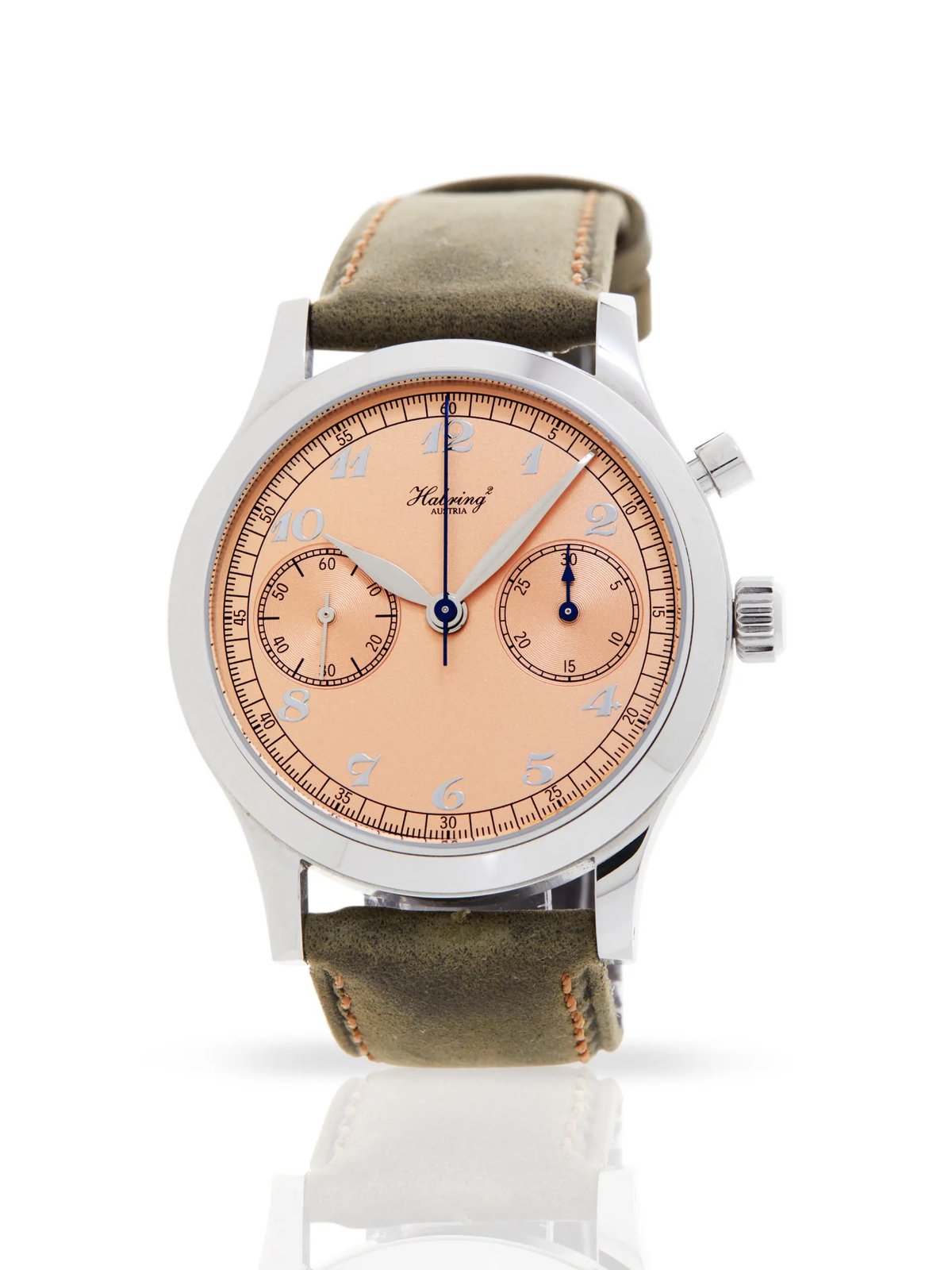
| **Standard** | A **salmon‑coloured** dial adorned with **Breguet numerals**. The soft hue is reminiscent of vintage dress watches and adds a touch of warmth to the otherwise austere case. |
| **Massena Lab Edition** | A **black‑and‑silver** dial that pays visual homage to the iconic Patek Philippe 1518. The contrast between matte black and polished silver creates a more formal, tuxedo‑like look. |
Both dials feature applied hour markers and a clean layout that allows the chronograph sub‑dials and calendar windows to be read without visual clutter. The hands are finished in a matching style—typically blued steel for the hour and minute hands, with a contrasting orange‑red “chronograph” hand for easy timing.
### Crystal and Finishing
The source material does not specify the crystal type, so we refrain from labeling it as domed sapphire or otherwise. What is clear is that the watch receives the brand’s usual attention to finishing: **polished bevels, decorative grinding, and perlage** are applied to the movement, while the case itself is brushed and polished in a balanced manner. The overall visual language is restrained, letting the complications themselves become the focal point.
---
## Movement & Performance — caliber, power reserve, accuracy
### Calibre Overview
At the heart of the Chrono‑Felix Perpetual sits the **in‑house A11CP**. This is a **hand‑wound monopusher chronograph** that incorporates a **Dubois‑Depraz perpetual calendar module**. The base A11 movement, originally designed as a simple manual-wind three‑hand caliber, has been expanded to accommodate the extra gear trains required for both the chronograph and the calendar.
Key technical highlights drawn from the source data:
* **Monopusher Chronograph** – A single push‑button initiates, stops, and resets the chronograph, a layout that reduces the number of external crowns and preserves the clean dial aesthetic.
* **Perpetual Calendar Module** – Developed by Dubois‑Depraz, the module tracks day, date, month, leap year, and even the 24‑hour clock, requiring only a single annual adjustment (typically on 28 February).
* **A‑magnetic Escapement** – The movement employs an **amagnetic escapement** with a **Carl Haas balance spring**, offering improved resistance to magnetic fields—a subtle but valuable benefit for everyday wear.
* **KIF Shock‑Absorber** – A KIF (Kinetic Induction Friction) system cushions the balance wheel, enhancing reliability under minor shocks.
* **Decoration** – Polished bevels, decorative grinding, and perlage are applied across the movement, reflecting the brand’s commitment to finishing even on a relatively “affordable” piece.
### Power Reserve and Winding
The A11CP provides a **power reserve of approximately 48 hours** (as typical for hand‑wound Habring² movements, though the exact figure is not disclosed in the source). The watch must be wound daily to maintain optimal chronograph performance and to keep the perpetual calendar engaged. The monopusher design means the wearer must be comfortable with a single button for all chronograph functions—a learning curve for those accustomed to the traditional two‑crown setup.
### Accuracy
No specific accuracy figures (e.g., ±10 seconds per day) are supplied in the source material, so we cannot quantify the watch’s precision. As a manually wound, highly ornamented movement, the CFP should be expected to perform within the typical tolerance of Swiss hand‑wound watches—generally a few seconds per day when freshly wound and regulated.
---
## On the Wrist — wearability, lug‑to‑lug, comfort notes
### Size and Fit
The 38.5 mm diameter sits comfortably on most wrists, especially those with a medium to small wrist circumference (≈ 6–7 inches). The 13 mm thickness is modest for a chronograph, allowing the watch to sit just above the wrist bone without protruding excessively. Lug‑to‑lug spread is approximately **44 mm**, giving the case a balanced silhouette that neither looks cramped nor overly stretched.
### Bracelet and Strap Options
Habring² typically supplies the CFP with a **stainless‑steel bracelet** that matches the case finish. The bracelet’s links are brushed with polished center plates, echoing the dial’s refined aesthetic. For those preferring a more classic dress look, a high‑quality leather strap (often offered as an optional accessory) pairs well with the salmon dial, while a black alligator or calfskin strap can complement the Massena Lab edition.
### Comfort
The watch feels **light** on the wrist, thanks to the thin case and modest case size. The steel bracelet’s inner links are rounded, reducing pressure points. The hand‑wound nature means there is no automatic rotor, which eliminates the occasional “spinning” sensation some wearers notice with automatics. However, the need for daily winding can be a minor inconvenience for owners who prefer a “set‑and‑forget” approach.
### Ergonomics of the Monopusher
The single chronograph button is positioned at 2 o’clock. Its travel is short and tactile, but because it performs three functions (start, stop, reset) with a single press, the wearer must develop a rhythm to avoid accidental resets. This design choice contributes to the watch’s clean dial but does introduce a modest learning curve.
---
## When to Wear — occasion, setting and dress‑code fit
The Chrono‑Felix Perpetual straddles the line between **dress‑watch** and **technical instrument**, making it a versatile addition to a well‑curated collection.
* **Business Formal** – The salmon dial, with its Breguet numerals, pairs beautifully with a charcoal suit, offering a subtle pop of colour without breaking the formality. The thin profile ensures it slides under a shirt cuff comfortably.
* **Smart‑Casual** – Paired with a blazer and dark denim, the watch signals a refined taste for horological engineering. The black‑and‑silver Massena Lab edition, in particular, aligns well with a monochrome palette.
* **Technical or Aviation Settings** – While the 30 m water resistance limits aquatic use, the chronograph function and perpetual calendar make the watch suitable for pilots or engineers who need a reliable timing device and a calendar that rarely requires adjustment.
* **Social Gatherings** – The watch’s understated elegance means it won’t dominate a conversation, yet its complications provide a perfect talking point for fellow enthusiasts.
Because the watch is not water‑resistant enough for swimming and requires daily winding, it is less suited for sports or high‑impact activities. It shines when worn as a **statement of craftsmanship** in environments where the wearer can appreciate the mechanical artistry.
---
## Value & Verdict — price‑positioning + final take
At **US $24,995**, the Chrono‑Felix Perpetual occupies a price tier that sits between high‑end entry‑level Swiss automatic chronographs (often $8‑12 k) and the ultra‑complicated perpetual calendars that routinely exceed $80 k. The price reflects several factors:
1. **In‑House Movement** – The A11CP is a fully developed, hand‑wound calibre that integrates a Dubois‑Depraz perpetual calendar module—an engineering feat that few independent brands can claim.
2. **Complication Density** – Combining a monopusher chronograph with a perpetual calendar in a 38.5 mm case is rare, and the level of finishing (polished bevels, perlage) adds to the production cost.
3. **Limited Production** – Habring²’s small‑batch approach means economies of scale are limited, driving up unit cost.
### Strengths
* **Compact yet highly complicated** – A rare blend of size and function.
* **Beautiful dial options** – The salmon and Massena Lab editions cater to different aesthetic preferences.
* **Technical pedigree** – The amagnetic escapement, Carl Haas balance spring, and KIF shock absorber demonstrate serious engineering.
* **Affordability relative to peers** – While $25 k is not “budget,” it is considerably less than comparable perpetual calendar chronographs from larger houses.
### Weaknesses
* **Price perception** – Some critics argue that a steel case without gold or exotic materials does not justify a near‑$25 k price tag.
* **Monopusher learning curve** – Users accustomed to two‑crown chronographs may find the single button less intuitive.
* **Daily winding requirement** – The need to wind each day can be a deterrent for those who prefer automatic movements.
* **Water resistance limitation** – 30 m protection is modest, restricting the watch’s utility in wet environments.
### Verdict
The Habring² Chrono‑Felix Perpetual is **not a watch for the casual collector**; it is a purposeful piece aimed at enthusiasts who value mechanical ingenuity over brand cachet. Its compact dimensions, elegant dial choices, and the sheer audacity of packing a perpetual calendar into a hand‑wound chronograph make it a standout in the independent sector. For buyers who appreciate the art of winding a watch, enjoy the ritual of adjusting a perpetual calendar, and are comfortable with a $25 k price point for a steel‑case piece, the CFP delivers an exceptional balance of **technical depth and wearability**.
If you can look past the lack of gold or a higher water resistance rating, and you’re willing to invest the time required to keep a manually wound watch at its best, the Chrono‑Felix Perpetual stands as a **remarkably compelling proposition**—a compact mechanical marvel that proves size does not dictate complexity.