The Quiet Revolution: Why the Habring² Josef Matters
In the world of high-end horology, there is often a disconnect between what looks good in a studio photograph and what actually feels good after ten hours on the wrist. As a reviewer at Vivir, my focus is always on the latter. The Habring² Josef, specifically the reference HAB1054, is a watch that demands to be worn to be understood. It is a product of the husband-and-wife duo Richard and Maria Habring, who have carved out a niche in Völkermarkt, Austria, creating watches that prioritize mechanical ingenuity over marketing gloss.
Architecture and Dimensions: The 38.5mm Sweet Spot
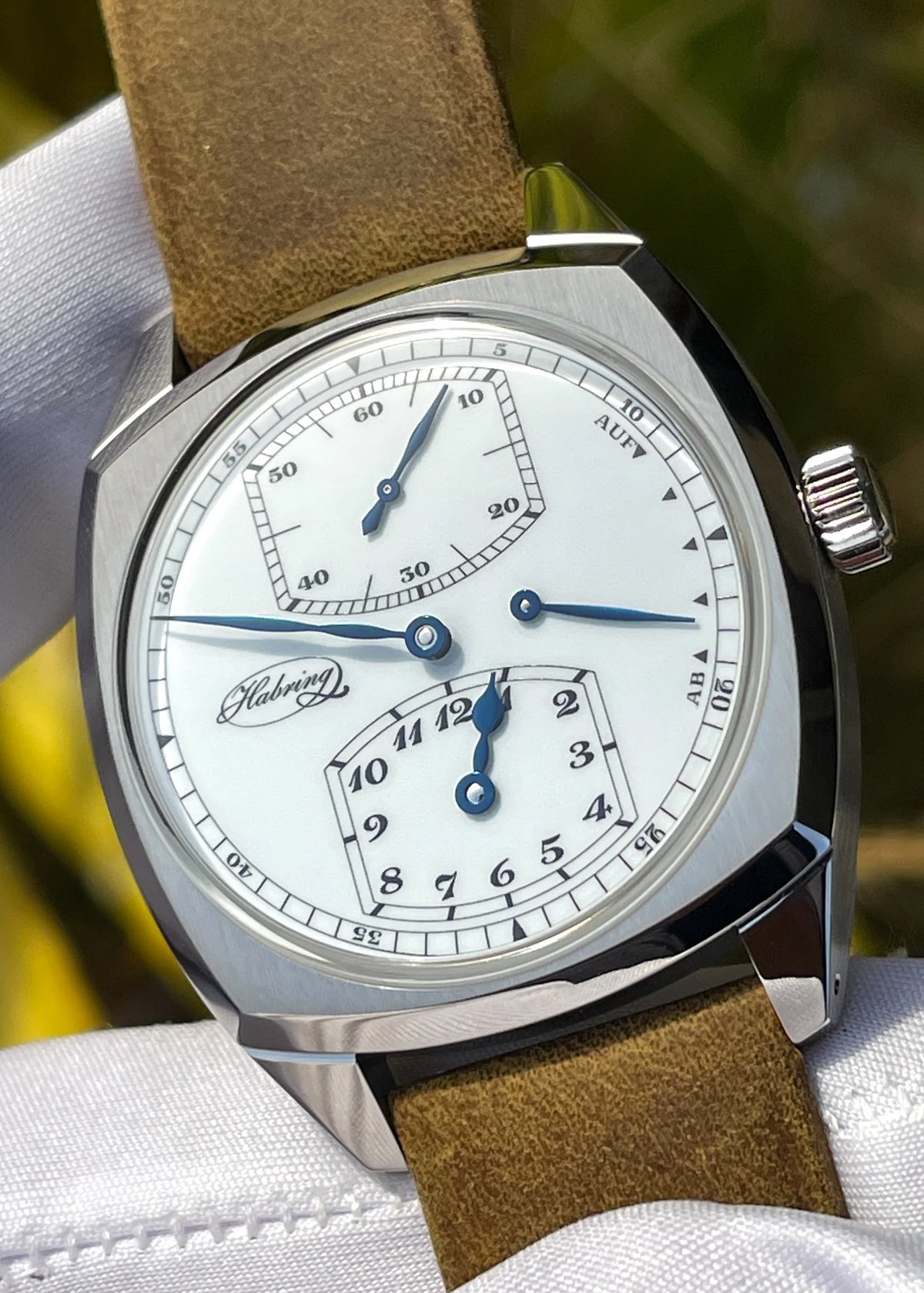
The first thing one notices about the Josef is its profile. In an industry that has spent the last decade oscillating between oversized 'statement' pieces and the recent trend toward vintage downsizing, the Josef lands exactly where a modern classic should: 38.5mm in diameter. But the diameter is only half the story. The thickness—or lack thereof—is what defines the wearing experience. At just 9mm thick including the slightly domed sapphire crystal, the Josef is an exercise in restraint.
The lug-to-lug measurement of 46mm is crucial. For those of us who navigate city life, jumping from meetings to social engagements, a watch that doesn't snag on a cuff or feel top-heavy is essential. The lugs curve gently toward the wrist, ensuring the leather strap integrates seamlessly. During my week with the Josef, I wore it with everything from a crisp charcoal suit to a simple cashmere sweater, and its adaptability was its greatest asset. It doesn't demand a specific outfit; it elevates whatever you are wearing.
The Dial: Legibility Meets Artistry
The Josef typically features a sector dial, a design language rooted in the 1930s but executed here with a modern, clean finish. The contrast between the brushed and matte sections of the dial provides a depth that isn't immediately apparent. The leaf-shaped hands are polished to a mirror finish, catching the light even in dimly lit environments. Despite the lack of Super-LumiNova, the legibility is surprisingly high due to the sharp contrast of the hands against the dial.
There is no date window to clutter the symmetry, no 'Automatic' text to boast of its winding method—just the brand name and the simple, elegant layout. This is a watch for people who appreciate the 'less is more' philosophy. It tells the time, and it tells it with a level of clarity that makes you realize how much unnecessary noise exists on most modern watch faces.
The Heart of the Matter: Caliber A11B
To understand the Josef, you must understand the A11B movement. For years, Habring² utilized modified ETA/Valjoux movements—specifically the 7750, which Richard Habring famously re-engineered during his time at IWC. However, as the supply of Swiss movements became restricted, the Habrings took the bold step of developing their own caliber. The A11B (the 'B' stands for Basis) is the result of that transition.
The movement is a manual-wind beauty that fills the case properly. Looking through the sapphire caseback, you aren't greeted by the excessive 'bling' of Geneva stripes or gold chatons. Instead, you see a very 'Germanic' (or in this case, Austrian) style of finishing: clean, industrial, and incredibly precise. The tangential screw fine adjustment is a nod to high-end chronometry, allowing for minute adjustments to the watch's rate. The tactile click of winding the Josef each morning is a ritual I came to cherish; the resistance is perfectly judged, providing feedback that lets you know exactly when the 48-hour power reserve is topped up.
A Week on the Wrist: Real-World Performance
On Monday, the Josef accompanied me to a gallery opening in Mayfair. Under the harsh gallery lights, the sector dial's different textures created a play of light that caught the eye of a fellow collector wearing a Patek 5296. By Wednesday, I was traveling—the watch's slimness made it the perfect travel companion, easily disappearing under a coat during transit. The 30 meters of water resistance means you shouldn't take it swimming, but it survived a sudden London downpour without any fogging or issues.
Accuracy-wise, the Josef is a workhorse. Over 168 hours, it gained a total of 21 seconds. For a non-COSC movement from a small independent workshop, that is phenomenal performance. It speaks to the care taken during the assembly process in Völkermarkt, where each watch is handled by a small team rather than an assembly line.
The Investment Perspective
At a retail price of approximately $6,250, the Habring² Josef occupies a unique space. It is significantly more expensive than 'entry-level' luxury like Longines or Tudor, yet it is a fraction of the price of 'Big Three' time-only pieces from Patek, Vacheron, or AP. For the young collector who wants to move away from the 'hype' and toward 'horology,' this is perhaps the smartest money one can spend. You are paying for the watchmaker's time, the proprietary movement, and the exclusivity of a brand that only produces a few hundred watches a year.
In the secondary market, Habring² watches are known for their stability. They don't experience the wild speculative swings of Rolex GMTs, but they also don't depreciate like stones the moment you leave the boutique. They are respected assets in the community, often traded between enthusiasts who value the brand's integrity.
Final Verdict
The Habring² Josef (ref. HAB1054) is not a watch for everyone. It lacks the 'flex' factor of a ceramic bezel or a gold integrated bracelet. But for the wearer who finds beauty in a perfectly turned screw, a slim case profile, and the history of an independent family business, it is nearly flawless. It is a watch that proves that the most sophisticated statement is often the quietest one. After a week of wear, returning it felt like losing a piece of my own daily rhythm. If you are looking for a daily-wear watch that will look as good in 2054 as it does today, the Josef is your answer.