The Philosophy of the Jump: Understanding the Habring² Roulette
In the world of high-end horology, the 'sweep' of a seconds hand is often cited as the definitive characteristic of a mechanical heartbeat. Yet, there is a more rarified, more technically demanding tradition that defies this expectation: the seconde morte, or jumping seconds. The Habring² Roulette, an evolution of the brand’s Erwin model, is perhaps the most significant modern ambassador of this complication. It is a watch that requires the wearer to look closer, to understand the mechanical tension required to make time jump rather than flow.
The Genesis of the A11B Caliber
To understand the Roulette, one must first understand the A11 caliber. For years, Richard and Maria Habring relied on the robust architecture of the ETA 7750/7760—a movement Richard knew intimately from his time at IWC. However, as the availability of ETA kits became restricted, the Habrings made a pivotal decision: they would engineer their own base. The A11 was the result. While it shares the tried-and-true gear train geometry of the 7750, every component has been reimagined and manufactured to higher tolerances.
The A11B (the 'B' standing for Blitz or 'flash', though it is commonly associated with the jumping seconds) is a manual-wind masterpiece. The jumping seconds is not merely a visual trick; it is a power-management challenge. In a standard movement, energy is released in small increments dictated by the escapement (usually 8 times per second for a 4Hz movement). In the A11B, a secondary module stores this energy over the course of a second and releases it all at once. This requires a delicate balance of tension and friction, managed by a star-wheel and a long, thin tension spring. The result is a hand that snaps precisely to each marker with zero backlash.
Aesthetic Precision: The Roulette Dial
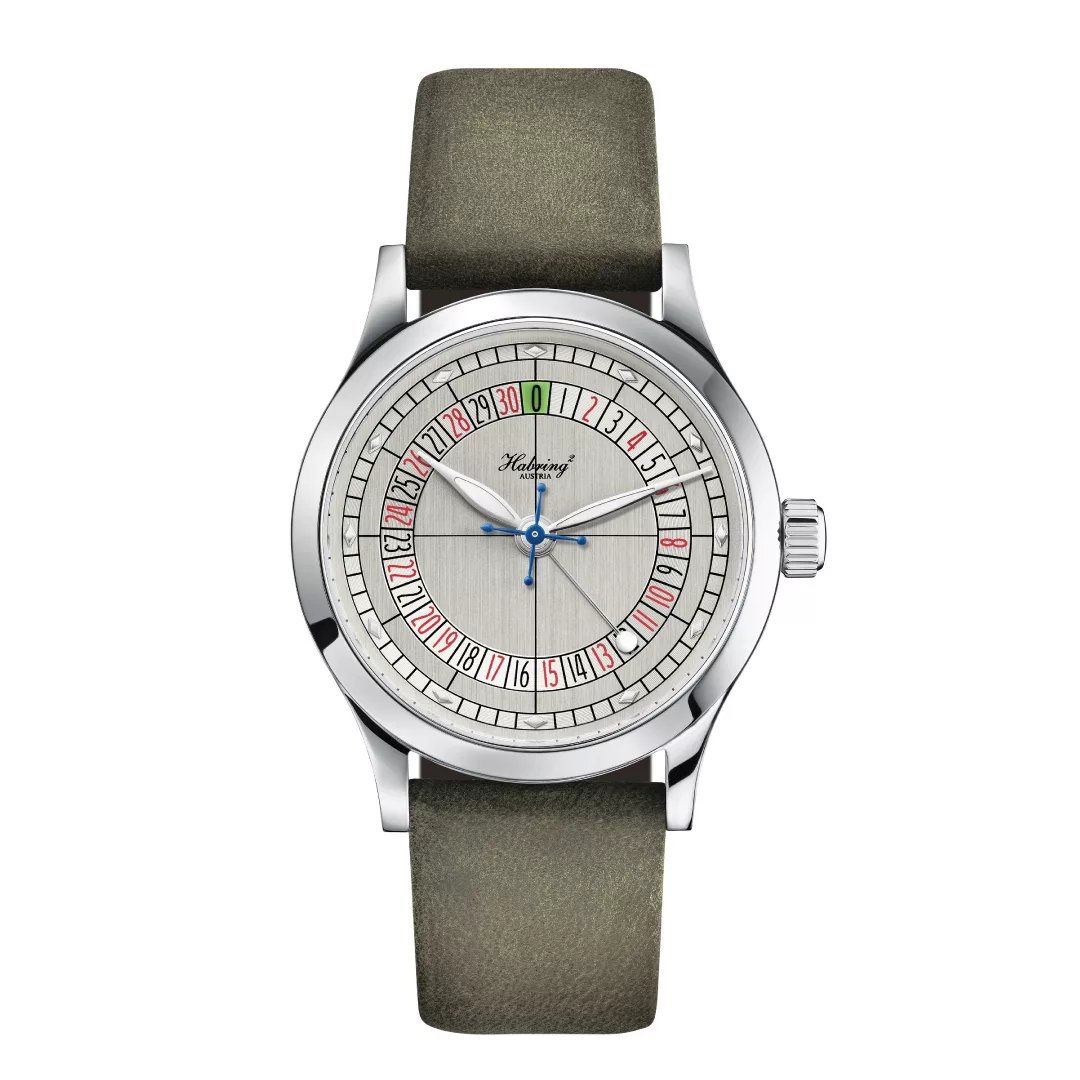
The 'Roulette' moniker refers to the specific dial layout that has become a cult favorite among collectors. Drawing inspiration from mid-century sector dials, the Roulette features a multi-toned silver or salmon base with a distinct outer track. The 'Roulette' element is often found in the alternating colors of the date or the seconds track, evoking the red and black of a casino wheel without ever feeling gimmicky. The typography is clean, modern, and quintessentially Austrian—functional yet elegant.
The case, at 38.5mm, is the perfect canvas for this dial. It features a stepped bezel and a mix of brushed and polished surfaces. The lugs are short and curved, allowing the watch to hug the wrist. It is a design that doesn't shout for attention across a room but commands it during a conversation. The sapphire caseback reveals the A11B in all its glory. Unlike the industrial finishing of mass-produced Swiss movements, the Habring² shows the hand of the watchmaker. You will see perlage on the baseplate, heat-blued screws, and a bridge layout that is logical and aesthetically pleasing.
Technical Deep Dive: The Seconde Morte
The mechanical implementation of the jumping seconds in the Roulette is what sets it apart from competitors like the JLC Geophysic. In the Habring² system, the jumping mechanism is modular. This allows for easier servicing and ensures that the complication does not interfere with the chronometric performance of the base movement. The jump is triggered by a jewel-tipped lever that interacts with the star-wheel. When you watch the movement through the caseback, the complexity of this interaction is visible, providing a secondary layer of entertainment for the horological nerd.
The accuracy of the Roulette is equally impressive. Because the jumping seconds mechanism requires a consistent flow of torque, the Habrings have optimized the mainspring delivery. This ensures that even as the power reserve depletes toward the 48-hour mark, the 'snap' of the seconds hand remains crisp and the timekeeping remains within tight tolerances. It is a movement built for longevity and reliability, echoing Richard Habring's philosophy that a watch should be a lifelong companion, not a fragile museum piece.
The Independent Advantage
Choosing a Habring² Roulette is a statement of intent. It suggests that the owner has moved past the 'Big Three' and the entry-level luxury brands and is seeking something more intimate. Because the Habrings produce only a few hundred watches a year, owning a Roulette means you are part of a very small club. There is no marketing department at Habring²; there are no billboards in Geneva. The value of the watch is entirely contained within its steel case and its mechanical heart.
For the young collector, the Roulette offers a gateway into the world of true independent watchmaking. At a price point under $7,000, it competes with mass-produced chronographs from major brands, yet it offers a level of exclusivity and mechanical intrigue that those brands simply cannot match. It is a watch that invites questions, a watch that demands an explanation, and ultimately, a watch that rewards the curiosity of its wearer.
Conclusion: A Masterpiece of Restraint
The Habring² Roulette is a rare bird in the modern landscape. It is technically sophisticated without being fragile, and it is aesthetically bold without being loud. By focusing on the jumping seconds—a complication that was once the pinnacle of precision timekeeping—the Habrings have created a bridge between the past and the future of watchmaking. It is a testament to what can be achieved when engineering excellence is paired with a clear, uncompromising vision. For the sophisticated collector, the Roulette isn't just a watch; it's a mechanical manifesto.