The Philosophy of the Jazzmaster: More Than Just a Name
When we talk about the 'Jazzmaster,' we are talking about a specific type of horological urbanity. In the world of Vivir, where we often obsess over the micro-adjustments of a diver’s clasp or the helium escape valve of a professional tool, the Jazzmaster serves as a necessary palate cleanser. It is a watch designed not for the Mariana Trench, but for the nuances of a high-stakes board meeting and the subsequent celebratory drinks. Hamilton, a brand that built its reputation on the accuracy of American railroads and the grit of WWII trenches, uses the Jazzmaster to flex its aesthetic muscles.
The name itself evokes a certain rhythmic complexity. Just as jazz music relies on a structured foundation to allow for improvisational brilliance, the Jazzmaster uses a classic case silhouette to host a variety of dial textures and complications. For the young collector, this is often the first 'serious' watch—the one that moves them away from fashion brands and into the realm of mechanical integrity.
Case Architecture: The 48mm Reality
As a reviewer, I am frequently asked: 'Does it wear big?' The 40mm diameter of the Viewmatic is a deceptive number. On paper, it is a modern standard. However, the true story of a watch's comfort lies in the lug-to-lug measurement. At 48mm, the Jazzmaster occupies a significant amount of 'real estate' on the wrist, yet it never feels cumbersome. Why? The secret lies in the lug curvature.
The lugs are not merely extensions of the case; they are sculpted, downward-sloping arcs that follow the natural contour of the human wrist. During a full week of testing—which included heavy typing, a flight from New York to Geneva, and a weekend cycling trip—the watch remained centered. Many watches in this price bracket suffer from 'flat-case syndrome,' where the watch sits like a dinner plate on the wrist. The Hamilton avoids this entirely, providing a snug, integrated feel that belies its sub-$1000 price point.
The Dial: A Study in Depth and Legibility
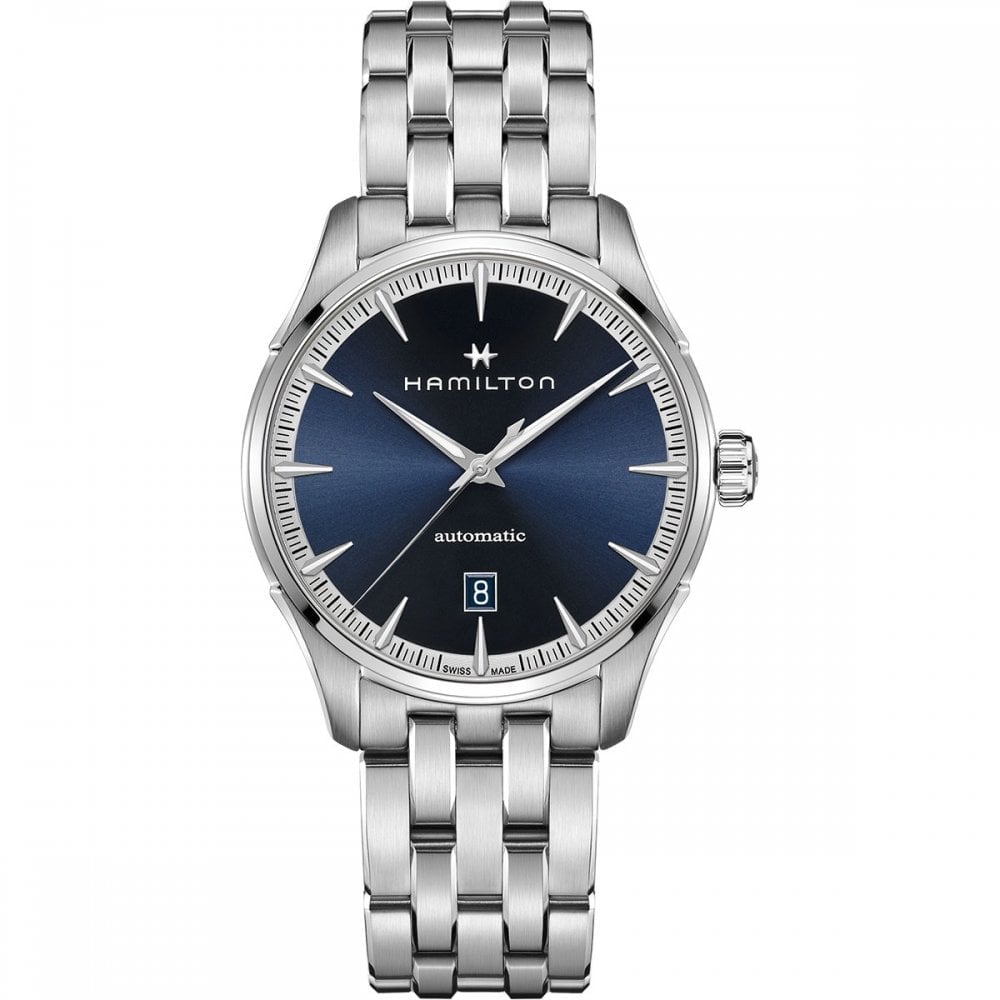
Legibility is the cornerstone of daily wear. If you have to squint to check the time during a presentation, the watch has failed its primary mission. The Jazzmaster Viewmatic features a multi-layered dial that is a joy to inspect under a loupe. The center of the dial often features a guilloché-style texture—a series of repeating patterns that add depth and prevent the dial from looking 'flat' in direct sunlight.
The dauphine hands are polished to a mirror finish and faceted. This is crucial: the facets ensure that even in low-light environments, at least one edge of the hand will catch whatever ambient light is available. The date window at 3 o'clock is framed, a small but significant touch that many brands omit to save on manufacturing costs. While the lume is not as potent as what you would find on a Khaki Field, the Super-LumiNova on the hands and the small pips at the hour markers provide enough visibility for a dark cinema or a late-night drive.
The H-10 Caliber: The 80-Hour Marathon
Inside the Jazzmaster beats the H-10 movement, and here is where Hamilton truly dominates the competition. Most mechanical watches in this price tier offer a 38 to 42-hour power reserve. The H-10 offers 80. This is not just a 'nice to have' feature; it is a fundamental shift in how you interact with your watch. You can take the Jazzmaster off on a Friday evening, leave it on your dresser all weekend, and on Monday morning, it is still ticking and accurately displaying the time. This 'weekend-proof' nature is a massive quality-of-life improvement for the collector who rotates between multiple pieces.
To achieve this, the Swatch Group (which owns Hamilton and movement-manufacturer ETA) reduced the frequency from 4Hz to 3Hz. Some purists argue that the sweep of the second hand is less 'smooth' as a result. While technically true, the difference is negligible to the naked eye, and the trade-off for nearly double the power reserve is a bargain I would take every single time. Furthermore, the inclusion of a Nivachron hairspring means the watch is less susceptible to the magnetic fields generated by our laptops and smartphones—a modern necessity.
A Week on the Wrist: Real-World Performance
Monday: The watch disappears under my blazer. Its 11.5mm thickness is the hero here. I spent six hours at a desk, and the pin buckle did not dig into my skin once. The leather strap, though stiff out of the box, began to soften by mid-afternoon.
Wednesday: A rainy commute. The 50m water resistance was tested by a heavy downpour and a splash from a passing taxi. While I wouldn't take this watch swimming, it handled the environmental moisture without any fogging of the sapphire crystal. The legibility remained high even through the raindrops on the glass.
Friday: Transitioned from the office to a cocktail lounge. The polished surfaces of the Jazzmaster thrive in artificial lighting. It has a 'sparkle' that suggests a much higher price point, drawing the eyes of fellow enthusiasts without screaming for attention.
The Bracelet vs. Leather Debate
The Jazzmaster is a chameleon. On the five-link stainless steel bracelet, it leans into its 'sport' identity. The bracelet is well-articulated and features a mix of brushed and polished finishes that hide scratches effectively. However, for the 'sophisticated young collector' Vivir targets, I recommend the leather strap. It emphasizes the Jazzmaster's dressier roots and allows the case geometry to take center stage. If you do opt for the bracelet, be aware that it lacks a micro-adjustment system, so finding the 'perfect' fit might require some patience with half-links.
Investment and Value: The Discerning Buyer's Perspective
Let’s be honest: at $945 MSRP, the Jazzmaster is not an investment in the sense that it will fund your retirement. It is, however, an investment in your personal brand. It signals that you value craftsmanship and heritage over the fleeting trends of smartwatches or fashion-house quartz pieces. In the pre-owned market, these watches are incredibly stable. You can pick one up for $500 and, five years later, likely sell it for $450. That 'cost of ownership' is remarkably low for a high-quality Swiss machine.
Final Verdict
The Hamilton Jazzmaster is not trying to be a tool for a diver or a pilot; it is trying to be a tool for a human living a modern, multifaceted life. It succeeds because it doesn't over-complicate its mission. It provides a world-class movement, a beautifully finished case, and a level of comfort that makes you forget you're wearing it—until you catch a glimpse of that guilloché dial in the sun. For the young professional building their first real collection, the Jazzmaster isn't just a choice; it's the benchmark.