The Purist’s Choice: An Introduction
In an era where watches are increasingly judged by their 'wrist presence'—a polite euphemism for how much gold they can flash or how many millimeters of ceramic they can stack—the Hamilton Khaki Field Mechanical feels like a quiet revolution. It is a watch that doesn't scream for attention; it waits to be noticed by those who know what they are looking at. At Vivir, we often talk about the 'soul' of a watch. Usually, that’s marketing fluff. But with the Khaki Mechanical, the soul is right there in the resistance of the crown as you wind it on a Tuesday morning.
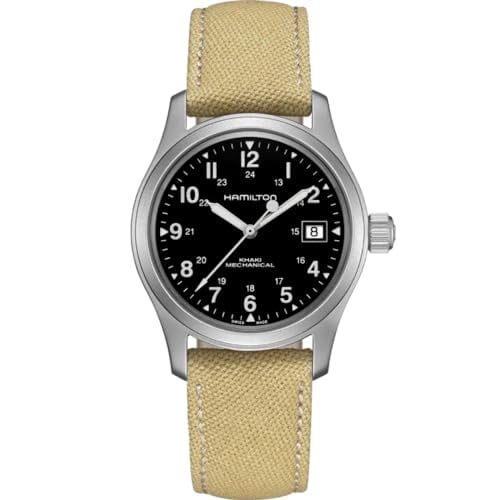
The model we are looking at today, the H69439931, is the direct descendant of the MIL-W-46374, a watch issued to American soldiers during the Vietnam War. Hamilton hasn't just captured the look of those vintage pieces; they’ve captured the ethos. This is a watch designed to be beaten up, to be worn on a muddy strap, and to keep ticking through the vibrations of a motorcycle ride or a trek through the woods.
The Case: A Study in Proportions
The case of the Khaki Field Mechanical is perhaps its most controversial and celebrated feature. At 38mm, it sits in the 'Goldilocks' zone for many collectors. However, the lug-to-lug measurement of 47mm is what defines the wearing experience. These are long, straight lugs that extend the footprint of the watch significantly. On my 6.5-inch wrist, the lugs stop just before the edge of my wrist, creating a flat, athletic stance. If your wrist is smaller than 6 inches, you might find the lugs 'float' above your arm, which is a dealbreaker for some.
The finish is a uniform bead-blasted matte steel. This is a brilliant choice for a daily wearer. Unlike polished surfaces, which act as 'scratch magnets,' the bead-blasted finish hides micro-abrasions exceptionally well. After a week of desk-diving and outdoor activity, the case looks exactly as it did when I took it out of the box. The crown is oversized and deeply knurled, making the act of manual winding—which you will be doing every few days—a tactile pleasure rather than a chore.
The Dial: Legibility Above All
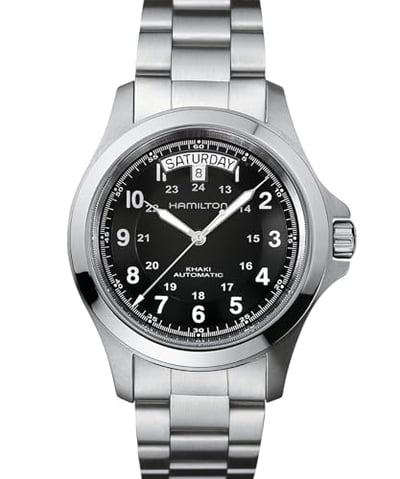
The dial is a masterclass in functional design. You have the standard 12-hour track in large Arabic numerals, and tucked just inside is a 24-hour scale. This 'military time' layout is a nod to its heritage, but it’s also surprisingly useful for those of us who travel across time zones. The triangular hour markers and the syringe-style hands are coated in an 'Old Radium' Super-LumiNova. While some purists dislike 'fauxtina,' here it feels earned. The warm, sandy hue of the lume against the matte black dial provides a high-contrast environment that is legible in almost any lighting condition.
One detail I appreciate as a daily wearer is the lack of a date window. While a date is practical, it often ruins the symmetry of a field watch dial. By omitting it, Hamilton has kept the Khaki Mechanical focused. There is no 'ghost position' on the crown, either—Hamilton has correctly modified the movement to ensure the crown only has one setting position, a small but significant detail that shows they care about the mechanical experience.
The H-50 Movement: Power for the People
Under the hood lies the H-50 caliber. For the uninitiated, this is a modified version of the venerable ETA 2801-2. The primary change Hamilton (via the Swatch Group) made was to lower the frequency from 28,800 vph to 21,600 vph. The result? A power reserve that has been boosted from roughly 42 hours to a staggering 80 hours. In practice, this means you can wind the watch on a Friday morning, leave it on your nightstand all weekend while you wear a diver, and it will still be ticking on Monday morning.
The movement is a manual-wind only. There is no rotor, which is why the watch is so thin. There is a certain romanticism to the manual wind; it forces a moment of connection between the owner and the machine. The winding action is crisp, with a definitive 'stop' when the mainspring is fully tensioned. In terms of accuracy, our test unit ran at +4 seconds a day, which is well within the acceptable range for a non-chronometer movement.
Real-World Wear: A Week on the Wrist
I wore the Khaki Mechanical for seven days straight. On Monday and Tuesday, I paired it with a grey cashmere sweater and chinos. The watch looked sophisticated in a 'rugged intellectual' sort of way. Because it is so thin, it never caught on my sleeve, a common annoyance with modern 14mm-thick automatics. On Wednesday, I swapped the factory NATO for a tan leather strap. The drilled lugs made this a thirty-second job. On leather, the watch transforms into something much more 'vintage explorer' and less 'infantryman.'
The biggest critique of this watch is the 50m water resistance. In the watch world, 50m usually means 'don't take it swimming.' For a field watch, which is supposed to be an all-terrain tool, this feels like a missed opportunity. While it will survive a rainstorm or a splash at the sink, I wouldn't take it into the pool. If you are the type of collector who needs one watch for everything—including the beach—this might be the only area where the Khaki Mechanical falters.
The Verdict
Is the Hamilton Khaki Field Mechanical the perfect watch? No. The water resistance is low, and the lugs are long. But it is a *perfectly honest* watch. It doesn't pretend to be a jewelry piece. It doesn't try to justify a $5,000 price tag with marketing jargon about 'heritage' while using a plastic movement spacer. It is a $600 Swiss-made mechanical watch with a sapphire crystal, an 80-hour power reserve, and a design that hasn't needed to change in fifty years.
For the young collector, this is the watch that teaches you what matters. It teaches you to appreciate the weight of a case, the clarity of a dial, and the ritual of the wind. It is a foundational piece. Whether it’s the first watch in your collection or the tenth, the Khaki Mechanical earns its spot on the wrist every single time you strap it on.