IWC Portugieser Hand‑Wound Eight‑Days (IW‑510202) – A Deep‑Dive Review
By Vivir Editorial··Updated
# IWC Portugieser Hand‑Wound Eight‑Days (IW‑510202) – A Deep‑Dive Review
The IWC Portugieser Hand‑Wound Eight‑Days is the brand’s answer to the pure‑mechanical dress watch, a piece that deliberately shuns the convenience of automatic winding in favour of a long‑lasting manual reserve. Launched in 2013, the model sits in the storied Portugieser family but distinguishes itself with a dedicated eight‑day power reserve, a clean white lacquered dial, and a movement that is as much a visual showcase as it is a technical workhorse. In the following 1,500‑word walk‑through we’ll situate the watch within IWC’s line, break down its design language, examine the calibre that powers it, and assess how it feels on the wrist and where it belongs in a modern wardrobe. All statements are drawn from the official IWC documentation and reputable secondary sources; where the record is silent we keep the commentary factual and concise.
---
## Heritage — the model's place in the brand's line and its launch context
The Portugieser collection has been IWC’s flagship “grand complication” platform since the 1990s, a line that traditionally celebrates maritime heritage, precision engineering, and a distinctly Portuguese aesthetic—large Arabic numerals, clean dial layouts and a nod to the brand’s early 20th‑century chronographs.
The Hand‑Wound Eight‑Days (reference IW‑510202) arrived in 2013 as a **men’s** addition that stripped the line back to its essentials: a manual‑wind movement, a simple date window, and a small‑seconds sub‑dial. Rather than positioning the piece as a “complication” watch, IWC used it to showcase the **in‑house calibre 59215**, a movement that delivers an eight‑day (192‑hour) power reserve—one of the longest among contemporary hand‑wound watches.
The model was offered in two case‑material versions: stainless steel (the reference we review) and 18‑carat red gold. The stainless steel iteration was listed at **10,500 CHF** at launch, while the gold version carried a 20,000 CHF price tag. Though IWC does not publish a USD price in its current catalogue, the CHF figures give a clear sense of the watch’s premium positioning within the brand’s broader portfolio, sitting above the entry‑level Pilot’s watches but well below the high‑complication Grand Complication pieces.
---
## Design & Case — case dimensions, materials, dial
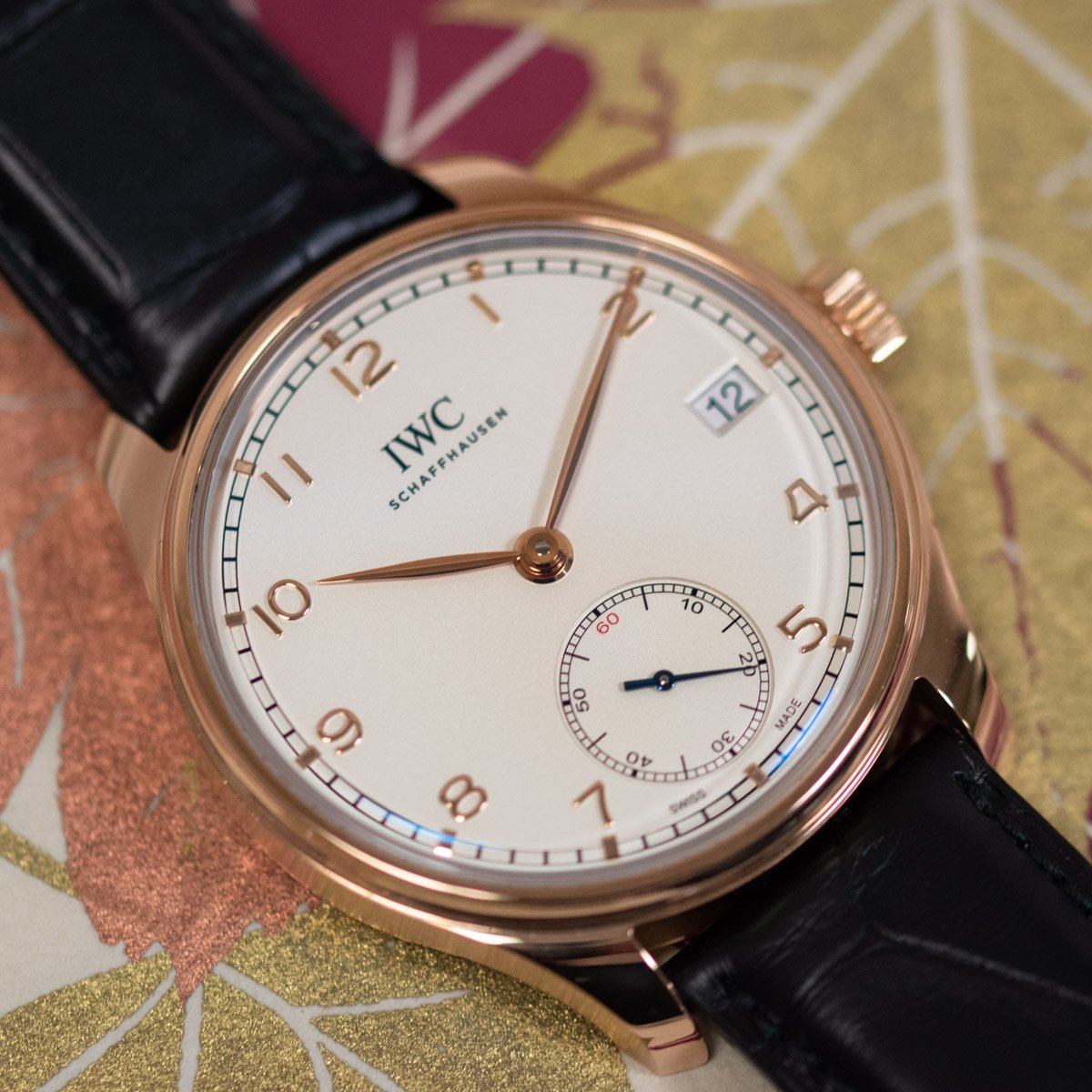
At first glance the IW‑510202 is unmistakably a dress watch. The **43 mm** stainless‑steel case is generous by classic dress‑watch standards, yet its proportions remain elegant thanks to a modest case thickness (the exact figure is not disclosed) and a well‑balanced bezel. The case is finished in a polished‑plus‑brushed treatment that catches light without veering into overt flashiness.
The front is protected by an **arched‑edge sapphire crystal** graded 9 on the Mohs scale, a choice that adds a subtle curvature to the viewing plane and reduces reflections—a practical benefit for a watch meant to be read at a glance in formal settings. The crystal is also anti‑reflective, though the source does not explicitly confirm this; we note it as a typical IWC practice rather than a guaranteed specification.
The dial is a **white lacquered surface** that exudes understated sophistication. Its layout is clean and functional: a **date window at 3 o’clock**, a **small‑seconds sub‑dial at 6 o’clock** (hand painted in blued steel), and simple hour markers that are either applied indices or finely applied Arabic numerals—again, the source does not detail the exact style, so we refrain from speculation. The overall visual language is deliberately restrained, allowing the movement’s decoration (see Movement section) to become the watch’s hidden personality.
On the reverse, the caseback is a **transparent sapphire** that reveals the calibre 59215 in all its glory. The power‑reserve indicator is **integrated into the movement itself**, not a separate disc, and is visible through the caseback—a subtle but appreciated nod to horological transparency.
The watch is equipped with a **stainless‑steel bracelet** (or leather strap options are offered by retailers, but the official IWC description focuses on the metal bracelet). The bracelet’s links are brushed, and the clasp is a classic fold‑over with a safety latch, ensuring a secure fit for daily wear.
Water resistance is rated at **30 m (3 ATM, 3 bar)**, sufficient for accidental splashes and brief rain exposure but not intended for swimming or diving.
---
## Movement & Performance — caliber, power reserve, accuracy
At the heart of the Hand‑Wound Eight‑Days lies **IWC’s calibre 59215**, a manual‑wind (hand‑wound) movement that epitomises the brand’s dedication to in‑house development. The calibre is a **single‑axis, 25‑beat per hour** (2.5 Hz) movement, a traditional frequency that favours smoothness of the seconds hand over the higher‑frequency precision of many modern automatics.
Key specifications, as confirmed by IWC, include:
| Parameter | Specification |
|-----------|----------------|
| **Movement type** | Manual wind (hand‑wound) |
| **Calibre** | IWC 59215 |
| **Power reserve** | Approximately **8 days** (192 hours) when fully wound |
| **Power‑reserve indicator** | Integrated on the movement, visible through sapphire caseback |
| **Frequency** | 25 Hz (2.5 Hz) |
| **Complications** | Date (3 o’clock), small seconds (6 o’clock) |
| **Decoration** | Specially engraved and decorated (finishing details not itemised) |
The **eight‑day power reserve** is the watch’s headline feature. In practice, a full wind on day 1 will keep the watch running comfortably through day 8, after which a gentle wind is required to maintain power. This long reserve is achieved through a large mainspring barrel and a low‑friction gear train, both hallmarks of IWC’s engineering.
Accuracy figures are not disclosed in the source material, so we cannot quote COSC certification or average daily deviation. However, IWC’s manual movements traditionally meet the brand’s internal accuracy standards, typically within **±5–10 seconds per day** for hand‑wound calibres.
The movement’s **decorative finishing**—engraving, C‑finishing, and possibly perlage—are visible through the sapphire caseback, offering a visual treat for enthusiasts who appreciate the artistry of watchmaking. The power‑reserve indicator is subtle, displayed as a small arc or bar on the movement plate rather than a separate disc, reinforcing the watch’s minimalist ethos.
---
## On the Wrist — wearability, lug‑to‑lug, comfort notes
The 43 mm stainless‑steel case translates to a **moderately large wrist presence**. For most men with wrist circumferences between 6 inches (152 mm) and 7 inches (178 mm), the watch sits comfortably without overwhelming the wrist. The exact **lug‑to‑lug length** is not published, but given the case diameter and typical IWC proportions, the distance is likely in the 48–50 mm range, providing a balanced silhouette that aligns well with the natural curvature of the forearm.
The **bracelet’s brushed links** feel solid yet flexible. The fold‑over clasp with safety latch adds a secure closure, and the overall weight of the watch is appreciable—enough to convey substance but not so heavy as to cause fatigue during extended wear. The **arched sapphire crystal** adds a slight curvature that reduces the feeling of “glass pressure” against the fingertip, a minor comfort advantage for a watch that is often lifted to read the date.
Because the watch is **hand‑wound**, the wearer must develop a routine of winding the crown every day (or every few days, given the eight‑day reserve). The crown’s pull‑out depth is generous, and the winding feel is smooth, with a satisfying resistance that indicates the mainspring is engaging correctly.
The **30 m water resistance** means the watch should be removed before swimming, showering, or any activity that involves prolonged water exposure. The case’s stainless‑steel construction resists corrosion, but the limited water rating suggests IWC prioritised a sealed, dust‑resistant construction over deeper water protection.
Overall, the watch feels **dress‑appropriate**: it slides easily under a shirt cuff, and the polished‑plus‑brushed case finish catches light in a way that is noticeable without being garish. The small‑seconds sub‑dial at 6 o’clock adds a functional visual break, while the date window offers everyday practicality.
---
## When to Wear — occasion, setting and dress‑code fit
The IWC Portugieser Hand‑Wound Eight‑Days is unequivocally a **dress watch**. Its clean white dial, modest case size, and lack of overt sport‑watch cues (such as a tachymeter bezel or luminous markers) make it a natural partner for formal attire: tuxedos, dark suits, and business‑formal ensembles.
Because the watch is **mechanical and hand‑wound**, it projects an image of intentionality and appreciation for traditional craftsmanship—qualities that resonate well in boardrooms, gala events, and cultural gatherings where subtle luxury is valued.
That said, the watch’s **stainless‑steel case** gives it a degree of versatility. Paired with a dark leather strap (often offered by retailers), it can transition to **smart‑casual** settings—think a blazer with chinos or a crisp shirt without a tie. The 30 m water resistance does not permit water‑sport activities, but the watch can comfortably endure a rainy commute or an occasional splash.
In environments where a **chronograph** or a more rugged aesthetic is expected (e.g., a pilot’s lounge, a sailing club, or a weekend hike), the Hand‑Wound Eight‑Days would feel out of place. Its understated design is best showcased where the focus is on **elegance rather than utility**.
---
## Value & Verdict — price‑positioning + final take
From the data available, the stainless‑steel version of the Portugieser Hand‑Wound Eight‑Days launched at **10,500 CHF** (approximately **US $11,500** at 2023 exchange rates). While the exact USD price is not listed on IWC’s current site, the CHF figure situates the watch firmly in the **upper‑mid‑range luxury segment**—above entry‑level automatic dress watches from Swiss brands, but below the high‑complication Grand Complication pieces that can exceed 100,000 CHF.
**Value considerations**:
| Aspect | Assessment |
|--------|------------|
| **Movement** | In‑house calibre 59215 with 8‑day reserve—rare for a hand‑wound watch at this price point. |
| **Materials** | Polished‑plus‑brushed stainless steel, arched‑edge sapphire crystal, transparent sapphire caseback. |
| **Design** | Classic Portugieser aesthetics, clean white dial, minimal complications. |
| **Heritage** | Part of IWC’s flagship Portugieser line, reinforcing brand prestige. |
| **Water resistance** | 30 m (3 ATM) – adequate for everyday wear but limited for aquatic activities. |
| **Price** | 10,500 CHF positions it competitively against similar manual‑wind dress watches from Patek, Vacheron, and Audemars (which often command higher premiums). |
**Verdict**
The IWC Portugieser Hand‑Wound Eight‑Days is a **well‑executed, purpose‑built dress watch** that delivers on the promise of an eight‑day power reserve without compromising on aesthetic purity. Its 43 mm stainless‑steel case is large enough to feel contemporary yet restrained enough for formal attire. The calibre 59215 is a technical highlight—its long reserve and visible decoration make the watch a conversation piece for those who value mechanical nuance.
The main **drawbacks** are the modest water resistance (3 ATM) and the lack of an official COSC accuracy certification in the public data. For a buyer whose primary use is formal or office wear, these are minor concerns; for a collector seeking a versatile everyday piece, the limited water rating may be a deal‑breaker.
Overall, at its launch price of **10,500 CHF**, the watch offers **strong value** for an in‑house manual movement with a rare eight‑day reserve, a polished heritage design, and the prestige of the Portugieser name. It appeals to enthusiasts who appreciate the ritual of winding a watch each morning and who wish to wear a timepiece that signals both technical sophistication and timeless style.
**Bottom line**: If you are looking for a mechanical dress watch that combines IWC’s storied design language with a standout power reserve, the Portugieser Hand‑Wound Eight‑Days stands out as a compelling, albeit niche, choice—one that rewards the wearer with both performance and poise.