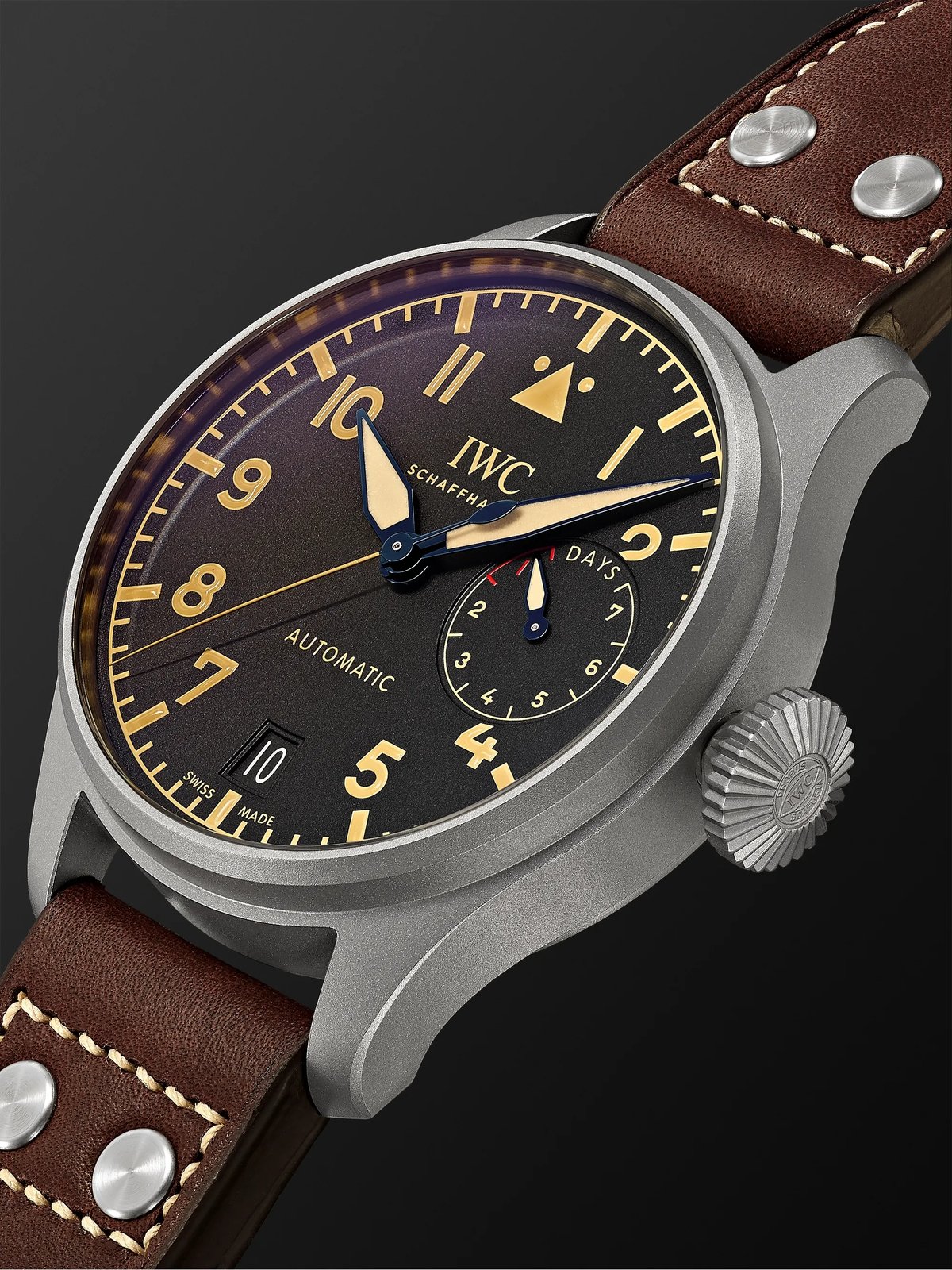
IWC Schaffhausen Big Pilot Review: The Original Cockpit Companion
There are pilot watches, and then there is the Big Pilot. Since its reissue in 2002, the IWC Schaffhausen Big Pilot has become the definitive oversized aviator—a watch that doesn't just tell time but commands presence. Its lineage traces back to the 1940s, when IWC supplied the German Luftwaffe with robust observation watches capable of withstanding magnetic fields and extreme cockpit conditions. Today's Big Pilot retains that original 55mm spirit, distilled into a more wearable 46.2mm case, yet it remains unmistakably bold.
For the sophisticated young collector, the Big Pilot represents a paradox: it is both a historical artifact and a modern statement piece. It is not a watch that disappears under a cuff; it is a watch that announces its owner understands the romance of flight, the precision of mechanical engineering, and the quiet confidence of wearing something genuinely iconic. This review will dissect every element of the Big Pilot, from its in-house movement to its dial architecture, to help you decide if this aviator deserves a place in your collection.
Manufacture History
Founded in 1868 in Schaffhausen, Switzerland, by American engineer Florentine Ariosto Jones, IWC was born from a vision to combine American manufacturing efficiency with Swiss watchmaking artistry. The company quickly earned a reputation for precision and robustness, particularly in the realm of pilot watches. In the 1930s, IWC began producing cockpit instruments and wristwatches for aviators, culminating in the 1940 Caliber 52 T.S.C. observation watch—the direct ancestor of today's Big Pilot. This 55mm behemoth featured a center seconds hand and a hacking mechanism, designed for navigational use in the cramped cockpits of the era.
After the war, IWC continued to refine its pilot watches, but it wasn't until 2002 that the Big Pilot was revived as a modern icon. The current generation, introduced in 2016 with the Caliber 52110, represents the pinnacle of this evolution, blending historical cues with contemporary engineering.
Movement
At the heart of the Big Pilot (reference IW501002) beats the in-house Caliber 52110, an automatic movement with a staggering 168-hour (7-day) power reserve. This is achieved through two barrels connected in series, providing consistent torque over the entire winding cycle. The Pellaton winding system, a hallmark of IWC, uses a pawl-winding mechanism that winds the mainsprings with minimal friction. The system's components are partially ceramic, reducing wear and ensuring longevity.
The movement operates at 28,800 vibrations per hour (4 Hz) and features 31 jewels. It includes a hacking seconds function and a date display with a quick-set mechanism. The bridges are decorated with Côtes de Genève, and the skeletonized rotor bears the IWC emblem, visible through the sapphire caseback. While not COSC-certified, the movement is regulated to tight tolerances. The balance wheel uses a variable inertia system with gold adjustment screws, and a Breguet overcoil spring improves isochronism.
Specifications
- Case: 46.2mm diameter, 15.6mm thickness, 56mm lug-to-lug
- Material: Stainless steel (also available in titanium)
- Crystal: Domed sapphire with anti-reflective coating
- Water Resistance: 60 meters (6 bar)
- Lume: Super-LumiNova X1 on hands and numerals
- Strap: Brown calfskin leather by Santoni, with IWC deployant clasp
Wrist Feel
Despite its 46.2mm diameter and 15.6mm thickness, the Big Pilot wears surprisingly well due to its short, downturned lugs that hug the wrist. The generous 56mm lug-to-lug length means it will dominate smaller wrists, but the weight—around 140 grams on the Santoni leather strap—is distributed evenly. The leather strap is thick and stiff out of the box but breaks in beautifully, conforming to the wrist over time.
The crown is massive and easy to grip, a necessity given the water resistance and the need to wind the seven-day mainspring. The titanium version (ref. IW501001) reduces weight significantly, making it more comfortable for all-day wear. However, the steel version carries a satisfying heft that reinforces the tool-watch ethos. It is not a watch for the faint of wrist; it demands a presence that the wearer must be willing to own.
Accuracy
In real-world use, the Caliber 52110 performs within -2 to +5 seconds per day, which is excellent for a large, seven-day movement. The balance wheel’s variable inertia and the Breguet overcoil spring contribute to stability across positions. The long power reserve means timing drift over a week is minimal, though accuracy can vary slightly when the mainspring is fully wound versus nearly depleted. Expect consistent, reliable timekeeping that rivals COSC-certified movements.
Occasions
The Big Pilot is remarkably versatile despite its size. It works as a daily driver for those with the wrist real estate, a travel companion thanks to its legibility and power reserve, and even a sport watch for casual wear. It can dress up with a suit if the shirt cuffs are generous, but it truly shines in smart-casual and aviation-themed settings.
Wrist Presence
5/5 – The Big Pilot is an undeniable statement. Its oversized conical crown, clean dial, and bold Arabic numerals ensure it captures attention without being garish. It is the watch that people notice, ask about, and remember.
Reference Variants
The current Big Pilot family includes several references. The IW501001 in titanium, the IW501002 in stainless steel on leather, and the IW501004 on a stainless steel bracelet. There is also the manual-wind IW510201 with an 8-day power reserve and small seconds. Limited editions like the Le Petit Prince (IW501003) feature a blue dial and golden accents.
Family References
Predecessors include the IW5009 with the Caliber 51111, and the current generation IW5010. Siblings include the Spitfire (IW5030) and the annual calendar models.
Other Notable IWC Models
IWC's catalog is rich with pilot watches like the Mark XX, as well as the Portugieser, Portofino, and Ingenieur families. Each offers a different take on IWC's engineering ethos.
Similar Watches
Competitors include the Breitling Navitimer B01, Zenith Pilot Type 20, and Rolex Air-King. Each offers a unique interpretation of the pilot watch genre.
Homages
For budget-conscious collectors, the Steinhart Nav B-Uhr 44 and Laco Flieger Pro offer faithful designs at under $500.
Investment Value
The Big Pilot has a stable secondary market. Pre-owned examples range from $8,500 to $12,000, depending on condition and reference. Limited editions may appreciate slightly, but the standard models are best purchased for enjoyment rather than speculation.
Service Interval
IWC recommends service every 5 years. Costs at an authorized center are approximately $800, though independent watchmakers can service the movement for less.
Pros and Cons
Pros: Exceptional 7-day power reserve, in-house Pellaton winding, iconic design, excellent legibility, superb build quality.
Cons: Large size not for everyone, thick case, 60m water resistance, high price, stiff strap initially.
Final Verdict
The IWC Big Pilot is a masterclass in purposeful design and mechanical ingenuity. It is not a watch for everyone—its size and price demand commitment—but for those who appreciate aviation history and robust engineering, it is peerless. The seven-day movement and iconic dial make it a worthy centerpiece for any collection.