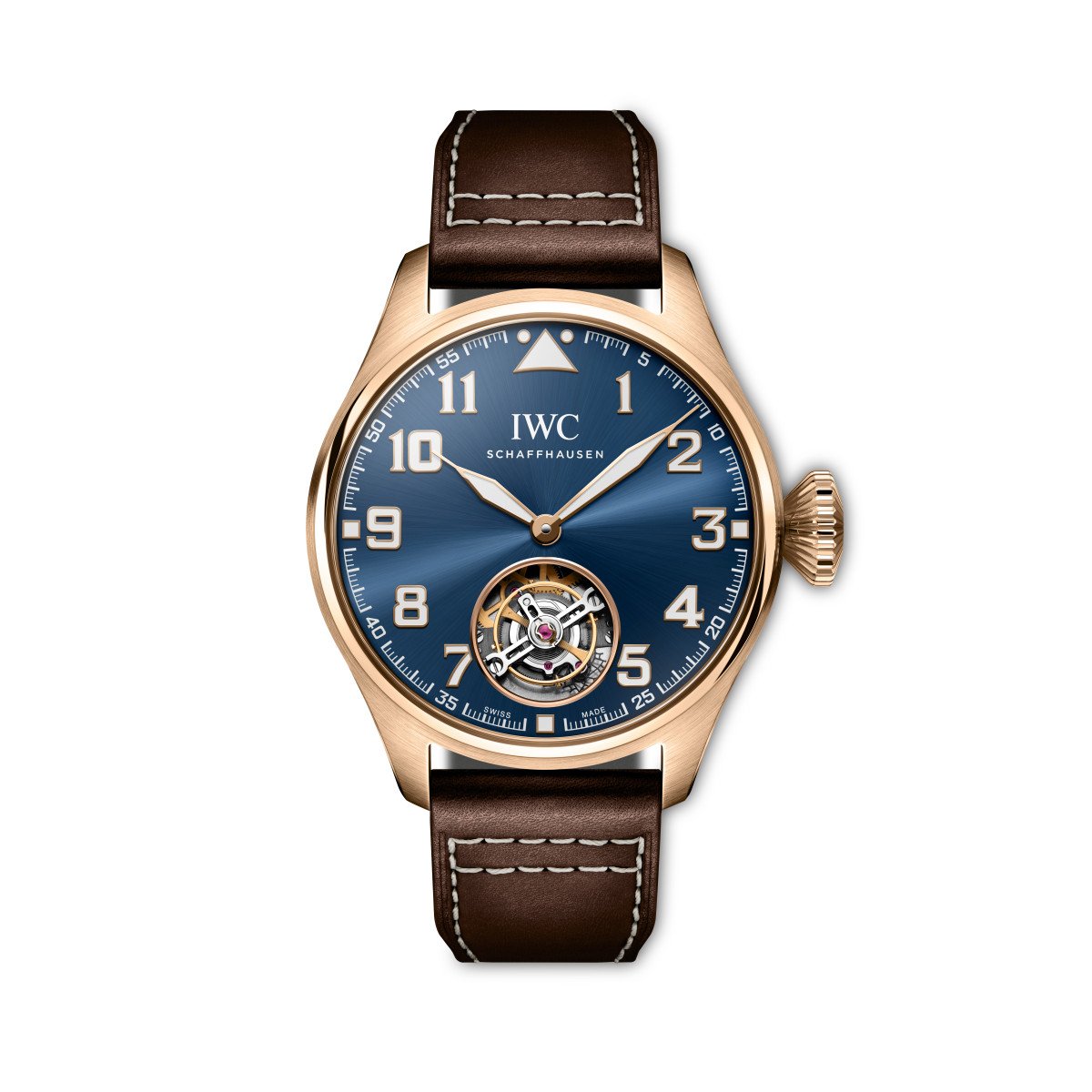
The Pivot: Why 43mm Matters
In the world of luxury horology, size has always been more than just a measurement; it’s a statement of intent. For years, the IWC Big Pilot was the definitive 'large' watch. It wasn't just big; it was a 46.2mm monolith that defined the 'oversized' trend of the early 2000s. But trends are fickle, and the modern collector—the one wearing Aime Leon Dore and driving a vintage 911—values proportion over percussion. The release of the IWC Big Pilot 43 (Ref. IW329301) is IWC’s acknowledgment that the culture has shifted.
By bringing the diameter down to 43mm, IWC has invited a whole new demographic to the cockpit. This isn't just a 'shrunk' Big Pilot; it’s a re-engineered masterpiece. The removal of the date window and the power reserve indicator—features that defined the 46mm version—results in a dial that is breathtakingly clean. It harks back to the original 1940s 52-calibre T.S.C. (Beobachtungsuhr), where legibility was the only metric that mattered.
Design Language: The Art of Subtraction
The IW329301 features a matte black dial that absorbs light, allowing the rhodium-plated hands and crisp white Arabic numerals to pop with clinical precision. The 'Type A' Flieger layout is respected here with religious fervor. The triangle with two dots at 12 o'clock remains, ensuring the pilot can orient the watch even in high-G maneuvers (or, more likely, a dimly lit cocktail bar in Soho).
The most polarizing change for purists was the omission of the power reserve indicator at 3 o'clock. On the 46mm version, this was a functional necessity for a 7-day movement. On the 43mm, which houses the 60-hour Calibre 82100, the indicator was deemed unnecessary. The result is a symmetrical dial that feels more balanced and, frankly, more expensive. It allows the eye to focus on the texture of the dial and the iconic 'onion' crown, which remains the tactile heart of the watch.
The Engineering: Calibre 82100
Inside the brushed stainless steel case beats the IWC-manufactured 82100 calibre. This isn't an off-the-shelf movement; it’s a high-end engine featuring the legendary Pellaton winding system. Named after Albert Pellaton, IWC’s former technical director, this system uses pawls rather than a complex gear train to wind the mainspring, making it more efficient and shock-resistant.
In the 82100, IWC has upgraded the most high-stress components—the automatic wheel, the pawls, and the cam—to black zirconium oxide ceramic. This makes the winding system virtually wear-free. While the movement is hidden behind a sapphire crystal caseback (a first for the standard Big Pilot line), the finishing is industrial-chic: circular graining, Geneva stripes, and a skeletonized rotor that allows a clear view of the ceramic components. It’s a movement built for the long haul, mirroring the ruggedness of the case it inhabits.
The Lifestyle: From Cockpit to Concrete
One of the most underrated features of the IW329301 is the EasX-CHANGE system. In an era where 'integrated' is the buzzword, IWC has provided a solution that allows the wearer to swap from the rugged brown calfskin strap to a rubber strap or a steel bracelet in seconds, without tools. It’s a nod to the versatility required by the modern 'Vivir' reader. You can wear the leather strap with a charcoal suit for a meeting, then swap to rubber for a weekend in Ibiza.
The 100m water resistance is another crucial upgrade. Previous Big Pilots were often limited to 60m, making them 'splash-proof' but not much more. At 100m, with a screw-down crown, the BP43 enters the 'Go Anywhere, Do Anything' (GADA) category. It is as much a sports watch as it is a pilot’s watch.
Wrist Presence and Cultural Impact
The Big Pilot has always been a celebrity favorite, but the 43mm version is the one you’ll see on the wrists of the 'quiet luxury' set. It doesn't scream for attention like a gold Daytona, but for those in the know, the silhouette of that crown is unmistakable. It’s a watch that signals an appreciation for history and engineering without the baggage of 'flexing' too hard.
When you strap it on, the first thing you notice is the dial's depth. The sapphire crystal has an anti-reflective coating on both sides, which is so effective that the crystal often seems to disappear. The lume is equally impressive; the 12, 3, 6, and 9 numerals, along with the hands and the 12 o'clock marker, glow with a sharp blue Super-LumiNova that lasts through the night.
Investment and Value Proposition
At an MSRP of $8,900, the Big Pilot 43 sits in a competitive space. It’s more expensive than a Tudor Pelagos or a Breitling Avenger, but it undercuts the Rolex Sky-Dweller or GMT-Master II. What you are paying for is the in-house movement and the pedigree of the Big Pilot name. While it won't see the 300% price jumps of a limited-edition Patek, it is a stable asset. On the secondary market, these are holding strong in the $7k range, suggesting that the demand for a 'wearable' Big Pilot is genuine and sustained.
Final Thoughts
The IWC Big Pilot 43 (Ref. IW329301) is a masterclass in evolution. It proves that you can change almost everything about a watch—its size, its movement, its dial layout—and still keep its soul intact. For the collector who always loved the look of the Big Pilot but couldn't stomach the 'dinner plate' proportions of the 46mm version, the wait is over. This is the icon, refined for a new generation.