The Enduring Allure of an Icon
There are watches, and then there are icons. The Jaeger-LeCoultre Reverso is unequivocally the latter. Born on the polo fields of 1930s India, its clever swiveling case was a brute-force solution to a gentleman's problem: protecting a watch crystal during a chukka. Nearly a century later, the Reverso has transcended its sporting origins to become a paragon of Art Deco design, a canvas for horological complications, and a staple in sophisticated collections. But can an icon truly be a daily companion? In a world of 100-meter water resistance and sapphire sandwiches, the Reverso's delicate elegance might seem anachronistic. We're here to challenge that notion. We’ve secured the Reverso Tribute Monoface Small Seconds, reference Q3918420, with its striking black dial and versatile steel case.
Our mission is simple: to move this watch from the safety deposit box to the wrist, subjecting it to a full week of meetings, commutes, and weekend errands. We’ll explore its comfort, legibility, and practicality, answering the ultimate question for the modern collector: Is the Reverso a precious relic, or can it be your everyday masterpiece?
A Legacy in Steel: The Watchmaker's Watchmaker
Before we delve into the watch itself, it's crucial to understand its pedigree. Jaeger-LeCoultre, founded in 1833 in the serene Vallée de Joux, has long been revered as the 'watchmaker's watchmaker.' For decades, the manufacture produced exceptional movements for many of the most hallowed names in Swiss watchmaking. This technical prowess is matched by a refined design language, and nowhere is this synergy more apparent than in the Reverso. Conceived in 1931, the design was a direct response to a request from British officers in India who were tired of smashing their watch crystals during polo matches. The ingenious swiveling case, which allows the watch to be flipped over to protect its face, was born. What began as a purely functional sports watch soon became an icon of the Art Deco movement, its clean lines and geometric form capturing the spirit of the age.
The Case for Art Deco: A Study in Form and Function
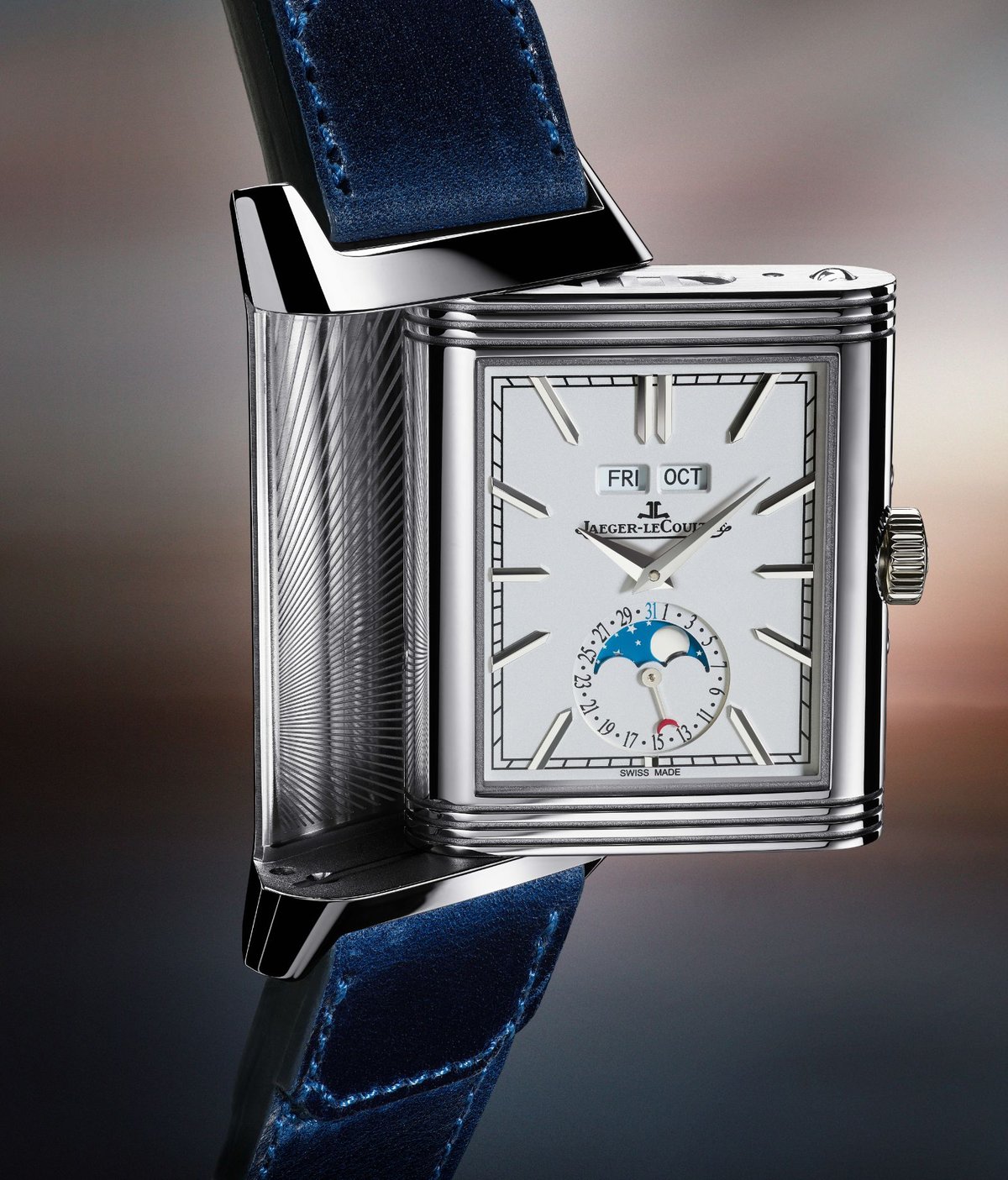
The first thing you notice about the Reverso Tribute is its case. In a sea of circular timepieces, its sharp, rectangular form is immediately distinct. The stainless steel case of the Q3918420 measures 45.6mm long, 27.4mm wide, and a wonderfully svelte 8.5mm thick. Forget conventional watch sizing; these dimensions wear completely differently. The 45.6mm 'lug-to-lug' is the most important measurement, and thanks to a gentle curvature in the caseback, it conforms to the wrist with an organic elegance. It feels custom-made.
The finishing is exemplary. Polished surfaces dominate, from the flat bezel to the gadroons—the three signature horizontal lines—that frame the dial. These polished planes play with light beautifully, creating a dynamic visual experience that changes with every turn of the wrist. The real party trick, of course, is the flip. The case slides out of its carrier with a satisfying, precision-engineered click, rotates 180 degrees, and snaps back into place. It's a tactile pleasure, a piece of kinetic art that never gets old. The reverse side is a blank canvas of polished steel, perfect for a personal engraving—a monogram, a family crest, or a significant date.
Dialing It In: Legibility and Elegance
The dial of this Tribute model is a masterclass in minimalist design. It's a deep, glossy black that provides a stunning backdrop for the polished, rhodium-plated hour markers. These applied indices are faceted, catching the light and enhancing legibility. The dauphine hands are similarly polished and perfectly proportioned. A railway minute track lines the periphery, adding a touch of vintage charm. At six o'clock, a recessed small seconds subdial with a concentric circular pattern adds depth and visual interest. There is no lume, which is appropriate for a watch of this style. Legibility in low light is compromised, but in any other condition, telling the time is an instant, effortless affair. The sapphire crystal is flat and features an anti-reflective coating, minimizing glare and keeping the focus on the dial's clean beauty.
The Heart of the Matter: Calibre 822/2
Powering the Reverso Tribute is the in-house, manually-wound Calibre 822/2. This is not some generic round movement shoehorned into a rectangular case. The Calibre 822/2 is a 'form movement,' meaning its tonneau shape was specifically designed to fit the Reverso's architecture. This is a mark of true high-horology. Comprised of 108 parts, it's a simple, robust, and time-tested engine. It operates at a frequency of 21,600 vibrations per hour (3 Hz) and offers a power reserve of 42 hours. This means a daily wind is necessary, but this is less a chore and more a cherished ritual. The winding action is smooth and precise, providing a tangible connection to the intricate mechanics within.
Jaeger-LeCoultre subjects this movement, once cased, to its rigorous '1000 Hours Control' test. This series of checks for accuracy, temperature and pressure resistance, and durability is more stringent than the industry-standard COSC certification. Our real-world testing confirmed this, with the watch maintaining an impressive accuracy of +2.5 seconds per day.
A Week on the Wrist: The Daily Wear Test
So, how does it all come together in the real world? On Monday, paired with a suit, the Reverso was in its element, sliding effortlessly under a cuff. Its slimness is a genuine asset in a professional setting. Tuesday involved more casual attire, and the watch proved surprisingly versatile. The steel case and the black dial, paired with the exceptional Casa Fagliano calf leather strap, dressed down nicely with a sweater and chinos. The strap itself is a key part of the experience. Made by the famed Argentinian polo boot maker, it starts off stiff but quickly softens, developing a unique patina. By Wednesday, it felt like a second skin.
The main challenge for daily wear is the stated 30 meters of water resistance. This is, in practical terms, splash resistance. It means you don't have to panic if you're caught in the rain, but washing your hands requires a conscious effort to keep the watch dry. For anyone accustomed to the go-anywhere, do-anything nature of a modern dive watch, this requires a mental adjustment. It's not a watch for the gym, the pool, or washing dishes. However, for the vast majority of a modern professional's day, it is more than capable.
By the end of the week, the Reverso had won me over. Its elegance is not fragility. It survived the commute, the office, and a crowded restaurant without a single scratch. Its comfort is unparalleled, and the daily winding ritual became a welcome moment of mindfulness to start the day.
The Competitive Landscape
The Reverso exists in a category with few direct competitors. Its most obvious rival is the Cartier Tank. While both are iconic rectangular dress watches, the Tank has a more Parisian, jewelry-like feel, whereas the Reverso feels more architectural and mechanically focused. For those who prioritize movement finishing and a more traditional horological experience, a round-cased option like the Grand Seiko SBGW231 offers incredible value and craftsmanship. And for a more accessible entry into the Art Deco style, the Longines DolceVita presents a compelling, Swiss-made alternative.
Value and Verdict
At an MSRP of $9,550, the Jaeger-LeCoultre Reverso Tribute is a significant investment. It sits in a competitive space, but it offers something unique: a timeless design, a rich history, and an interactive element that no other watch can replicate. On the pre-owned market, they hold their value well, typically trading between $7,500 and $9,000, indicating stable and consistent demand. This is not a watch to be bought for speculative purposes, but as a cornerstone for a growing collection, its value is immense.
After a week of continuous wear, the verdict is clear. The Jaeger-LeCoultre Reverso Tribute Q3918420 is not just a dress watch; it is a magnificent everyday companion for the discerning individual. It demands a certain level of care—a mindful approach to water and a commitment to daily winding—but the rewards are immeasurable. It is comfortable, legible, and endlessly fascinating. It is a piece of history on your wrist, a testament to the enduring power of great design, and a watch that proves an icon can indeed be part of your daily life.