Junghans 1972 Competition: A Retro Chrono Reborn
Channeling Olympic spirit with a vibrant, accessible '70s-inspired quartz chronograph.
Introduction: A Cultural Time Capsule on Your Wrist
In a world obsessed with vintage reissues and the relentless pursuit of mechanical purity, Junghans throws a curveball. The 1972 Competition, reference 27/4509.00, isn't just another heritage piece; it's a direct portal to a specific moment in time – the Munich Olympics, a cultural explosion, and the dawn of a new era in watchmaking. This isn't your grandad's dress watch; it's a statement, a nod to a bygone era of audacious design and sporting prowess.
Vivir.com's discerning collectors understand that true style transcends price tags or movement types. It's about the narrative, the impact, and the sheer 'cool' factor. The 1972 Competition delivers on all fronts, offering a slice of '70s athletic chic without breaking the bank. Forget the hype-driven mechanical drops for a moment; sometimes, the sharpest flex is a piece that tells a story, perfectly captures a vibe, and just looks damn good doing it.
The Legacy: Junghans and the Spirit of '72
Before we dive into the specifics of this modern marvel, let's set the stage. Junghans, founded in 1861 in the Black Forest region of Germany, has a storied past. From pioneering mass production techniques to crafting some of the most elegant Bauhaus-inspired designs, the brand has consistently been at the forefront of German horology. But for the 1972 Competition, one moment looms largest: the 1972 Munich Olympic Games.
Junghans served as the official timekeeper for these games, a monumental task that demanded absolute precision and cutting-edge technology. It was a time of vibrant design, technological advancement, and a shift in global consciousness. The watches produced by Junghans during this period, particularly their chronographs, were infused with this energy – bold colors, distinctive case shapes, and an unwavering focus on legibility and functionality. The 1972 Competition isn't just a watch; it's a celebration of that pivotal role and the audacious spirit of an era.
Design & Aesthetic: A Burst of Olympic Color
Case and Crystal: The Cushion of Cool
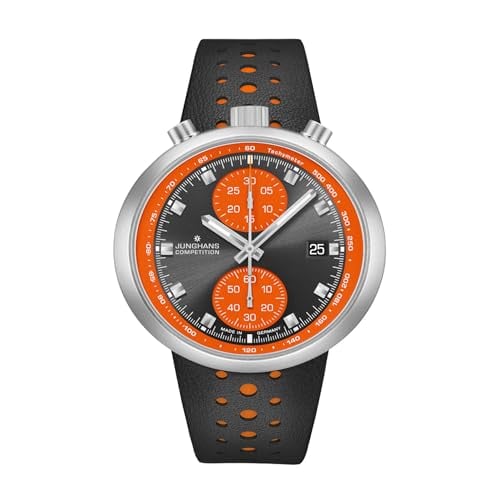
The 27/4509.00 immediately grabs attention with its distinctive cushion-shaped stainless steel case. Measuring 43.3mm in diameter, it's undeniably a contemporary size, yet the integrated lugs and relatively short lug-to-lug distance (around 47mm) ensure it wears smaller and more comfortably than the numbers might suggest. The case features a pleasing mix of brushed and polished surfaces, adding depth and visual interest without being overly flashy. The pushers and crown are robust and well-executed, offering a tactile experience that belies its accessible price point.
Perhaps the most defining feature of its retro aesthetic is the domed crystal. Junghans has opted for a 'hard plexiglass with SICRALAN coating.' While some purists might lament the absence of sapphire, this choice is historically accurate for the era it evokes. The SICRALAN coating significantly enhances scratch resistance, addressing one of the primary concerns with acrylic, while retaining that warm, distortion-rich vintage charm that only a domed acrylic can offer. It's a thoughtful compromise that perfectly captures the period.
Dial & Hands: The Blue and Orange Power Play
The star of the show is undoubtedly the dial. This specific reference features a stunning blue dial, a hue that perfectly encapsulates the '70s penchant for bold, saturated colors. The sunburst finish catches the light beautifully, shifting between deep navy and vibrant sky blue. Contrasting against this canvas are the instantly recognizable orange accents – on the central chronograph seconds hand, the minute track, and the hands of the two sub-dials. This color combination is pure '70s gold, reminiscent of athletic uniforms and graphic design of the era.
The two sub-dials, positioned at 3 and 9 o'clock, are dedicated to the 30-minute counter and the 1/10th second counter, respectively. A small running seconds sub-dial is subtly integrated at 6 o'clock, sharing space with the date window. The layout is clean, balanced, and highly legible, a testament to Junghans' design prowess. The applied indices are filled with Super-LumiNova X1, ensuring excellent low-light visibility – a crucial feature for any sports chronograph, even one primarily worn for style today. The hands are well-proportioned, with the main hour and minute hands featuring a generous application of lume, completing the highly functional yet stylish package.
The Engine Room: Movement Analysis
Powering the Junghans 1972 Competition (27/4509.00) is the Junghans Caliber J645.83. This is a robust and reliable Swiss quartz chronograph movement, based on the widely respected ETA G10.211. For some collectors, the mention of 'quartz' might be a sticking point, but for a watch designed to be a faithful, accessible homage to a period when quartz technology was revolutionary, it's an entirely appropriate choice.
The J645.83 offers precise timekeeping, a crucial factor for any chronograph. Its functions include a central chronograph seconds hand, a 30-minute counter, a 1/10th second counter, a small running seconds display, and a date complication. The reliability and low maintenance of a quartz movement are undeniable advantages for an everyday watch. You don't need to worry about winding, setting, or expensive servicing every few years. It simply works, accurately and consistently, allowing the wearer to focus on enjoying the watch's aesthetics and functionality.
While it's not an in-house mechanical marvel, its choice speaks to the era it references, where quartz was seen as the future of precision. For this particular model, it allows Junghans to offer a compelling design and heritage story at a price point that makes it accessible to a wider audience, including younger collectors just starting their journey.
On the Wrist: Ergonomics & Presence
The true test of any watch is how it feels on the wrist, and the 1972 Competition truly shines here. Despite its 43.3mm diameter, the cushion case shape and the short, downward-curving lugs allow it to conform beautifully to the wrist. The 11.0mm thickness is svelte for a chronograph, ensuring it doesn't feel top-heavy or cumbersome. The overall impression is one of solid, yet comfortable, presence.
The light brown perforated leather strap, often in a rally style, complements the watch's sporty aesthetic perfectly. It's supple and breaks in quickly, ensuring a comfortable fit right out of the box. The pin buckle is simple, secure, and fits the vintage-inspired design. For those who prefer, the watch also looks fantastic on a Milanese mesh bracelet, further leaning into that '70s integrated bracelet vibe.
This watch is a conversation starter. Its vibrant dial and unique profile garner compliments and attention, making it a strong choice for those who want their wristwear to make a statement. It’s not just a time-telling device; it’s a piece of wearable art with a story.
The Competition: Market Context & Alternatives
Family Ties & Brand Lineage
Within the Junghans family, the 1972 Competition stands distinct from the brand's more minimalist, Bauhaus-inspired Max Bill line, though it shares the same commitment to clean design and legibility. Collectors familiar with the Max Bill Chronoscope or the Meister Chronoscope will appreciate the quality of execution, even if the aesthetic is a radical departure. Other notable Junghans models like the Max Bill Automatic and the Meister Fein Automatic showcase the brand's broader design spectrum, emphasizing elegant simplicity.
Similar Vibes, Different Pockets
For collectors drawn to the retro-inspired chronograph look, several alternatives exist:
- Seiko Speedtimer Solar Chronograph (SSC Series): Seiko offers a fantastic range of solar-powered quartz chronographs that capture a similar '70s and '80s racing aesthetic. They offer Japanese precision, robust build quality, and often come with eye-catching dial colors.
- Tissot PRX Chronograph Quartz: If the integrated bracelet look is a key draw, the Tissot PRX Chronograph offers a distinctively '70s vibe with accessible quartz power. It's a slightly different flavor but hits many of the same notes of retro cool.
- Hamilton Intra-Matic Chronograph Quartz: For those who love the classic panda or reverse-panda dial, Hamilton offers a quartz version of their popular Intra-Matic Chronograph. It's a more dressy take on the vintage chrono but offers modern convenience with a quartz movement.
On the more budget-friendly side, microbrands and established brands offer excellent homages:
- Timex Q Chronograph: Priced around $219, the Timex Q Chronograph is an ultra-accessible quartz chronograph that perfectly nails the vintage aesthetic, making it a great entry point.
- Dan Henry 1972 Maverick Chronograph: Dan Henry is renowned for his vintage-inspired pieces, and his 1972 Maverick Chronograph (around $350) is a direct homage to 1970s racing chronographs, offering a very similar cushion-case, retro vibe with a quartz movement.
Value Proposition: Investment or Everyday Flex?
Let's be clear: the Junghans 1972 Competition (ref. 27/4509.00) is not an investment piece in the sense of appreciating value like certain limited edition mechanical watches or vintage Rolexes. Its MSRP typically hovers around $795, with current retail prices often settling around $750. On the pre-owned market, you can expect to find good examples in the $400-$650 range, indicating a stable but not appreciating trend.
However, its value lies elsewhere. For the discerning collector, it offers tremendous value as a stylish, well-made, and historically significant daily wear. You're getting a piece of German design heritage, a direct link to the Olympic Games, and a highly functional, accurate timepiece for a very reasonable sum. It's the kind of watch you buy to wear and enjoy, to tell a story, and to express a distinct sense of style. Its hold recommendation is simple: enjoy it for its aesthetic and heritage; don't expect it to fund your retirement. There's no major auction history to speak of, reinforcing its position as a collector's choice for personal enjoyment rather than speculation.
Maintenance & Longevity
One of the practical benefits of a quartz movement is its straightforward maintenance. The Junghans 1972 Competition will typically require a battery change every 3-5 years. During this time, it's also advisable to have the gaskets checked and replaced if necessary to maintain its 100m water resistance. The approximate cost for this service, including a fresh battery, is around $150. This can be performed by most reputable independent watchmakers, so you're not locked into exclusive authorized service centers, making ownership even more convenient and affordable.
The SICRALAN-coated plexiglass, while more robust than uncoated acrylic, can still pick up minor scuffs over time. These are often easily buffed out with a product like Polywatch, restoring the crystal to its original clarity. The stainless steel case is durable and built to withstand daily wear, ensuring this watch will be a reliable companion for years to come.
The Verdict: A '70s Vibe That Still Slaps
The Junghans 1972 Competition (27/4509.00) is more than just a watch; it's a statement of style and a tangible link to a pivotal moment in history. For the collector who values design, narrative, and wearability over movement snobbery, this piece is an absolute knockout. It's cool, it's capable, and it offers a unique flavor that stands apart from the typical vintage reissues.
In an era where everyone chases the same few mechanical grails, the 1972 Competition offers a refreshing alternative. It’s a watch that says you know your history, you appreciate bold design, and you’re confident enough to rock a quartz movement when it makes perfect sense. This Junghans isn't just a watch for '72; it's a watch for right now, a sharp, culture-forward choice for the discerning Vivir.com collector.
Quick Specs Summary
- Reference Number: 27/4509.00
- Case Diameter: 43.3mm
- Case Thickness: 11.0mm
- Lug-to-Lug: 47mm
- Case Material: Stainless Steel
- Crystal: Domed Hard Plexiglass with SICRALAN coating
- Water Resistance: 100m (10 Bar)
- Movement: Junghans Caliber J645.83 (Quartz Chronograph)
- Complications: Chronograph (30-min, 1/10th sec), Small Seconds, Date
- Lume: Super-LumiNova X1
- Strap: Light Brown Perforated Leather with Pin Buckle
- Price Range: $700-$850
Pros & Cons
- Pros:
- Distinctive '70s aesthetic and vibrant dial
- Reliable and accurate quartz chronograph movement
- Comfortable and balanced wrist feel despite its size
- Strong historical connection to the Munich Olympics
- Accessible price point for a German heritage brand
- Cons:
- Quartz movement may deter mechanical purists
- Acrylic crystal, while coated, is still more prone to scratches than sapphire
- Not an investment piece for financial appreciation