The New Era of Restraint
In the high-octane world of luxury horology, where the 'flex' is often measured in millimeters of thickness and carats of weight, there is a quiet revolution happening. Collectors are looking backward to move forward, seeking out timepieces that prioritize the fundamental tenets of design: proportion, clarity, and soul. Enter the Junghans Meister Hand-Winding (Ref. 27/3504.02). This isn't a watch for the person who wants to be seen across the room at a crowded gala; it’s for the person who wants to be understood by the person sitting across from them at a private dinner.
As a Watch Trend Spotter at Vivir, I’ve seen the pendulum swing from the 'bigger is better' era of the early 2000s to the current obsession with vintage reissues. But Junghans doesn't need to 'reissue' anything. The Meister line has been a consistent pillar of German watchmaking since the 1930s. The 27/3504.02 is a modern refinement of a philosophy that has remained unchanged for nearly a century: elegance is the elimination of the unnecessary.
A Dial That Captures the Zeitgeist
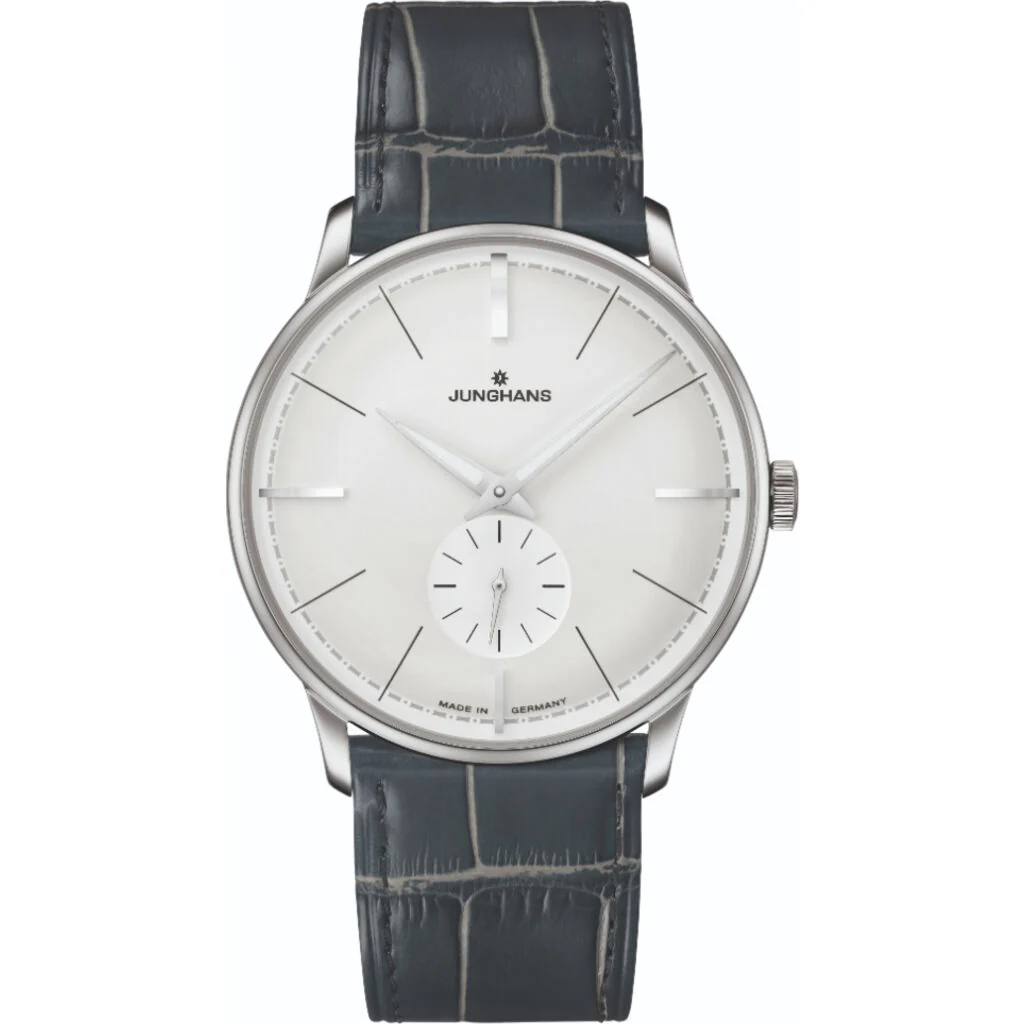
While the silver-white dial variants of the Meister are the traditionalists' choice, the reference 27/3504.02 introduces a deep, midnight sunray blue that changes the entire personality of the watch. In low light, it appears almost black, a stoic companion for a tuxedo. Under the sun, however, the brushwork reveals a dynamic range of teals and navy, providing a depth that belies its accessible price point.
The dial layout is a masterclass in balance. The small seconds sub-dial at 6 o’clock is slightly recessed, adding a layer of three-dimensionality to the otherwise flat surface. The hour markers are applied batons, thin and sharp, echoing the sword-shaped hands. There is no date window to clutter the symmetry, no superfluous text—just the brand name and 'Made in Germany.' It is a layout that would make a Mies van der Rohe building look cluttered.
The Engineering of Thinness: Caliber J815.1
To achieve the Meister’s signature 7.3mm thickness, Junghans turned to a movement with a pedigree as thin as its profile: the Peseux 7001. Renamed the J815.1 in Junghans’ parlance, this movement has been the backbone of ultra-thin watchmaking since 1971. It has been used by everyone from Blancpain to Nomos, and for good reason.
The manual winding experience is crisp. There is a distinct mechanical feedback as you turn the crown, a morning ritual that connects you to the gears and springs within. Through the sapphire caseback, the movement is a sight to behold. While it isn't finished to Patek Philippe standards, the Geneva stripes and blued screws offer a level of visual interest that is rare in this price bracket. It is honest watchmaking—robust, reliable, and beautiful in its utility.
On the Wrist: The Architecture of Comfort
The 37.7mm case diameter is the 'Goldilocks' size for the modern enthusiast. It satisfies the current trend toward smaller, more classical proportions while maintaining enough surface area to feel contemporary. The bowl-shaped case is a clever piece of design; the bottom of the case is narrower than the top, allowing the watch to nestle into the wrist rather than sit on top of it.
The choice of a shell cordovan strap is another nod to the brand's commitment to quality. Sourced from the fibrous flat muscle (the 'butt') of a horse, shell cordovan is prized for its durability and its ability to develop a unique patina. It doesn't crease like standard calfskin; it ripples. Over time, the strap on the 27/3504.02 will become as much a part of your history as the watch itself.
The Verdict for the Modern Collector
Is the Junghans Meister Hand-Winding a 'hype' watch? No. You won't see it being flipped for three times its MSRP on the grey market. But you will see it on the wrists of architects, creative directors, and collectors who have moved past the need for brand-name validation. It is a watch that rewards close inspection and daily wear.
In the context of a collection, the Meister serves as the perfect 'reset' button. When you are tired of the weight of a GMT-Master II or the complexity of a perpetual calendar, the Junghans is there to remind you what watchmaking is actually about: the simple, elegant measurement of time. At roughly $1,400, it is not just a purchase; it is a declaration of taste.