Junghans Max Bill Chronoscope 27/3493.00: Bauhaus Icon on the Wrist
In an era saturated with bold statements and overt luxury, true sophistication often whispers. The Junghans Max Bill Chronoscope ref. 27/3493.00 is one such whisper, a design marvel that transcends fleeting trends, offering a masterclass in functional elegance. For the Vivir.com collector, this isn't just a watch; it's a piece of wearable art, a testament to enduring design principles.
Born from the visionary mind of Bauhaus artist Max Bill, this chronoscope is more than a time-telling device; it's a philosophy on the wrist. It challenges the maximalist tendencies often seen in haute horology, proving that less, when executed with precision and purpose, is profoundly more. It’s the kind of watch you see on architects, designers, and those who appreciate substance over flash, making a quiet statement in a noisy world.
The Genesis of Modernism: Junghans & Max Bill
To understand the Max Bill Chronoscope, one must first appreciate its roots. Junghans, founded in 1861 in Schramberg, Germany, quickly rose to prominence as a pioneer in precision timekeeping. By the early 20th century, they were the largest clock manufacturer in the world, renowned for their innovation and quality. Fast forward to the mid-century, and the brand embarked on a collaboration that would forever etch its name into the annals of design history.
This partnership began with Max Bill, a Swiss artist, architect, and product designer who was a student of the legendary Bauhaus school. Bill’s philosophy, deeply rooted in 'form follows function,' sought clarity, precision, and an absolute rejection of ornamentation. In 1956, he designed a kitchen clock for Junghans, a piece that redefined domestic timekeeping. This success led to the development of wristwatches in 1961, which mirrored the same minimalist principles. The Max Bill Chronoscope, while a later iteration, perfectly encapsulates this enduring design language, presenting a chronograph that is remarkably clean and intuitive, a stark contrast to the often cluttered dials of its contemporaries.
Design Purity: Aesthetics That Endure
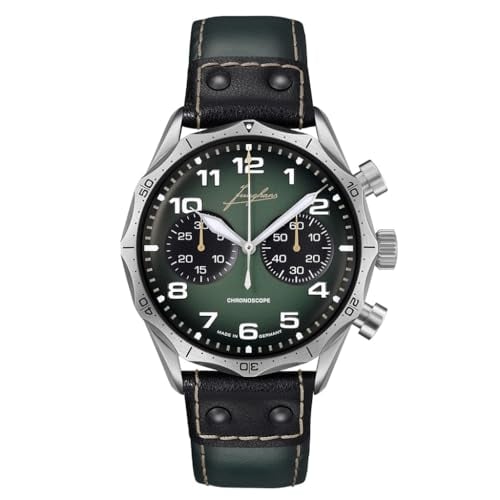
The Max Bill Chronoscope’s most striking feature is its unwavering commitment to Bauhaus principles. The dial, often a silver-plated matte finish for the 27/3493.00, is a lesson in negative space and perfect proportions. The numerals are rendered in Max Bill’s distinctive sans-serif typeface, thin and elongated, creating an airy, open feel. The minute track consists of fine, precise lines, with slightly thicker markers at the hours, punctuated by luminous dots for low-light legibility. This minimalist approach extends to the chronograph subdials, which are subtly recessed and perfectly balanced, avoiding any visual overload.
The hands are equally deliberate – pencil-thin, black, and perfectly proportioned to reach their respective tracks without obscuring any information. The chronograph seconds hand, slender and elegant, sweeps across the dial with satisfying precision. It's a design where every element serves a purpose, and nothing is superfluous. This isn't just a watch; it's a functional sculpture, a piece of art that tells time with understated authority. The choice of a dramatically domed hard plexiglass crystal, treated with Junghans’ proprietary Sicralan coating for scratch resistance, is crucial to its aesthetic. This dome distorts the dial at extreme angles, a charming characteristic that adds warmth and a vintage feel, enhancing the watch's unique personality.
The Engine Room: A Reliable Workhorse
Underneath that pristine dial beats the Junghans Caliber J880.2. This automatic movement is based on the highly respected ETA 7750, or in some iterations, the Sellita SW500 – both renowned for their robustness and reliability. While not an in-house manufacture movement, the J880.2 is a testament to Junghans' pragmatic approach: utilize a proven, dependable engine that aligns with the watch's functional ethos.
The J880.2 offers a power reserve of approximately 48 hours and operates at a frequency of 28,800 vibrations per hour (4 Hz), ensuring smooth sweep of the central chronograph hand. Its chronograph function is controlled by pushers that offer a satisfying click, and the date complication is neatly integrated at 3 o'clock, maintaining the dial's balance. For the Vivir.com collector, this means a movement that is not only accurate and durable but also easily serviced by any competent watchmaker, a practical consideration often overlooked in the pursuit of exotic calibers.
Specifications: Precision in Detail
- Case Diameter: 40mm – A versatile size that fits most wrists comfortably.
- Case Thickness: 14.4mm – Notably thick due to the domed crystal, contributing to its unique profile.
- Lug-to-Lug: Approximately 42mm – Short, curved lugs ensure a snug fit and prevent overhang.
- Case Material: Polished Stainless Steel – Elegant and durable, reflecting light beautifully.
- Crystal: Domed Hard Plexiglass with Sicralan Coating – A signature Max Bill feature, offering warmth and a unique visual distortion, with enhanced scratch resistance.
- Water Resistance: 30 meters (3 ATM) – Suitable for splashes, but not swimming or showering. This is a design-first piece, not a dive watch.
- Lume: Super-LumiNova – Applied to the hour and minute hands, and the small dots at the hour markers, providing adequate legibility in low light, consistent with its minimalist design.
- Bracelet/Strap: High-quality Leather Strap (typically calfskin) – Comfortable and complements the watch's aesthetic perfectly.
- Clasp Type: Pin Buckle – Simple, secure, and in keeping with the watch’s understated nature.
On the Wrist: Wearability & Comfort
The Junghans Max Bill Chronoscope wears with an unexpected grace. Despite its 14.4mm thickness, largely due to the dramatically domed plexiglass crystal, its 40mm diameter and short 42mm lug-to-lug make it incredibly adaptable to a wide range of wrists. It doesn't feel bulky; instead, the curvature of the crystal and the seamless integration with the case create a pebble-like smoothness that nestles comfortably against the skin.
The balance is superb, with the watch feeling centered and stable. The supplied leather strap, often a high-quality calfskin, adds to the comfort, ensuring the watch stays put without pinching or unnecessary movement. This isn't a watch that demands attention through sheer mass; rather, its ergonomic design allows it to melt into your wrist, becoming a natural extension of your personal style. Its wrist presence is a confident 3 out of 5 – it’s noticeable for its elegance and unique profile, not for its size or flash.
Accuracy & Performance in the Real World
Powered by a modified ETA 7750 (J880.2), the Max Bill Chronoscope delivers reliable and consistent accuracy. While not COSC-certified, you can expect typical performance within -5/+15 seconds per day, often much better in real-world conditions. For a mechanical chronograph at this price point, it's more than sufficient for daily wear, keeping pace with your schedule without fuss. The chronograph functions operate smoothly, with crisp pusher action, making it a joy to use for timing events, however mundane or significant.
Occasions & Versatility: A Watch for All Seasons
The Max Bill Chronoscope's versatility is one of its strongest assets. Its minimalist design allows it to seamlessly transition across various settings. It’s perfectly at home:
- Daily: Comfortable and legible enough for everyday wear, from casual errands to office commutes.
- Dress: Its clean lines and elegant proportions make it an excellent choice for business casual or even semi-formal attire, slipping easily under a cuff.
- Casual: Paired with jeans and a t-shirt, it adds an intellectual, understated cool.
- Business: Projects professionalism and a discerning taste without being ostentatious.
This is not a watch for extreme sports or deep-sea diving, given its 30m water resistance. Its true strength lies in its ability to complement a sophisticated, thoughtful lifestyle.
Variants & Family: Expanding the Max Bill Universe
The Junghans Max Bill line is extensive, but the Chronoscope holds a special place. While the reference 27/3493.00 is the classic silver-plated dial on a leather strap, several other compelling variants exist within the Chronoscope family:
- 27/3400.00: The striking black dial version, offering a more contemporary and assertive aesthetic for those who prefer a darker canvas.
- 27/4003.44: A similar white dial Chronoscope but paired with a sleek Milanese mesh bracelet, adding a distinct vintage-modern feel and a different texture on the wrist.
- 27/3401.00: Featuring a sophisticated anthracite grey dial, this variant offers a subtle departure from classic white or black, providing a unique depth.
Beyond the chronographs, the Max Bill collection includes simpler Automatic, Hand-Winding, and Quartz models, all sharing the same iconic design language, offering options for every preference and budget. Junghans also offers other notable lines like the elegant Meister Chronoscope and the robust Meister Pilot, showcasing the brand's diverse capabilities.
The Competition: Standing Apart
In the world of minimalist mechanical chronographs, the Max Bill Chronoscope faces contenders, but its unique heritage and design language set it apart. German brands like Nomos Glashütte, with models such as the Tangente Neomatik, offer a similar Bauhaus aesthetic but typically with in-house movements and a higher price tag. Stowa, with its Antea Classic Chronograph, also presents clean German design. For those seeking more robust, tool-watch chronographs, Sinn's 356 Sa Flieger II offers a different, more utilitarian interpretation of functional design.
While homages exist, such as the Sternglas Naos Chrono (quartz) or customizable options from Undone, none quite capture the authentic spirit, historical significance, and design purity of the original Max Bill. The Junghans isn't just a watch; it's a direct lineage to a pivotal moment in design history, something no homage can replicate.
Investment Value: A Design Icon's Worth
The Junghans Max Bill Chronoscope, with an MSRP around $2,200, represents excellent value for a mechanical chronograph from a brand with such a rich history and iconic design. While it's not a watch known for appreciating significantly on the secondary market, its value is remarkably stable. Pre-owned examples typically trade in the $1,000-$1,500 range, demonstrating strong retention. For the Vivir.com collector, this is not a speculative flip but a long-term acquisition for pure enjoyment and appreciation of design.
There is no major auction history for this model, as its appeal lies in its accessibility and everyday elegance rather than ultra-rare collectibility. Holding onto a Max Bill Chronoscope means owning a piece of enduring design, a watch that will always be relevant and admired, making it a solid long-term acquisition for enjoyment.
Service & Maintenance: Keeping the Engine Running
Given its ETA 7750-based movement, the Junghans Max Bill Chronoscope benefits from a widely understood and serviceable caliber. A recommended service interval of approximately 5 years is standard for automatic movements. The approximate cost for a routine service, which includes cleaning, oiling, and regulating, would be around $500. This service can be performed by Junghans' authorized service centers or any independent watchmaker proficient with the ETA 7750, ensuring ease and affordability of maintenance.
The Vivir.com Verdict: Why It Matters Now
The Junghans Max Bill Chronoscope 27/3493.00 is more than just a watch; it's a statement of refined taste and an appreciation for enduring design. It's for the collector who understands that true luxury lies in thoughtful execution and timeless aesthetics, not just flash. This piece is a perennial favorite for a reason, offering an unparalleled blend of history, design, and reliable performance.
In a world obsessed with hype drops and limited editions, the Max Bill stands as a beacon of understated cool. It’s the watch for the individual who curates their life with intention, from their art collection to their wardrobe. It’s not about shouting; it’s about knowing. And for that, the Max Bill Chronoscope remains an absolute must-have.
Pros and Cons
- Pros:
- Iconic, timeless Bauhaus design
- Excellent legibility and clean dial layout
- Comfortable and versatile wearability
- Reliable ETA 7750-based movement
- Strong value proposition for a mechanical chronograph with historical significance
- Cons:
- Plexiglass crystal prone to scratches (though easily polished)
- 30m water resistance is minimal for active lifestyles
- No in-house movement, which some purists might prefer
- Lume is functional but not a bright torch for extended night viewing