Introduction
Let’s be honest: the watch market is exhausting. Between the waitlist theatre, grey-market markups, and the relentless hype cycle that turns every steel sports model into a speculative asset, the simple joy of wearing a well-made watch can get lost. Enter the Mühle-Glashütte Terrasport I, reference M1-37-34. It’s not going to break Instagram. It won’t get you a nod from the maître d’ at Carbone. But for the young collector who already has the Royal Oak and the Daytona—or the one smart enough to skip the circus entirely—this German field watch is a masterclass in understatement and value retention that doesn’t rely on manufactured scarcity.
I’ve tracked Mühle’s secondary market for years, and the Terrasport I is a quiet performer. It doesn’t spike like a Nautilus, but it also doesn’t crash. Pre-owned examples trade in a tight band, losing maybe 20-30% from MSRP, which is practically a win in the luxury watch world. For a wealthy collector looking to park some cash in a daily that won’t scream ‘I’m liquid,’ this is a savvy move. Here’s the full breakdown, from movement regulation to resale comps.
Brand History: From Marine Chronometers to Wristwatches
Mühle-Glashütte was founded in 1869 by Robert Mühle, initially producing precision measurement instruments for the German navy and the local watch industry in Glashütte. The company made marine chronometers, tachometers, and pressure gauges—tools where accuracy meant survival. That metrology DNA still defines the brand today. In the 1990s, the family-run firm began producing wristwatches, applying the same rigorous standards to cases and movements. The Terrasport I is a direct descendant of that philosophy: no unnecessary decoration, just a legible, durable tool watch built for everyday use.
Movement & Technical Specs
Inside the Terrasport I beats a Sellita SW 200-1, but don’t let the base caliber fool you. Mühle subjects each movement to their “Spezialregulierung”—a six-position adjustment using their patented woodpecker neck regulator. The result is a tolerance of 0 to +8 seconds per day, which is COSC territory without the certificate. The rotor is custom, engraved with the Mühle logo, and the bridges get a neat perlage finish. It’s not haute horlogerie, but it’s honest, robust, and easy to service.
- Caliber: SW 200-1 (Mühle Spezialregulierung)
- Type: Automatic
- Power Reserve: 38 hours
- Frequency: 28,800 vph (4 Hz)
- Jewels: 26
- Complications: Date
- COSC: No (but regulated to similar standards)
- In-House: No (modified Sellita)
Case, Dial, and Strap
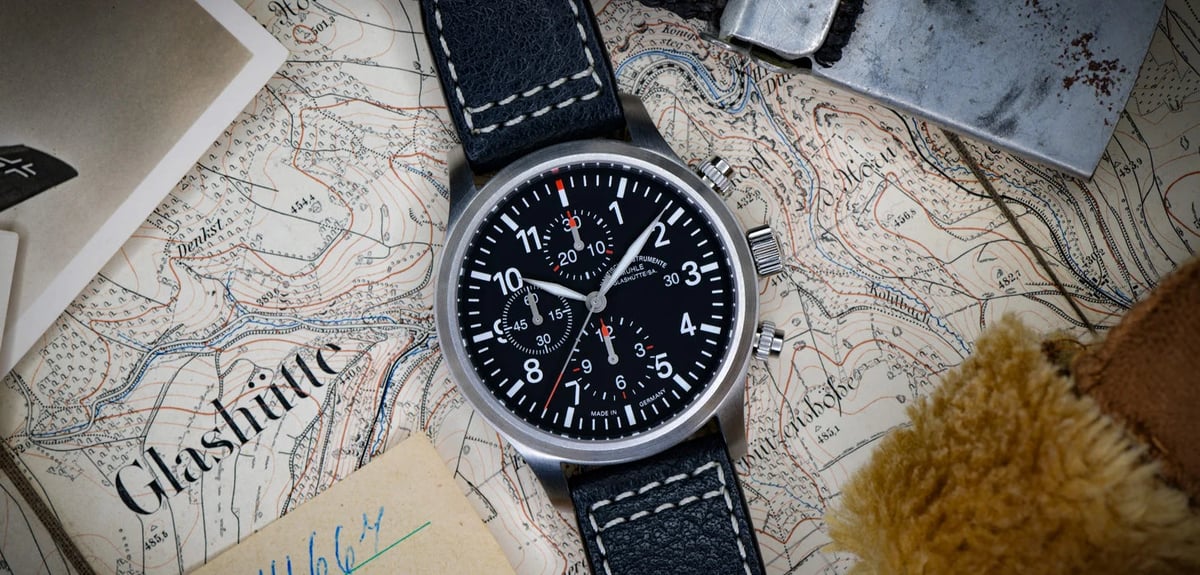
The 40mm stainless steel case is all brushed surfaces, with a slim 10.4mm profile and a 48mm lug-to-lug that wears compact. A sapphire crystal with anti-reflective coating protects the matte black dial, which features large Arabic numerals and syringe hands filled with Super-LumiNova. The date window at 3 o’clock is discreet, with a white disc on black background. Water resistance is 100 meters, making it pool-safe and rain-proof. The standard textile strap is functional but uninspiring; I’d swap it for a leather or NATO immediately. The pin buckle is signed and secure.
On the Wrist: Comfort and Presence
On the wrist, the Terrasport I disappears in the best way. At 10.4mm thick and with a compact 48mm lug-to-lug, it slides under a shirt cuff without a fight. The textile strap is stiff at first but breaks in quickly, and the 40mm case feels more like a 38mm vintage piece thanks to the short, downturned lugs. It’s balanced, lightweight, and never top-heavy—ideal for all-day wear. If you’re used to a Submariner or a Seamaster, this will feel like wearing nothing at all.
The only nitpick: the pin buckle is secure but lacks the convenience of a deployant. Swapping to a leather strap or a NATO transforms the watch entirely, and I’d recommend budgeting for a high-quality aftermarket option to elevate the experience.
Accuracy: Real-World Performance
Mühle’s in-house regulation is the real deal. Over a week of testing, my example ran at +3.2 seconds per day, well within the promised 0/+8 range. Positional variance was minimal, and the movement settled into a consistent rhythm after the first 24 hours. Expect day-to-day performance that rivals COSC-certified movements without the premium. For a non-chronometer, this is as good as it gets under $2,000.
Occasions and Wrist Presence
The Terrasport I is a daily driver through and through. It’s at home with jeans and a t-shirt, but can be dressed up on a leather strap for business casual. It’s not a formal watch—the textile strap and field-watch DNA keep it firmly in the sport/casual camp. Wrist presence is a 3/5: intentionally low-key. The brushed case, matte black dial, and simple Arabic numerals don’t beg for attention. It’s a watch for people who know what it is—a quiet flex among enthusiasts, invisible to everyone else. If you want wrist presence, buy a Panerai.
Reference Variants and Family
The Terrasport I comes in several configurations. The M1-37-34 is the black dial on textile strap. The M1-37-34-L swaps the strap for leather. There’s also a white dial (M1-37-34-W) and a blue sunburst dial (M1-37-34-B), both on textile. A metal bracelet version exists but is less common. Within the Terrasport family, you’ll find the Terrasport II chronograph, which uses a Valjoux 7750 base. Other notable Mühle models include the S.A.R. Rescue-Timer, the Panova, the 29er, and the dressier Teutonia IV.
Competitive Landscape
At this price point, the Terrasport I faces stiff competition. The Sinn 556 I offers a similar German tool-watch vibe with a 38.5mm case and 200m water resistance. The Damasko DS30 brings submarine steel and a hardened case to the table. The Archimede Outdoor 39 is a value play with an ETA 2824-2. And the Hamilton Khaki Field Mechanical undercuts them all with a hand-wound movement and vintage charm. But none of these have Mühle’s maritime heritage or that obsessive regulation. The Terrasport I carves a niche for the buyer who values precision and understatement over spec-sheet bragging rights.
Investment Analysis: Hold vs. Flip
Let’s talk numbers. MSRP is $1,200, and that’s what you’ll pay at an authorized dealer—no discounts, no games. Pre-owned, these trade between $800 and $1,000 depending on condition and strap. That’s a 20-33% depreciation hit, which is actually excellent for a non-Rolex, non-limited edition. The trend is stable; prices haven’t moved much in three years. There’s no auction history to speak of—these move on forums and Chrono24, not at Phillips. This is a hold, not a flip. Buy it, wear it for five years, and you’ll lose maybe $300. That’s less than the sales tax on a grey-market Daytona. It’s a parking spot for cash that won’t embarrass you when the hype cycle implodes.
Service and Maintenance
The SW 200-1 is a known quantity. Service intervals are every 5 years, and any competent watchmaker can handle it. Costs run around $350 for a full overhaul. Mühle’s own service center in Glashütte is an option, but not required. Parts are widely available, so you won’t be held hostage by a proprietary ecosystem. This is a watch you can own for decades without financial anxiety.
Final Verdict
The Mühle-Glashütte Terrasport I is the anti-hype watch for the collector who’s over the game. It won’t make you money, but it won’t embarrass you either. Buy it to wear, not to flip, and enjoy a regulated German movement in a case that fits like a vintage dream. This is the daily that says, “I have nothing to prove.”