The Fluidity of Form: First Impressions
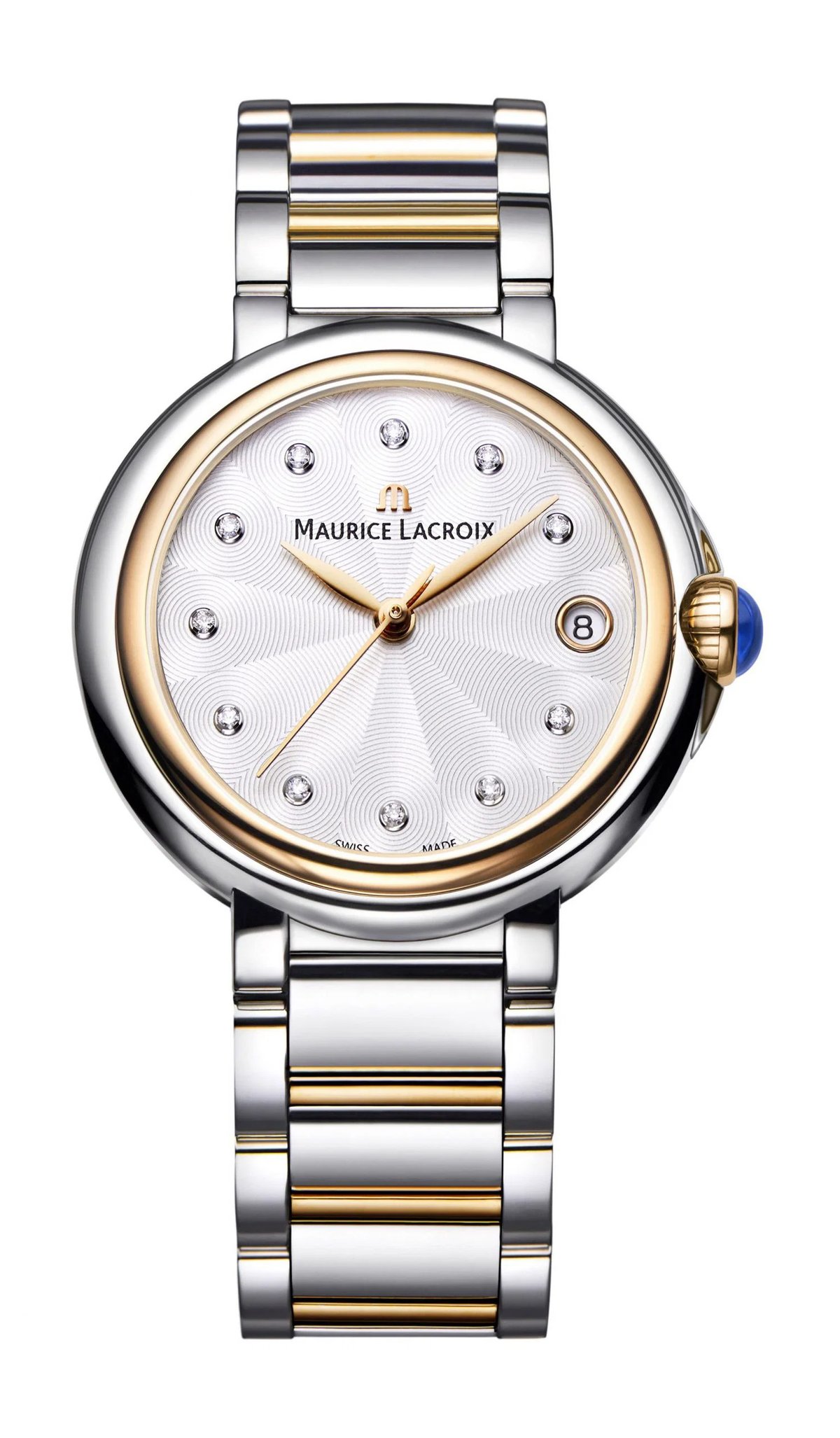
When I first unboxed the Maurice Lacroix Fiaba ref. FA1205-SS001-110-3, the first thing that struck me wasn't the sparkle of the polished steel, but the geometry. In a world currently obsessed with the integrated-bracelet sports watch—a trend Maurice Lacroix themselves helped democratize with the Aikon—the Fiaba is a refreshing return to soft, organic curves. It feels less like a machine and more like a river stone that has been smoothed by centuries of alpine water. The name 'Fiaba' means fairy tale, and while that might sound overly romantic for a technical review, there is a certain whimsical elegance to the way the light plays off the convex case.
At 28mm, this is a watch that embraces traditional feminine proportions without feeling antiquated. Many modern brands have pushed their 'smaller' watches into the 34mm or 36mm range, but for a daily-wear piece intended for a sophisticated young collector, the 28mm diameter offers a level of discretion that larger watches lack. It is a piece that whispers rather than shouts.
A Week on the Wrist: The Ergonomic Reality
To truly understand a watch, you have to live with it. I wore the Fiaba for a full seven days, tracking its performance through a variety of real-world scenarios. On Monday morning, during a frantic commute involving laptops and coffee runs, the Fiaba's 6.6mm thickness was its greatest asset. It slid effortlessly under the cuff of a crisp white shirt, never snagging or creating that unsightly 'watch bulge' that ruins the silhouette of a well-tailored blazer.
The lug-to-lug measurement of 33.5mm is the secret to its comfort. Because the lugs are short and curve sharply downward, the watch occupies the center of the wrist perfectly. Even on smaller wrists (mine is approximately 6 inches), there is no 'lug overhang.' The bracelet, a three-row construction with a hidden butterfly clasp, provides a fluid wrap. Unlike cheaper bracelets that use folded links, these are solid 316L stainless steel, precisely machined to ensure there is no 'hair-pulling'—a common complaint with entry-level luxury steel.
By Wednesday, I had forgotten I was wearing it. This is the ultimate compliment for a daily-wear watch. It doesn't demand adjustment; it doesn't require you to be careful when reaching into a bag; it simply exists as a functional extension of your arm. The butterfly clasp is secure, with a satisfying 'click' that suggests high-tolerance manufacturing. However, collectors should note that there is no micro-adjustment on this clasp, so getting the perfect fit might require swapping in a half-link, which Maurice Lacroix thankfully provides.
The Dial: A Study in Texture and Legibility
One of the pitfalls of small watches is legibility. When you shrink the canvas, you often sacrifice the ability to actually tell the time. Maurice Lacroix has bypassed this issue through clever use of contrast. The dial of the FA1205-SS001-110-3 features a central sun-brushed zone surrounded by a circular guilloché pattern. This isn't just for show; the varying textures catch the light at different angles, creating a clear separation between the center of the dial and the hour track.
The Roman numerals are printed in a deep, crisp black, providing a stark contrast against the silver-white background. But the real stars are the hands. They are leaf-shaped (feuille) and heat-blued. In low light, they appear almost black, but when they catch a direct beam of sun, they glow with a vibrant, electric cobalt. This pop of color is mirrored in the spinel set into the crown, creating a cohesive design language that feels intentional and high-end.
At the 6 o'clock position, we find a circular date window. While some purists argue that a date window ruins the symmetry of a dress watch, for a daily-wear piece, it is a non-negotiable utility. Maurice Lacroix has executed it well, using a color-matched date wheel that blends into the dial rather than standing out like a sore thumb.
Technical Prowess: The Quartz Argument
In the halls of Vivir, we often debate the merits of mechanical versus quartz. For the Fiaba, quartz is not just a cost-saving measure; it is a design choice. Using a mechanical movement would have inevitably added 3-4mm of thickness to the case, destroying the 'second-skin' feel that makes this watch so successful. The Swiss quartz caliber used here is a workhorse. It is shock-resistant, highly accurate, and requires zero interaction from the wearer beyond a battery change every few years.
For the young collector who may be rotating through several watches, the quartz movement is a blessing. You can leave the Fiaba on your dresser for a weekend and pick it up on Monday morning knowing it is perfectly accurate to the second. There is no winding, no setting of the moon phase, and no worry about the power reserve running out mid-meeting. In the context of a busy, modern lifestyle, that reliability is a form of luxury in itself.
The Manufacture: Saignelégier’s Hidden Gem
To appreciate the Fiaba, one must appreciate Maurice Lacroix. Founded in 1975, the brand is a relative newcomer compared to the centuries-old houses of the Vallée de Joux. However, this lack of baggage has allowed them to be more agile. Based in Saignelégier, they have invested heavily in their own case-making and finishing facilities. When you look at the Fiaba under a 10x loupe, the quality of the polishing is evident. There are no burrs on the links, the transition between the crystal and the bezel is seamless, and the dial printing is sharp without any bleeding.
The brand has found its niche by offering 'accessible luxury.' They provide 90% of the finishing of a top-tier Swiss brand at roughly 20% of the price. The Fiaba is the feminine embodiment of this philosophy. It doesn't try to be a Cartier or a Longines; it tries to be the best version of a Maurice Lacroix, focusing on tactile quality and everyday usability.
The Investment Perspective
Let's be candid: a quartz Maurice Lacroix is not a 'financial investment' in the way a vintage Patek Philippe is. You should not buy this watch expecting to sell it for a profit in five years. However, an investment is not always about capital gains; it is about 'cost per wear.' Given its MSRP of under $1,000 and its robust construction, the Fiaba offers an incredibly low cost-per-wear ratio.
On the pre-owned market, these pieces are stable. They are sought after by professionals who want a reliable, branded Swiss watch without the 'gray market' headaches associated with more hyped models. It is a safe purchase—a watch that will look as good in 2034 as it does today.
Final Verdict
The Maurice Lacroix Fiaba ref. FA1205-SS001-110-3 is a triumph of ergonomic design. It understands that a woman's daily watch needs to be more than just a pretty face; it needs to be a partner. It needs to survive the rigors of a modern week while maintaining an air of effortless grace. While the 30m water resistance means you shouldn't take it for a swim, and the lack of lume makes it difficult to read in a dark cinema, these are minor concessions for a watch that wears this well.
For the sophisticated young collector looking to anchor their collection with a versatile, elegant, and impeccably finished daily driver, the Fiaba is a fairy tale that delivers on its promises. It is, quite simply, one of the most comfortable watches I have reviewed this year.