The Philosophy of the Open Dial
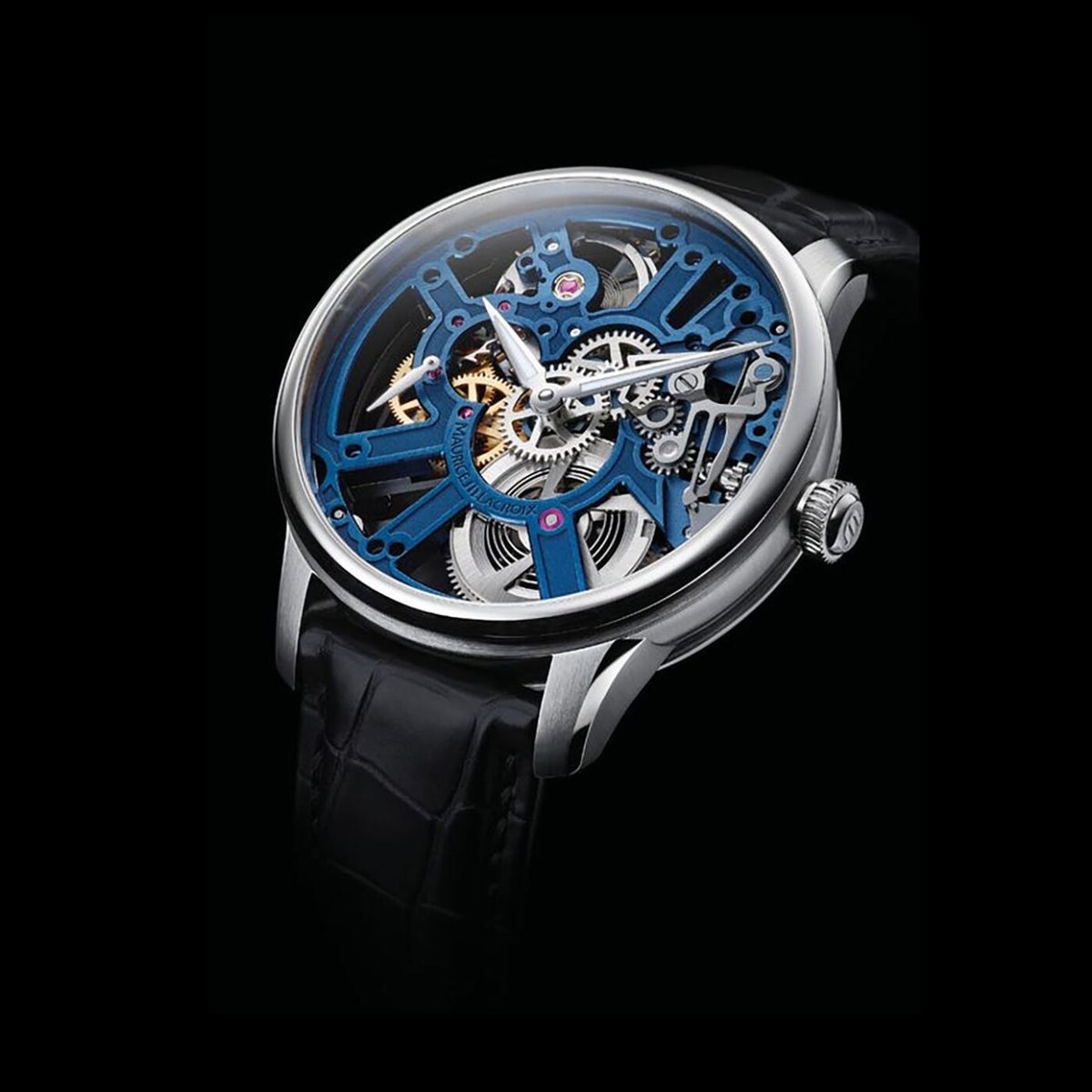
In the world of luxury horology, there is a fine line between transparency and exhibitionism. Skeletonization is often criticized as a gimmick—a way to distract the buyer from a mediocre movement by cutting away the brass. But the Maurice Lacroix Masterpiece Skeleton (ref. MP7228-SS001-000) approaches the concept from an architectural perspective. Instead of merely removing material, the brand has designed the ML134 movement to be a structural element of the watch's identity. This isn't a movement with holes in it; it is a movement designed to be seen.
Case and Dimensions: The 43mm Reality
Let’s address the elephant in the room: 43mm. In today’s market, where the trend is aggressively swinging back toward 36mm and 39mm, a 43mm case can feel like a relic of the mid-2000s 'big watch' era. However, size is relative to design. Because the Masterpiece Skeleton has almost no bezel, the entire 43mm is dedicated to the sapphire crystal and the movement beneath. This gives the watch a massive visual presence, but on the wrist, the 50mm lug-to-lug saves the day. The lugs are short and taper sharply downward, allowing the strap to wrap around the wrist rather than flare out. During my week of testing, I found that it fits comfortably on a 17cm wrist, though it would certainly overwhelm anyone with a wrist under 16cm.
The case finishing is a mix of brushed and polished surfaces. The bezel is high-polish, which frames the movement like a piece of jewelry, while the case flanks are brushed to hide the inevitable scuffs of daily wear. It’s a practical choice for a watch that is meant to be worn, not just admired in a safe.
The ML134: A Mechanical Heartbeat
The soul of this watch is the Calibre ML134. While its DNA can be traced back to the venerable Unitas 6497—a movement originally designed for pocket watches—Maurice Lacroix has transformed it beyond recognition. The bridge work is finished in a tantalum-gray or silver-tone (depending on the light) with a sandblasted texture that absorbs light, contrasted by the polished edges of the bridges. This 'Anglage' or chamfering is done with impressive precision for this price point.
One of the joys of a manual-wind skeleton is the winding process itself. As you turn the crown, you can see the mainspring tensioning inside the barrel at 1 o'clock. There is no mystery here; you are witnessing the physics of timekeeping. The click of the winding mechanism is tactile and audible, providing a ritualistic start to the day that automatic watches simply cannot replicate. The 18,000 vph beat rate is slow by modern standards, but it fits the aesthetic. You can see the large balance wheel oscillating at 9 o'clock, a rhythmic, hypnotic motion that serves as the watch's 'heartbeat.'
Daily Wear: The Monday-Friday Test
How does a skeleton watch survive a real week? On Monday, I wore it to a high-stakes meeting. The watch acted as an immediate icebreaker. It’s a 'loud' watch in terms of design, but because it lacks bright colors or gold, it remains professional. However, legibility is the trade-off. The hands are black-gold or blued steel (depending on the specific sub-ref), and while they are well-proportioned, they can get lost against the backdrop of gears and bridges. You don't 'glance' at this watch to tell the time; you 'observe' it.
By Wednesday, I was testing its durability. With a 50m water resistance, this is not a swimming watch, but it survived a sudden downpour and the standard splashes of hand-washing without issue. The lack of lume, however, became apparent during a late-night Uber ride. In low light, the watch is effectively a very expensive bracelet. If you’re the type of person who needs to check the time in a dark cinema, this isn't the tool for you.
On Friday, I focused on the strap. The genuine crocodile leather is thick and high-quality. The deployant clasp is a double-push-button design that feels secure. My only gripe is the thickness of the clasp; it can dig into the wrist slightly when typing on a MacBook. It’s a common issue with deployant buckles, but worth noting for the desk-divers among us.
Investment and Value Proposition
For the young collector, the Maurice Lacroix Masterpiece Skeleton is an interesting value proposition. It has an MSRP of nearly $7,000, which puts it in direct competition with the likes of the Omega Seamaster or a Tudor Black Bay. From a pure 'brand equity' standpoint, Maurice Lacroix loses that fight. However, from a 'horological complexity' standpoint, the ML wins. You are getting a level of hand-finishing and movement architecture that Omega and Tudor simply don't offer in their mass-produced skeletons.The smart move here is the secondary market. These watches often trade in the $3,500 to $4,000 range. At that price, the Masterpiece Skeleton is an absolute steal. It offers a level of visual drama that usually costs five figures. It’s a 'trust fund baby' watch for the self-made professional—someone who wants the aesthetic of high-end independent horology without the $50k entry fee.
The Verdict
The Maurice Lacroix Masterpiece Skeleton (MP7228-SS001-000) is a polarizing watch, and that is exactly why I like it. It doesn't try to be everything to everyone. It’s too big for some, too illegible for others, and too bold for the rest. But for the collector who appreciates the raw, industrial beauty of a mechanical movement and wants a watch that feels like a piece of kinetic art on the wrist, it is a triumph. It’s a reminder that even in a world of smartwatches and quartz accuracy, there is still a place for the slow, deliberate tick of a manual-wind machine. Wear it with a crisp white shirt, rolled up at the sleeves, and let the movement do the talking.