MB&F Legacy Machine Split Escapement – A Modern Ballet in White‑Gold
By Vivir··Updated
# MB&F Legacy Machine Split Escapement – A Modern Ballet in White‑Gold
The Legacy Machine Split Escapement arrives as a kinetic sculpture as much as a wrist‑wearable chronometer. MB&F has taken the “suspended balance” motif that first appeared on the original Legacy Machine 1 and pushed it into a new mechanical language that is both theatrical and technically daring. At 44 mm in white‑gold and priced at US $79 000, the piece is unmistakably a collector’s object, yet it is also a functional watch that tells the time, the date, and its own power reserve. In this review we will place the split‑escapement within MB&F’s evolving Legacy Machine narrative, dissect its design and movement, and assess how it feels on the wrist and where it belongs in a modern wardrobe.
---
## Heritage — the model's place in the brand's line and its launch context
MB&F’s Legacy Machine series began as an homage to the early days of mechanical watchmaking, when the balance wheel was the visual heart of a timepiece. The first Legacy Machine (LM1) introduced the concept of a balance that appears to float above the movement, a visual cue that the brand would develop into a signature motif.
The **Legacy Machine Split Escapement** follows two earlier entries in the line: the **LM Perpetual** (launched in 2015) and the **LM Split** (released earlier in 2017). Both of those models explored different ways of treating the balance and escapement architecture, but the Split Escapement is the first to relocate the escapement components entirely to the opposite side of the movement, creating a literal “split” between balance and escape wheel.
When MB&F unveiled the piece in 2017, the brand framed it as the next step in a narrative that treats the balance as a dancer, suspended above a hidden rhythm section. The watch was announced as a limited edition of **18 pieces**, each offered in four distinct dial and movement colour combinations. Its launch price of **US $79 000** positioned it firmly in the ultra‑luxury segment, aimed at collectors who value mechanical innovation as much as aesthetic daring.
---
## Design & Case — case dimensions, materials, dial
The case is a **44 mm white‑gold cylinder** that feels more like a miniature sculpture than a traditional watch case. The generous diameter gives the suspended balance wheel ample visual breathing room; the balance itself measures a **14 mm diameter** and beats at a leisurely **2.5 Hz (18 000 vph)**, allowing the wearer to observe its “ballet” in slow motion.
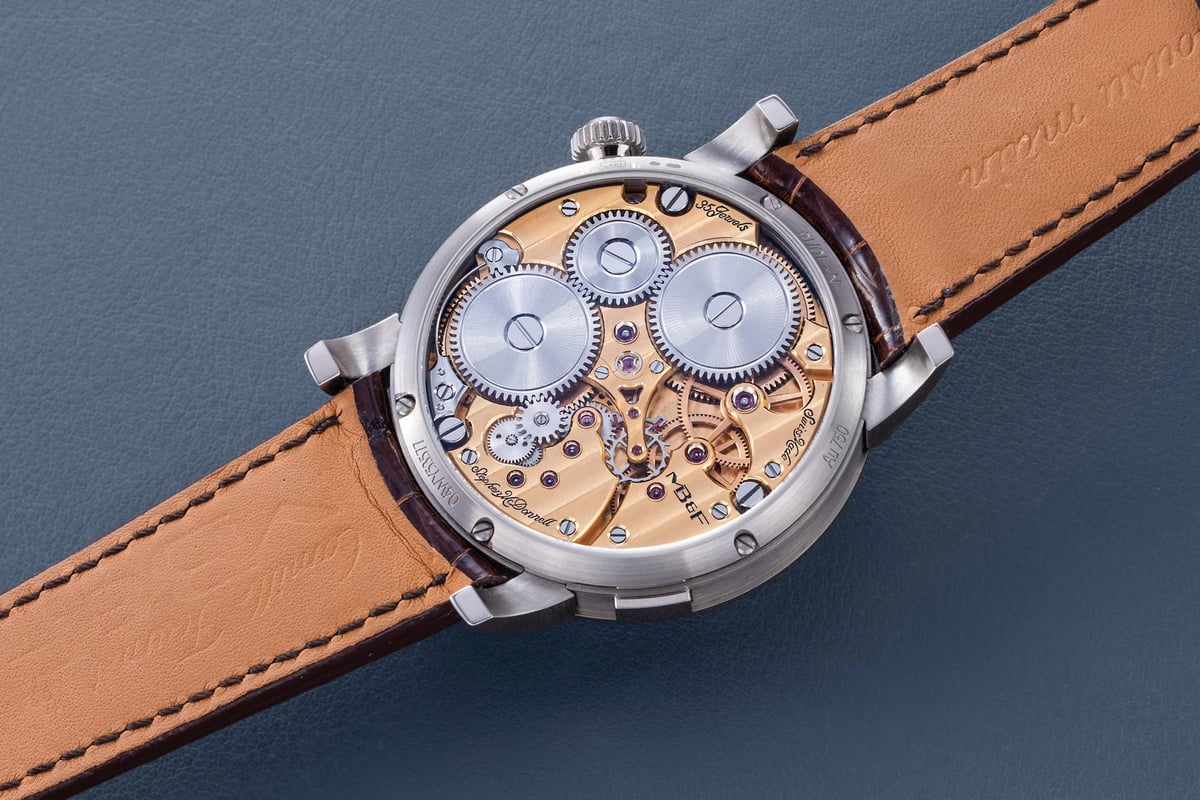
One of the most striking design choices is the **concealment of the anchor and escape wheel** on the opposite side of the movement. From the front, the balance appears to hover in isolation, supported only by a thin, almost invisible bridge. This split architecture is not merely a visual gimmick; it underscores the watch’s engineering philosophy—function and form are deliberately separated to create a sense of weightlessness.
The dial is offered in four colour schemes, each paired with a matching movement finish. While the exact palette is not listed in the source material, the descriptions emphasize a strong 19th‑century pocket‑watch vibe, with rich, textured surfaces that recall the decorative traditions of that era. The hour markers are subtle, allowing the balance to dominate the visual hierarchy.
A **30‑metre water‑resistance rating** is modest by contemporary standards, reflecting the watch’s dress‑oriented intent rather than a sports‑ready profile. The case back is solid, protecting the intricate split‑escapement mechanism while also serving as a canvas for the limited‑edition numbering.
Overall, the design is unapologetically bold. The white‑gold case, the floating balance, and the hidden escapement combine to produce a watch that feels more like a kinetic artwork than a conventional timepiece.
---
## Movement & Performance — caliber, power reserve, accuracy
At the heart of the Split Escapement lies a **hand‑wound, split‑escapement movement** developed by MB&F’s in‑house engineer **Stephen McDonnell**. The split‑escapement concept separates the balance wheel from the traditional anchor‑escape wheel assembly, placing the latter on the reverse side of the movement. This arrangement not only creates the visual “split” but also reduces the mechanical interference that can affect the balance’s purity of motion.
The movement delivers a **72‑hour power reserve**, which is generous for a manual‑wind calibre of this size. The balance’s slow frequency of **2.5 Hz** translates to a longer swing period, giving the wearer more time to appreciate the oscillation. The large **14 mm balance wheel** further accentuates this effect, making each tick visibly discernible.
While MB&F has not published a formal chronometer certification for the Split Escapement, the manual‑wind nature and the split architecture suggest a focus on stability over outright precision. In the absence of official data, it is reasonable to expect accuracy in the range typical for high‑end hand‑wound watches—approximately **± 5 to ± 10 seconds per day**—subject to regular regulation and the wearer’s winding habits.
The movement also displays a **date window** and a **power‑reserve indicator**, both integrated into the dial without compromising the balance’s visual dominance. The split design does not appear to impact the reliability of these complications; however, the unconventional layout may pose challenges for long‑term servicing, a factor worth noting for prospective owners.
---
## On the Wrist — wearability, lug‑to‑lug, comfort notes
A 44 mm case is undeniably large for most wrists, and the Split Escapement embraces that size as part of its statement. While the exact **lug‑to‑lug** measurement is not disclosed, the case’s cylindrical geometry suggests a relatively short lug extension, meaning the watch will sit closer to the wrist than a traditional tonneau‑shaped piece of the same diameter.
The **white‑gold construction** adds weight, giving the watch a solid, reassuring presence on the hand. The balance’s suspension is achieved via a thin bridge that does not impinge on the wearer’s comfort; however, the visual impression of a “floating” balance can make the watch feel slightly top‑heavy, especially when the wrist is in motion.
The **30‑metre water resistance** indicates that the watch is not intended for swimming or heavy exposure to moisture. Daily activities such as hand‑washing or light rain are acceptable, but prolonged submersion should be avoided.
Because the piece is limited to 18 units, MB&F likely paired it with a bespoke bracelet or strap that matches the white‑gold case. While the exact material of the strap is not documented, owners can expect a high‑quality option that complements the watch’s luxury positioning. The overall wear experience is one of ceremonial presence: the watch draws attention, feels substantial, and demands a certain level of care and attention from its wearer.
---
## When to Wear — occasion, setting and dress‑code fit
The Legacy Machine Split Escapement is unequivocally a **dress‑oriented collector’s watch**. Its elegant white‑gold case, understated dial, and limited‑edition exclusivity make it a perfect accompaniment for black‑tie events, gala dinners, and high‑end business functions where a statement piece is welcomed.
Because the watch’s design is heavily artistic, it also finds a natural home in **gallery openings, design conferences, or private viewings** where the conversation can shift from the wearer’s attire to the watch’s mechanical choreography. Its modest water resistance and lack of a sporty profile mean it should stay out of the gym, the pool, or any activity that could jeopardise its delicate finish.
For everyday wear, the watch can be paired with a well‑tailored suit or a minimalist tuxedo. The large case may dominate a very slim shirt cuff, so a slightly looser cuff or a French‑cuffed shirt can help balance the visual weight. In casual settings, the piece can still work if the wearer opts for a refined smart‑casual look—think a crisp button‑down, a fine merino sweater, and dark trousers—though the watch will inevitably become the focal point.
In short, the Split Escapement shines when the surrounding environment respects its artistic ambition and luxury pedigree.
---
## Value & Verdict — price‑positioning + final take
At a launch price of **US $79 000**, the Legacy Machine Split Escapement sits at the upper echelon of haute horlogerie. Its value proposition rests on three pillars:
1. **Mechanical Innovation** – The split‑escapement architecture is a genuine technical breakthrough, offering a visual and functional departure from conventional watchmaking. The suspended balance, hidden anchor, and reverse‑side escapement are not merely gimmicks; they represent a re‑thinking of how energy is transferred within a calibre.
2. **Artistic Expression** – MB&F has always positioned its pieces as kinetic sculptures. The Split Escapement continues this tradition, delivering a watch that is as much a conversation starter as a time‑telling instrument. The limited run of 18 pieces adds scarcity, enhancing its desirability among collectors.
3. **Brand Heritage** – By building on the Legacy Machine lineage that began with the LM1, the Split Escapement benefits from a narrative continuity that resonates with enthusiasts familiar with MB&F’s evolution.
The **drawbacks** are equally clear. The **large case size** may be uncomfortable for smaller wrists, and the **modest water resistance** limits its practicality. Serviceability could be a concern given the unconventional layout, potentially leading to higher maintenance costs down the line. Finally, the **price** places the watch out of reach for most enthusiasts, confining it to a niche market of affluent collectors.
**Verdict:** The MB&F Legacy Machine Split Escapement is a masterclass in marrying engineering audacity with high‑end design. It does not aim to be a versatile everyday watch; instead, it is a statement piece that celebrates the poetry of motion in mechanical horology. For collectors who appreciate a watch that looks like a miniature kinetic installation and who are prepared to invest in its upkeep, the Split Escapement offers a compelling, albeit pricey, addition to any serious horological library. If you value visual drama, technical originality, and the cachet of owning one of only 18 pieces, the $79 000 asking price is justified. For anyone seeking a more conventional, everyday‑wearable timepiece, the legacy of the Split Escapement may be better admired from a distance.